Grupo Cibest (CIB) — Customer relationships that shape the next re-rating
Grupo Cibest is a regional financial-services group that generates returns through banking operations, fee income, corporate lending and selective balance-sheet transactions including strategic asset disposals. Recent newsflow shows management executing large corporate financings and a transformative sale of Banistmo, which together drive both near-term earnings reallocation and long‑term franchise value. For investors and operators, the practical takeaway is straightforward: CIB is monetizing through deal-driven capital redeployment as much as through core banking spreads. Learn more at https://nullexposure.com/.
Why these customer relationships matter for investors
Grupo Cibest’s publicly visible customer interactions over the last 12–18 months paint a picture of a bank engaged in high‑value, strategic counterparties rather than purely retail banking campaigns. That posture influences capital allocation, concentration risk and the predictability of future earnings — asset sales and one‑off financings will materially affect reported EPS and book value as the company transitions business mix.
- Deal-driven revenue: The Banistmo sale to Inversiones Cuscatlán is a large, discrete transaction that will materially shift CIB’s balance sheet and cash position.
- Corporate lending and structured financings: Items in the feed show participation in significant financings and capital support for corporate customers.
- Product-level competitive moves: Announcements about digital-payment flows (Nequi) reflect a competitive retail/payments environment that affects fee income volatility.
Operational constraints and what they imply about CIB’s business model
The dataset returned no explicit contractual constraints or named contracting clauses tied to specific counterparties. As a company-level signal, that absence implies limited contract-level disclosure in the captured feed rather than an absence of contractual complexity in reality. From the relationship evidence we infer the following operating-model characteristics:
- Contracting posture — transactional and strategic: CIB executes both routine product changes and high-stakes bilateral transactions (asset sales, large financings). That dual posture demands flexible deal teams and episodic capital deployment.
- Concentration — episodic concentration risk: Large counterparties and single‑transaction exposures (e.g., a $1.42bn divestiture) create episodic concentration that affects capital and liquidity when deals close.
- Criticality — high for select relationships: Transactions such as the Banistmo disposal are critical to corporate strategy and will materially influence reported capital ratios and investor guidance.
- Maturity — mixed: Some relationships are mature corporate contracts (disposal/transfer agreements), others are product-level or operational (payment routing to Nequi) and are persistent but lower dollar-impact.
These characteristics mean investors should weigh transaction timing and accounting impacts as heavily as recurring net‑interest and fee metrics when modeling CIB.
The customer relationships in the feed — plain-English takeaways
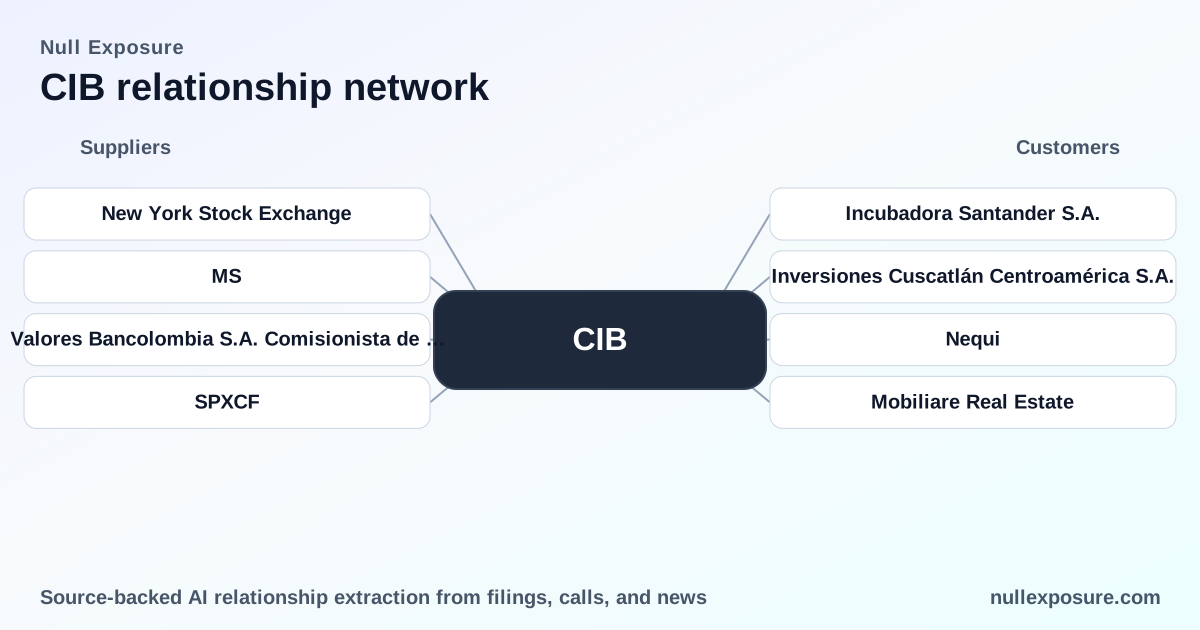
Below are every relationship captured in the results, each summarized with the primary source cited.
Incubadora Santander S.A. (FY2025)
A March 9, 2026 report in Yahoo Noticias recorded a large refinancing of Incubadora Santander S.A. in which Bancolombia acted as lead structuring bank and bookrunner for COP 254,600 million of corporate debt; this item sat in CIB’s relationship feed, highlighting the company’s exposure to corporate‑sector financings in agriculture‑linked customers. (Source: Yahoo Noticias, March 9, 2026)
Inversiones Cuscatlán Centroamerica S.A. — promise to purchase Banistmo (FY2025)
A May 2, 2026 MarketScreener item documented that Inversiones Cuscatlán Centroamerica S.A. entered into a promise to purchase Banistmo S.A. from Grupo Cibest for $1.42 billion, a direct, high‑value transaction that will materially alter CIB’s asset base and capital deployment options once executed. (Source: MarketScreener, May 2, 2026)
Inversiones Cuscatlán Centroamérica S.A. — accounting impacts on Q4 (FY2026)
An earnings‑call transcript published March 9, 2026 on InsiderMonkey described accounting adjustments recorded in Q4 tied to the recently announced agreement to sell 100% of Banistmo’s shares to Inversiones Cuscatlán, confirming that the transaction produced immediate accounting and disclosure effects on CIB’s quarterly results. (Source: InsiderMonkey transcript, March 9, 2026)
Nequi — payments integration and fee flow (FY2024)
A Portafolio article reported that Bancolombia announced transfers to Nequi would be free and unlimited from February 19, a product‑level change that affects consumer payment flows and fee income dynamics in the retail channel reflected in CIB’s news universe. This item signals competitive pressure and product integration trends in digital payments. (Source: Portafolio, reporting on February 2026 announcement)
Mobiliare Real Estate — financed by Grupo Cibest (FY2025)
La República flagged that Mobiliare Real Estate received US$216 million with financial support from Grupo Cibest, evidencing CIB’s role as an active lender and balance‑sheet backer for large real‑estate clients. This underwriting exposure is relevant to asset‑quality oversight and concentration monitoring. (Source: La República, March 2026)
Investment implications and risk checklist
- Balance-sheet reallocation: The $1.42bn Banistmo transaction is the dominant event. Expect one‑time gains, capital reallocation and potential volatility in EPS while proceeds are redeployed or returned to shareholders. This is the single largest customer-related driver in the feed.
- Credit and concentration monitoring: Financing activities for real estate and agribusiness clients introduce sector concentration that investors should stress‑test against slower revenue growth noted in recent quarters.
- Fee income volatility: Product moves (e.g., free transfers to Nequi) compress fee pools in retail payments and push banks to monetize through scale or alternative revenue sources.
- Accounting noise: The feed already records accounting impacts from the Banistmo sale; modelers should adjust near‑term EPS and book‑value trajectories accordingly.
Bottom line for investors and operators
Grupo Cibest is executing a mix of strategic disposals and targeted financings that are reshaping its capital base and revenue composition. Close attention to the timing of the Banistmo closing, the deployment of proceeds, and ongoing corporate‑lending exposure (real estate, agribusiness) is essential to any valuation or operational assessment. For a deeper view of CIB’s customer‑level signals and to track how these relationships evolve, visit https://nullexposure.com/.
Key takeaway: treat CIB as a bank whose current valuation will pivot on transaction outcomes as much as on normalized banking performance — model both to capture the next re‑rating.