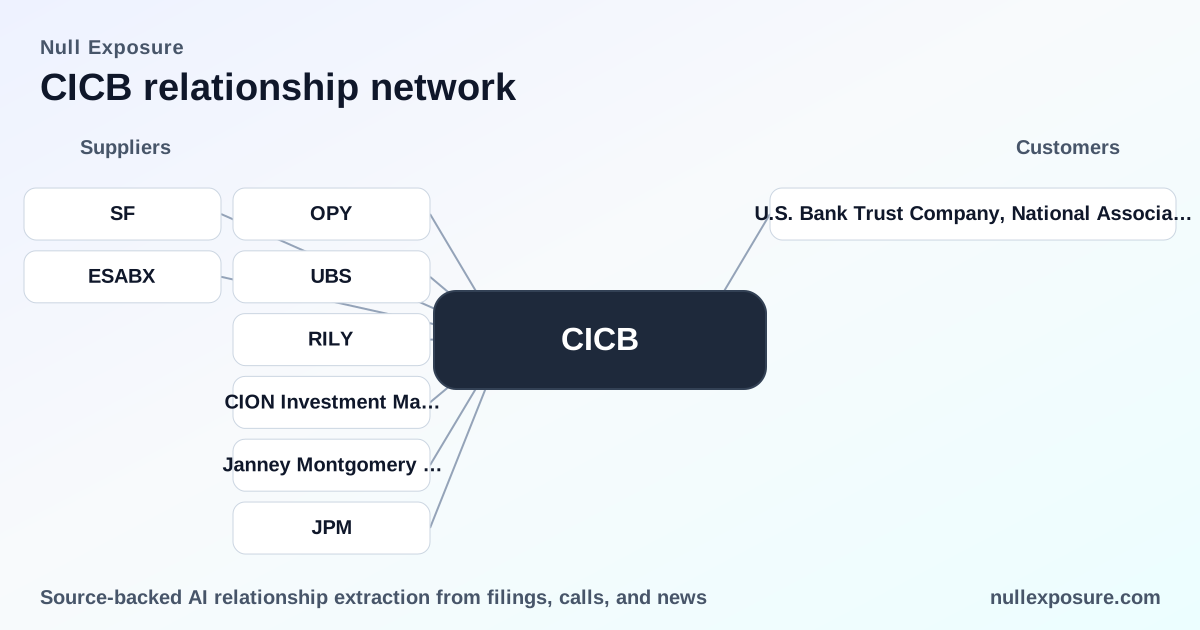
CION Investment Corporation (CICB) — how its customer relationships shape credit delivery and capital markets access
CION Investment Corporation operates as a closed-end business development company that originates and buys secured and unsecured debt and selective equity investments in U.S. middle‑market companies, and monetizes through recurring interest income, contractual amortization, investment fee income and periodic realizations that support dividend distributions to shareholders. The firm finances operations and extends leverage through public note issuances and trust structures, so capital‑markets counterparties and trustees are operationally important partners for both liquidity and documentation. Learn more about our coverage at https://nullexposure.com/.
Quick read for investors: the commercial logic in one paragraph
CICB targets middle‑market borrowers (generally EBITDA ≤ $75 million) and structures mostly multi‑year, secured first‑lien loans and unsecured notes to deliver attractive risk‑adjusted yields. The company’s business model combines active portfolio management and occasional managerial assistance to portfolio companies with public debt issuance (notes listed domestically and abroad) to fund deployments—creating a hybrid originator/credit investor that relies on long‑dated contracts and trustee relationships to execute its funding strategy.
Relationship in the filings: a trustee for note indentures
CICB has formally documented trustee relationships as part of its debt financing. According to the company’s FY2024 10‑K filing, U.S. Bank Trust Company, National Association serves as trustee under the Indenture for CICB’s 2029 Notes, with the 2029 Notes having been issued pursuant to a Base Indenture and a First Supplemental Indenture between CICB and U.S. Bank Trust. This establishes U.S. Bank Trust in a classic capital‑markets custody and indenture role that supports CICB’s public debt program (FY2024 10‑K).
Operating and business model constraints that matter for counterparties and investors
The filings surface several company‑level signals that describe how CICB contracts, where it concentrates risk, and how relationships are structured:
- Long‑term funding and investment tenor. CICB’s typical first‑lien loans carry three‑to‑six year maturities and the company has issued multi‑year unsecured notes (for example, 7.50% notes due 2029 issued in October 2024 and senior unsecured notes due 2026 issued under a 2021 Note Purchase Agreement). These long maturities create calendarable refinancing risk and a predictable interest income runway cited in the FY2024 filing.
- Middle‑market borrower focus. The company explicitly targets U.S. middle‑market private companies (generally EBITDA ≤ $75 million), which makes CICB exposed to concentrated credit cycles within a higher‑yielding borrower segment (FY2024 10‑K).
- Geographic footprint is primarily North American with targeted international issuance. As a BDC CICB invests at least 70% of assets in U.S. companies, yet the firm has executed international capital transactions—most notably a Series A unsecured note offering in Israel that closed and listed on the TASE in February 2023. That issuance used Mishmeret Trust Company Ltd. as trustee under the associated Deed of Trust (FY2024 10‑K). The combined pattern shows domestic underwriting focus with selective access to foreign investor pools, which diversifies funding channels but adds structural and FX‑linked conversion considerations for certain instruments.
- Active, services‑oriented posture. The filing describes an obligation to offer managerial assistance to qualifying portfolio companies and states that CIM provides such assistance on CICB’s behalf, which positions the firm as an active lender‑manager rather than a purely passive creditor, increasing operational touchpoints and monitoring needs (FY2024 10‑K).
- Segment orientation on services and transaction structuring. CICB emphasizes broad transaction structuring capabilities across capital stacks to manage risk and pursue returns, which translates into complex legal documentation and reliance on professional counterparties (trustees, placement agents, counsel) to execute bespoke financings.
What the trustee and capital markets links imply for risk and operations
Trustee relationships like the one with U.S. Bank Trust are low‑operational‑risk but high‑process‑critical: trustees do not drive credit decisions but are essential for note administration, redemption/repurchase mechanics, and covenant enforcement if defaults occur. Given CICB’s reliance on multi‑year notes and public debt issuance, robust trustee and indenture arrangements materially reduce execution risk for bondholders and support orderly liability management (FY2024 10‑K).
At the same time, CICB’s mid‑market borrower profile and active managerial posture mean credit selection and surveillance remain the primary drivers of performance, rather than trustee choice. The Israeli Series A offering via Mishmeret Trust Company Ltd. demonstrates that the company will engage local trustees when tapping non‑U.S. investor pools, which is a funding diversification tactic described in the filings (FY2024 10‑K).
Single relationship detail required by the review
U.S. Bank Trust Company, National Association — CICB entered into an Indenture and First Supplemental Indenture under which U.S. Bank Trust acts as trustee for CICB’s 2029 Notes, formalizing the trustee role for that note issuance and the related administration responsibilities (FY2024 10‑K).
Investment implications and monitoring checklist for operators
- Monitor note maturity ladders and call provisions: long‑term instruments smooth funding costs but create concentrated refinancing dates that investors should track (FY2024 10‑K).
- Assess portfolio credit concentration in middle‑market sectors and CICB’s documented managerial assistance intensity, which affects recovery expectations in stressed scenarios (FY2024 10‑K).
- Watch capital markets activity: international issuances (e.g., the TASE Series A offering) indicate management actively diversifies funding; monitor cross‑border conversion mechanics and any currency‑linkage clauses (FY2024 10‑K).
- Confirm trustee arrangements and covenant mechanics in successive filings to verify continuity of administrative safeguards (FY2024 10‑K).
For investors seeking a deeper read on how CICB’s counterparty network underwrites its funding strategy and credit operations, our analysis and signals are available at https://nullexposure.com/.
Bold takeaways: CICB is a long‑dated, active middle‑market credit investor that depends on trustee and capital‑markets relationships for funding execution; credit selection and portfolio surveillance are the central drivers of shareholder returns.