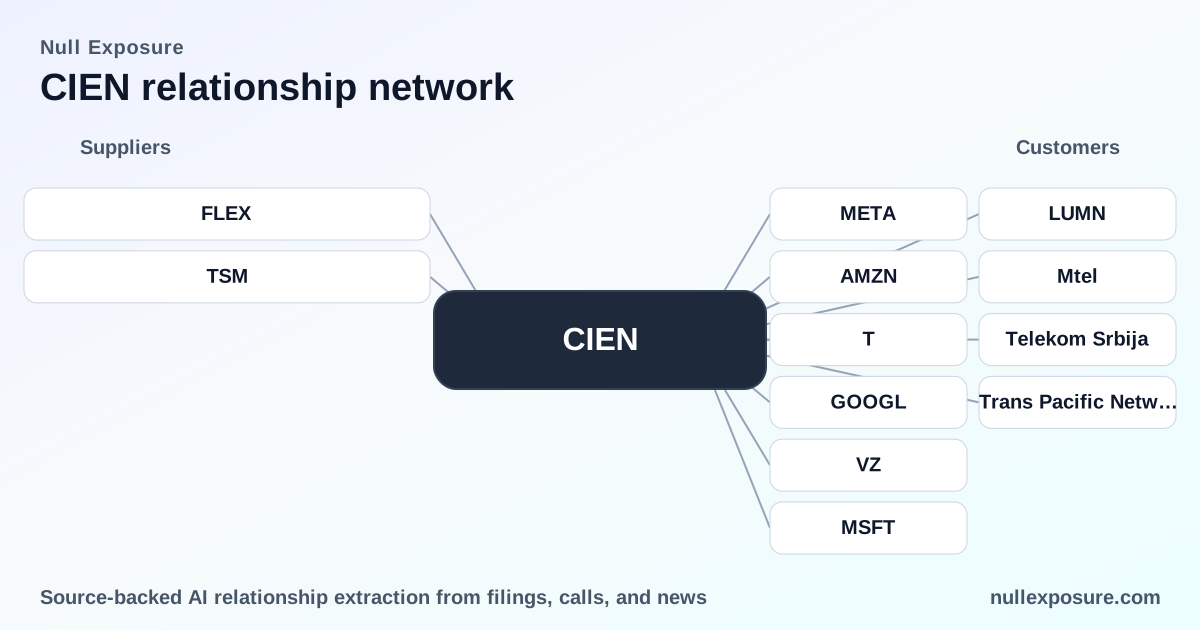
Ciena’s customer profile: hyperscalers and telcos fueling an optical backbone play
Ciena operates, sells, and supports high-capacity optical and packet networking hardware, software and services to service providers, cloud hyperscalers, data-center operators and enterprises. The company monetizes through a mix of hardware sales, software licenses and subscriptions, and professional services, with large, often multi-year purchase orders under framework agreements that translate into a sizeable backlog and remaining performance obligations. Investors should view Ciena as a supplier whose revenue visibility is driven by a concentrated set of large buyers—hyperscalers and Tier-1 carriers—and whose earnings leverage depends on the cadence of those customers’ capital spending. Learn more at https://nullexposure.com/.
Customer relationships: who buys Ciena and why they matter
Below I list every customer relationship surfaced in the coverage and provide a concise take on each engagement, with source notes.
-
Meta Platforms (META / Meta) — Meta is a major buyer of Ciena components, having “flooded Ciena with orders” as hyperscaler demand for AI-ready transport capacity accelerated in FY2026. Source: Finviz coverage, March 9, 2026 (https://finviz.com/news/294043/the-best-ai-stock-that-nobodys-talking-about-for-2026).
-
Google (GOOGL / Google) — Google is identified among the Webscale hyperscalers that drive a majority share of Ciena’s revenue by FY2026, positioning Ciena as a primary partner for hyperscaler optical interconnects. Source: Finterra/FinancialContent analysis, March 9, 2026 (https://markets.financialcontent.com/stocks/article/finterra-2026-3-5-cienas-ai-inflection-inside-the-2026-earnings-beat-and-the-future-of-global-optical-networking).
-
Amazon / AWS (AMZN / AWS) — Amazon is cited alongside other hyperscalers in Ciena’s pivot to cloud customers, contributing materially to backlog and revenue generation tied to data-center and interconnect upgrades. Source: Finterra/FinancialContent, March 9, 2026 (https://markets.financialcontent.com/stocks/article/finterra-2026-3-5-cienas-ai-inflection-inside-the-2026-earnings-beat-and-the-future-of-global-optical-networking).
-
Microsoft (MSFT / Microsoft) — Microsoft is named among hyperscalers whose capital-expenditure pauses would cause pronounced revenue volatility for Ciena, underlining the strategic importance and sensitivity of those relationships. Source: Finterra/FinancialContent, March 9, 2026 (https://markets.financialcontent.com/stocks/article/finterra-2026-2-10-the-optical-backbone-of-the-ai-revolution-a-deep-dive-into-ciena-corporation-cien).
-
AT&T (T / AT&T) — AT&T is a historic Tier‑1 customer and represented roughly 11% of revenue in the referenced annual reporting period, reflecting telco legacy demand that coexists with hyperscaler business. Source: CNBC reporting on company annual disclosures, February 4, 2026 (https://www.cnbc.com/2026/02/04/ciena-returns-to-sp-500-after-getting-booted-17-years-ago.html).
-
Verizon (VZ / Verizon) — Verizon is listed as one of the traditional telecommunications customers that remain important to revenue and backlog, even as Ciena shifts toward direct sales to non-telco buyers. Source: Finterra/FinancialContent, March 9, 2026 (https://markets.financialcontent.com/stocks/article/finterra-2026-3-5-cienas-ai-inflection-inside-the-2026-earnings-beat-and-the-future-of-global-optical-networking).
-
Vodafone Idea Limited / Vodafone Idea (IDEA / Vodafone Idea Limited) — Vodafone Idea deployed Ciena’s WaveLogic 6 Extreme on its 6500 platform to upgrade inter-data-center transport in India, a concrete service-provider win that supports revenue visibility in APAC. Source: SahmCapital (Apr 12, 2026) and TradingKey coverage (May 2026) (https://www.sahmcapital.com/news/content/is-ciena-cien-quietly-becoming-the-backbone-of-indias-ai-ready-network-infrastructure-2026-04-12; https://www.tradingkey.com/news/Market-Movers/261748296-market-movers-cien-20260402).
-
Sify Technologies (SIFYR / Sify) — Sify upgraded its National Long Distance network with Ciena optical technology, demonstrating Ciena’s traction with regional carriers and managed service providers in India. Source: TechCircle, October 8, 2024 (reported in coverage first seen March 2026) (https://www.techcircle.in/2024/10/08/sify-sxpands-national-long-distance-network-capacity-with-ciena-technology/).
-
Lightstorm — Lightstorm uses Ciena’s Navigator Network Control Suite for end-to-end network management and high spectral performance on long-haul routes, illustrating software-driven operational value beyond hardware sales. Source: Yahoo Finance reporting, May 2, 2026 (https://finance.yahoo.com/markets/stocks/articles/ciena-cien-lightstorm-upgrade-jga-101932469.html).
-
Lumen Technologies (LUMN / Lumen) — Lumen is adopting Blue Planet AI agents (a Ciena division solution) across its operations to automate network tasks and improve customer experience, signaling recurring-software and services adoption at a large carrier. Source: StockTitan / press reporting, March 2026 (https://www.stocktitan.net/news/CIEN/lumen-boosts-ai-network-transformation-with-blue-planet-s-ai-studio-nnf9v9weqjxj.html).
-
Telekom Srbija — Telekom Srbija and affiliate Mtel deployed Ciena optical tech to improve cross-border connectivity, showing Ciena’s role in national and regional transport upgrades in EMEA. Source: StockTitan press summary, March 2026 (https://www.stocktitan.net/news/CIEN/ciena-announces-reporting-date-and-web-broadcast-for-fiscal-first-uzkjcx5vxrzy.html).
-
Mtel — As part of the Telekom Srbija engagement, Mtel implemented Ciena’s optical technology for enhanced cross‑border links, reinforcing EMEA footprint. Source: StockTitan press summary, March 2026 (https://www.stocktitan.net/news/CIEN/ciena-announces-reporting-date-and-web-broadcast-for-fiscal-first-uzkjcx5vxrzy.html).
-
Trans Pacific Networks — Trans Pacific Networks is using Ciena technology to advance the Echo and Tabua undersea cable systems, underscoring Ciena’s exposure to subsea and international wholesale connectivity projects. Source: StocksToTrade summary, February 2026 (https://stockstotrade.com/news/cienacorporation-cien-news-2026_02_22/).
Each of these relationships contributes either to immediate hardware shipment revenue, to multi-period software and subscription revenue, or to services and support contracts that create recurring revenue and installation/implementation backlog.
What the contract and revenue signals tell investors
Ciena’s public filings and analyst coverage outline a consistent contract profile and commercial posture:
-
Framework agreements govern sales: Ciena sells primarily via purchase orders placed under framework agreements that set commercial terms, enabling scalable, repeatable supply relationships with large customers rather than bilateral one-off deals. (Company filing language excerpt.)
-
Software monetization is mixed: Revenue from Ciena software includes perpetual and term licenses and subscriptions, with license revenue often recognized at a point in time and subscription/support revenue recognized ratably over the service period. (Company disclosure language.)
-
Purchase flexibility and short-term order risk: Customer contracts generally do not include guaranteed minimum purchases and allow modification or cancellation of purchase orders; this structure increases revenue sensitivity to customer capex cycles even as backlog/RPO provides near-term visibility. (Company filing language.)
-
RPO and backlog provide visibility: As of November 1, 2025, aggregate Remaining Performance Obligations stood at $2.1 billion, with roughly 83% expected to convert to revenue within 12 months, signaling significant near-term recognition tied to active purchase orders. (Company disclosure.)
-
Customer concentration is material: The five largest customers accounted for approximately 50% of revenue in fiscal 2025, and one unnamed cloud provider alone generated $851.6 million (about 17.9% of revenue)—a concentration profile that drives both upside in large wins and downside in capex pauses. (Company annual report; CNBC reporting, Feb 2026.)
-
Global footprint with regional skew: Revenue is global but skewed by geography—Americas accounted for the largest share, with EMEA and APAC representing important regional markets (FY2025 distribution: Americas ~$3.61B; EMEA ~$731.9M; APAC ~$431.2M). This underlines exposure to both developed carrier spend and high-growth APAC infrastructure projects. (Company geographic disclosure.)
-
Segments and revenue mix: Ciena’s monetization is across hardware, software, and services, and the business model therefore blends high-margin software/subscription growth opportunities with capital-intense hardware deliveries. (Company description.)
Investment implications: concentration, optionality, and operational posture
-
Concentration is a double-edged sword. Large hyperscaler wins drive outsized revenue growth and margin expansion when spending is active; however, revenue volatility follows hyperscaler capex cycles and a pause by a major cloud customer would meaningfully impair results.
-
Backlog and RPO smooth near-term risk. The $2.1B RPO and planned recognition cadence give visibility through the next 12 months; investors should monitor ordering behavior and RPO conversion rates for early signs of demand change.
-
Contracting posture favors repeatable engagements but limited minimums. Framework agreements accelerate procurement but the lack of minimum purchase guarantees leaves Ciena exposed to order cancellations or deferrals.
-
Software and services increase margin optionality. Adoption of Blue Planet and Navigator management suites with customers such as Lumen and Lightstorm signals growing recurring revenue that improves long-term margin mix.
If you want to track these customer-level cues and how they affect Ciena’s revenue risk profile, see more research and summaries at https://nullexposure.com/.
Bottom line
Ciena’s FY2025–FY2026 narrative is clear: the company has rebalanced from a carrier-centric supplier to a hyperscaler‑anchored optical infrastructure partner, driving higher-ticket hardware deals and growing software/service recurring revenue. Concentration and capex sensitivity remain the primary risk vectors; conversely, RPO, framework contracts, and expanding software footprints provide structural upside if hyperscaler and carrier spending continues.