Cipher Mining (CIFR): From Bitcoin Rigs to Hyperscaler Leasing — What Investors Need to Know
Cipher Mining operates industrial-scale data centers and monetizes them through two distinct revenue engines: short-term bitcoin-mining services and long-term, contracted leases to hyperscalers and AI/HPC customers. The company is executing a strategic pivot—selling non-core mining stakes while signing multiyear, high-capacity leases with Amazon Web Services, Google-backed Fluidstack, and other cloud/HPC operators to convert power capacity into predictable, contracted cash flows. For a concise analysis of Cipher’s customer relationships and the operational constraints that matter to investors, read on. For ongoing coverage and relationship maps, visit https://nullexposure.com/.
Hyperscaler anchor: Amazon Web Services (AWS) — a transformational lease
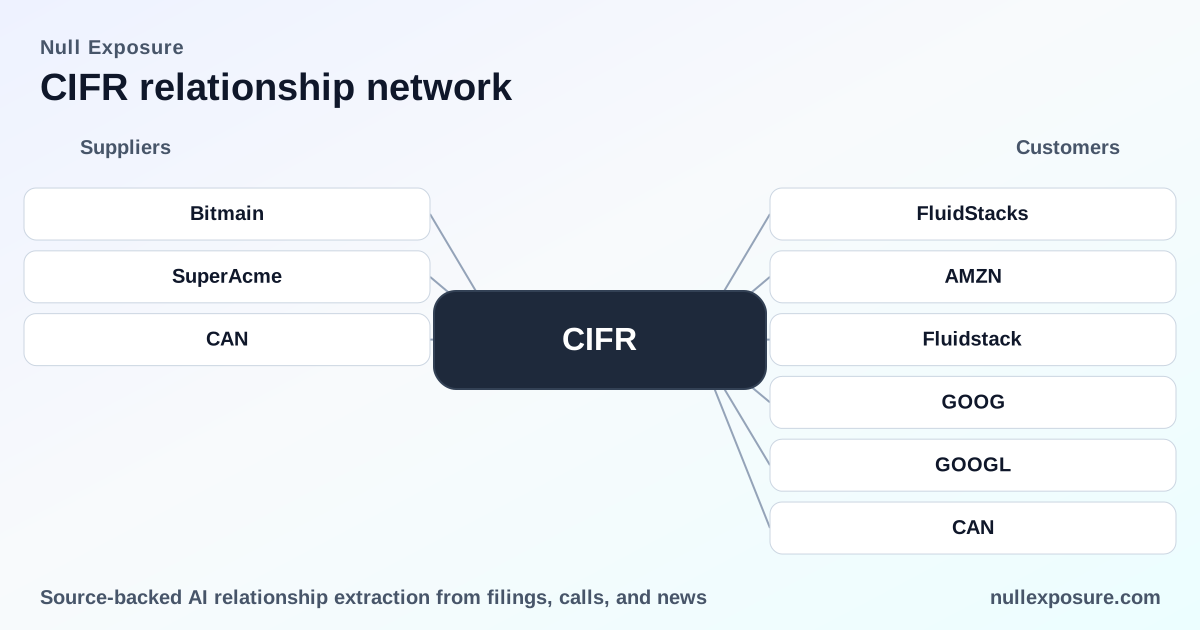
Cipher has signed a 15-year, 300 MW triple-net lease with Amazon Web Services, positioning a meaningful portion of its capacity under long-duration, high-credit tenancy. Cipher described the agreement in its Q4 2025 earnings commentary and disclosed transaction economics in investor materials (slide 12), and multiple market reports quantify the AWS commitment as part of a multi-billion dollar contracted revenue pool; Intellectia and company filings characterize the AWS deal as a cornerstone of the company’s AI data-center strategy (Q4 2025 / Mar 2026). According to an 8-K and subsequent coverage, this is a long-term, high-durability revenue stream that materially derisks capacity monetization relative to spot bitcoin operations.
Fluidstack and Google: a bundled commitment with underwriting
Cipher upsized a 10-year, 300 MW lease tied to Fluidstack, with Google providing financial backing to a portion of Fluidstack commitments. Company remarks in the Q4 2025 earnings call cite the Fluidstack upsizing and note Google’s support; market reports and investor presentations quantify Fluidstack-related commitments (March 2026) and reference up to $1.73 billion in Google-backed commitments and a broader Fluidstack package reported in press coverage. This relationship converts capacity into mid-term contracted revenue and brings an underwriter role from a hyperscaler (Google), enhancing credit quality of that cash flow.
Canaan Inc. (CAN): disposition of West Texas mining assets
Cipher sold a 49% stake in several West Texas mining joint ventures (Alborz LLC, Bear LLC and Chief Mountain LLC) to Canaan Inc. for approximately $39.75–$39.8 million in stock. Multiple sources—Coindesk, PR wire summaries, and Cipher’s material-event disclosure—report the all-stock transaction closed in February 2026 and described as the divestiture of non-core mining assets totaling roughly 4.4 EH/s. This transaction accelerates Cipher’s pivot from legacy bitcoin-mining positions toward data-center hosting and HPC leasing (Feb–Mar 2026).
Google (Alphabet / GOOGL): direct backing and marketplace signal
Beyond Google’s support of Fluidstack commitments, Cipher’s disclosures and market write-ups list Google as a named participant in the Fluidstack arrangement and as an investor-level underwriter for a portion of capacity-related commitments. Company commentary in the Q4 2025 call directly references Google’s role while news sources in March–May 2026 consolidate Google into the company’s AI/HPC go-to-market narrative. The Google linkage strengthens the portfolio’s tenant credit profile and supports investor re-rating assumptions around contracted HPC revenue.
How these customer relationships stack together
- AWS (15 years, 300 MW): Long-term, high-credit anchor that converts capacity into predictable rent and services revenue (Q4 2025 earnings call; 8-K; March 2026 press).
- Fluidstack + Google (10 years, 300 MW): Mid-duration institutional commitment with Google backing that bridges cloud/HPC demand to Cipher capacity (Q4 2025 call; March 2026 press).
- Canaan (asset sale, ~$39.75M stock consideration): Exit of non-core West Texas mining equity to accelerate transition from mining output to data-center leasing (Feb 2026 PRs and filings).
Each of these relationships is documented in Cipher’s Q4 2025 disclosures and in contemporaneous market coverage (March–May 2026). Collectively they represent a deliberate reallocation of capital away from volatile mining receipts toward contracted HPC and hyperscaler revenue.
Operating and business-model constraints that drive investment outcomes
Cipher’s customer relationships and operational posture deliver clear characteristics investors must price:
- Contracting posture: Dual contract architecture is in place—long-term leases with hyperscalers (high contract durability; evidence supports multi-year, fixed leases) alongside short-duration mining pool arrangements that settle daily and are terminable on short notice. This hybrid model produces both predictable rental cash flows and residual exposure to daily crypto economics.
- Concentration and criticality: Historical revenue concentration is acute—the company reported that in the year ended December 31, 2024 it earned revenue of $151.3 million from pool operators Foundry USA and Luxor, representing 100% of consolidated revenue. That fact is a company-level signal of prior earnings concentration and explains the strategic pivot to diversify into hyperscaler contracts (company filing / constraints excerpt).
- Geography and build cadence: Operations and development remain concentrated in West Texas and the Texas Panhandle, an area Cipher cites for low-cost power and scalable site development; this concentration reduces site diversification but accelerates build and interconnection logistics for large hyperscaler campuses (company disclosures).
- Relationship role and stage: Cipher operates both as a seller of computing power (bitcoin-mining pools) and as a service provider / developer of industrial-scale data centers for lease to HPC customers. The company’s contracts span active, operational mining pool terms and nascent, long-term hyperscaler leases slated to energize in October 2026 per investor presentations and press reports.
- Segment focus and maturity: Cipher is evolving from a pure mining operator into a two-segment business—infrastructure (data center development/hosting) and services (mining operations and treasury management)—a strategic reorientation that changes capital and margin profiles.
These constraints combine into a predictable set of investment implications: revenue durability and credit quality should improve as hyperscaler leases ramp, but geographic concentration and legacy pool reliance give residual downside to mining-cycle volatility.
What this means for investors and operators
- Positive: contracted cash flows and top-tier tenant underwriting materially reduce commodity exposure, supporting valuation re-rates observed in several analyst reports that lifted price targets after the AWS announcement (March–May 2026 media coverage).
- Negative: execution risk is timing-driven. Energization and construction milestones (targeted October 2026) and interconnection delivery determine when contracted revenue replaces legacy mining receipts.
- Balance-sheet and capital allocation will determine final realized returns. Cipher funded development through high-yield bond offerings and asset sales (Canaan deal), but construction, interconnection, and tenant ramp remain the operational focus.
If you want a relationship-level map or a tailored counterparty risk brief for portfolio diligence, NullExposure provides structured customer intelligence and source-traced relationship narratives—see our coverage hub at https://nullexposure.com/.
Bottom line
Cipher’s customer relationships with AWS and Google/Fluidstack convert speculative capacity into long-duration, contracted revenue, while the Canaan transaction reflects a purposeful shedding of non-core mining assets. The company’s valuation trajectory now hinges on execution of build timelines and the conversion of signed leases into cash flow, not on bitcoin production alone. Investors should underwrite both the improved revenue durability from hyperscaler tenancy and the operational execution risk tied to site energization and interconnection.