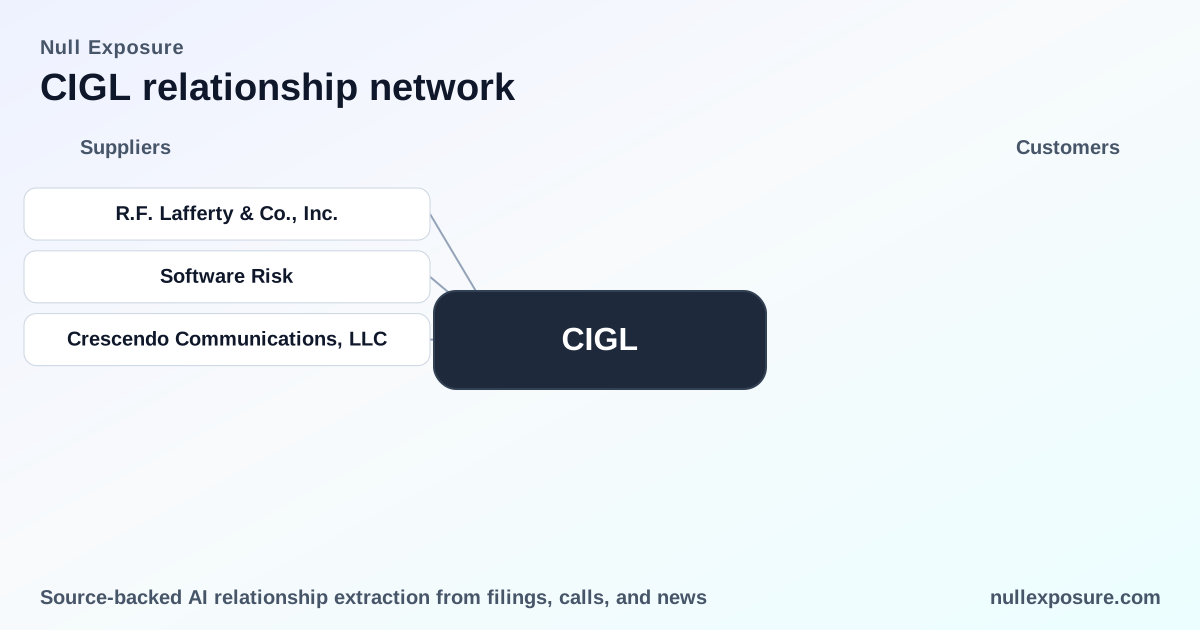
Concorde International Group Ltd (CIGL): Customer Relationships and the RYDE Partnership
Concorde International Group Ltd (NASDAQ:CIGL) monetizes by delivering professional upskilling, facilities and security management services, and related B2B programs that are contracted by corporate and platform customers; revenue is generated through program fees and service contracts tied to client engagements. For investors, the company’s commercial profile is defined by service-led deliverables, client partnerships that convert to recurring or repeatable assignments, and dependence on a small number of visible enterprise relationships for proof of market fit. For ongoing coverage and relationship signals, visit https://nullexposure.com/.
The single reported customer link — why it matters for valuation
Concorde’s customer footprint in the available records is concentrated but strategically relevant: the company partnered with a mobility platform to deliver a facilities and security management upskilling programme for driver-partners, demonstrating a clear route to monetizing training services into platform labor markets. That single partnership functions as a proof point for Concorde’s service delivery model and its ability to access employee-upskilling budgets within platform ecosystems.
All reported customer relationships (complete list)
- RYDE — A March 10, 2026 Yahoo Finance report states that the first batch of driver-partners completed professional upskilling through a Facilities and Security Management Programme conducted in collaboration with Concorde International Group Ltd (NASDAQ:CIGL), establishing a direct customer delivery relationship between Concorde and RYDE’s driver network. (Source: Yahoo Finance, March 10, 2026. https://finance.yahoo.com/news/ryde-expands-driver-partner-career-100000747.html)
What the RYDE collaboration tells investors
The RYDE engagement is instructive on three operational vectors that matter for investment analysis:
- Commercial channeling into platform labor markets. Concorde is converting institutional demand from gig-economy platforms into billable training and security services, which is a higher-margin vector than commodity staffing if scale and repeatability are achieved.
- Productized service delivery. The RYDE programme is presented as a named curriculum—Facilities and Security Management—indicating Concorde sells discrete, modular offerings that are easier to price and replicate across customers.
- Client-facing credibility. A publicized delivery to a mobility provider increases Concorde’s visibility to other large corporate buyers that require compliant, certified training for distributed workforces.
Investors should treat the RYDE example as evidence of product-market fit in training for operational roles, but not as proof of broad diversification or scale.
Operational constraints and company-level signals investors need to know
The dataset supplied includes no explicit constraint excerpts tied to specific customers; the following are company-level operational signals derived from reported activity and public disclosures:
- Contracting posture — project and program-based B2B contracts. Concorde’s revenue profile is shaped by discrete training engagements and service contracts rather than by fully asset-backed, annuity-like sales. That structure supports faster go-to-market but increases the importance of winning repeat business.
- Concentration risk — visibility is limited; client base appears concentrated. With the single documented relationship to RYDE, customer concentration is a material consideration until additional, diversified customer wins are disclosed and sustained.
- Criticality to the client — operationally relevant but not necessarily mission-critical. Facilities and security training materially improves operational compliance for clients, which supports pricing power, but such services are often replaceable among vendors if competing on price or local delivery.
- Maturity of offerings — productized but still scaling. The presence of a packaged programme suggests an offering that can be scaled, but one public engagement does not confirm broad commercial traction or geographic coverage.
These signals combine into a moderate-risk, growth-oriented profile: Concorde benefits from service-level margins and repeatable programs, but investors should prioritize evidence of client diversification and contractual tenure before upgrading revenue predictability assumptions.
Risk and upside drivers investors should weigh
- Upside: Repeatable program sales to platform operators and large enterprises can compound quickly, turning single engagements into multi-client frameworks and licensing opportunities for standardized curricula.
- Risk: Revenue concentration and the project-based contracting posture limit predictability until multiple, long-duration contracts are visible. Delivery execution and client retention are the primary operational risks for valuation.
- Near-term monitoring: Track public announcements of additional enterprise partnerships, contract durations, and any move toward subscription or retainer pricing that converts project revenue into recurring revenue.
For detailed tracking of customer relationships and signals, see https://nullexposure.com/.
How to monitor developments that matter
Focus on three data points that will move the narrative for Concorde:
- Publicized customer wins beyond RYDE and the mix between one-off projects and multi-year contracts.
- Progress toward productizing training into licenseable curricula or digital bundles that reduce delivery marginal cost.
- Disclosure of client concentration and contributions to revenue in regulatory filings or investor materials.
Bottom line
The RYDE relationship validates Concorde International Group’s core commercial capability: selling and delivering structured upskilling and operational services into platform ecosystems and enterprise clients. That validation is meaningful for investors but remains an early indicator rather than conclusive evidence of scale. The investment case depends on Concorde’s ability to convert discrete engagements into a diversified, repeatable revenue base and to demonstrate contract tenure that reduces execution and concentration risk.