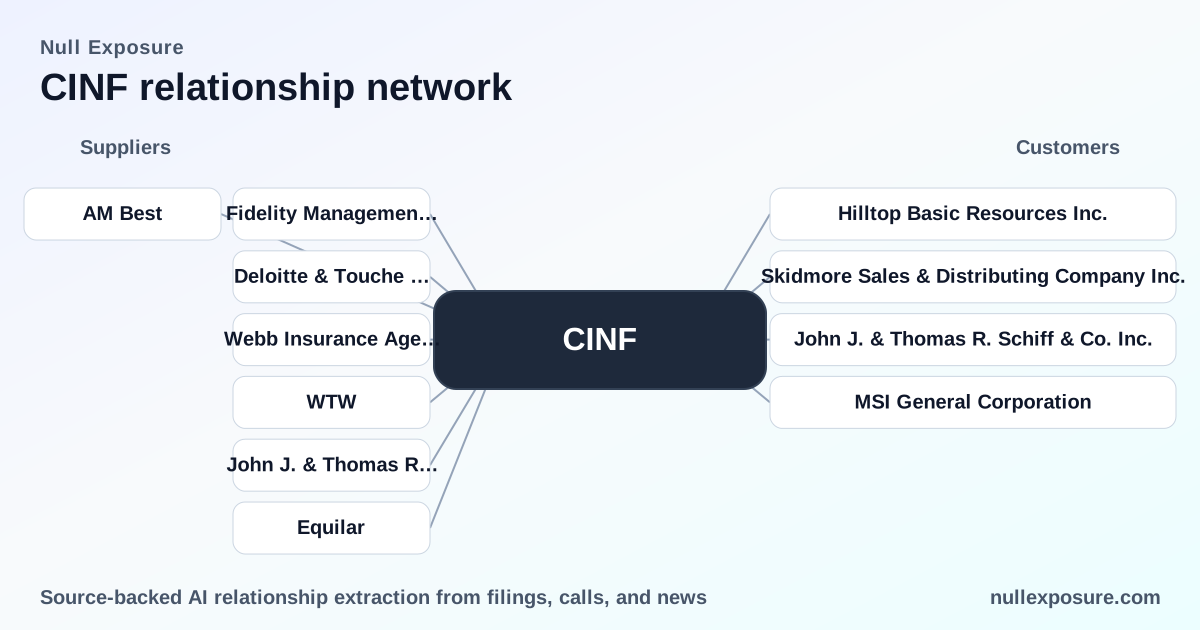
Cincinnati Financial (CINF): Customer Relationships and What They Signal for Investors
Cincinnati Financial underwrites property & casualty insurance primarily through three operating subsidiaries and monetizes through insurance premiums, underwriting margins and investment income on the float. The company distributes products through a network of independent agents and retains a mix of short-duration excess & surplus lines and longer-duration commercial packages that lock rates for multi-year terms; this combination shapes both revenue stability and underwriting risk. For detailed portfolio and relationship monitoring visit https://nullexposure.com/.
Named commercial customers in the latest filings — concise investor read
Cincinnati Financial’s FY2026 preliminary proxy discloses a small number of named customers connected to company directors and executives; each relationship is transactional and measured in premium dollars rather than strategic dependency.
Hilltop Basic Resources Inc.
Hilltop Basic Resources purchased property and casualty policies from Cincinnati’s insurance subsidiaries for $931,966 in premiums in FY2026, and the disclosure links the account to a director-level executive. According to Cincinnati Financial’s FY2026 preliminary proxy filing (published via StockTitan, March 2026), this is a reportable related-party insurance relationship: https://www.stocktitan.net/sec-filings/CINF/pre-14a-cincinnati-financial-corp-preliminary-proxy-statement-1171ff09cfa0.html.
Skidmore Sales & Distributing Company Inc.
Skidmore Sales & Distributing recorded $1,368,924 in premiums paid to Cincinnati’s insurance subsidiaries in FY2026, with the filing stating the company is owned and led by a company director. This disclosure appears in the same FY2026 preliminary proxy (StockTitan, March 2026): https://www.stocktitan.net/sec-filings/CINF/pre-14a-cincinnati-financial-corp-preliminary-proxy-statement-1171ff09cfa0.html.
John J. & Thomas R. Schiff & Co. Inc.
John J. & Thomas R. Schiff & Co. paid $167,954 in insurance premiums and also paid $184,611 in rent for office space within Cincinnati Financial’s headquarters building during FY2026, making this a dual commercial relationship (tenant and insurance customer). The FY2026 preliminary proxy (StockTitan, March 2026) lists these amounts and arrangements: https://www.stocktitan.net/sec-filings/CINF/pre-14a-cincinnati-financial-corp-preliminary-proxy-statement-1171ff09cfa0.html.
MSI General Corporation
MSI General Corporation and related development entities bought commercial property casualty policies from Cincinnati for $223,779 in aggregated premiums in FY2026, and the filing identifies the buyer as connected to a Cincinnati director. This detail is disclosed in Cincinnati Financial’s FY2026 preliminary proxy (StockTitan, March 2026): https://www.stocktitan.net/sec-filings/CINF/pre-14a-cincinnati-financial-corp-preliminary-proxy-statement-1171ff09cfa0.html.
What investors should extract from these named accounts
- Scale and materiality: Named premiums are modest relative to Cincinnati’s $12.9 billion revenue run-rate, confirming these are routine commercial relationships rather than single-customer revenue concentration risks.
- Governance transparency: The company discloses director-affiliated customers and ancillary landlord receipts, which is positive from a governance and related-party transparency perspective.
- Customer profile: These are commercial, middle-market or privately held companies, consistent with Cincinnati’s stated emphasis on middle market and small-business accounts marketed through independent agencies.
Operating model constraints and how they shape customer economics
Cincinnati’s customer footprint and contract posture create a characteristic risk/reward profile that investors should incorporate into valuation and underwriting outlook.
- Contracting posture: The company offers three-year commercial lines packages for many business policies, creating rate lock-ins and revenue predictability; conversely, excess & surplus (E&S) lines are written for one year, introducing higher repricing flexibility and exposure to short-term market cycles. These are company-level operating choices disclosed in management commentary for FY2024–FY2026.
- Distribution concentration: Cincinnati is committed to the independent agency channel, which acts as a reseller and principal originator of new business and renewals; this translates into lower direct marketing costs but amplifies dependence on agent relationships for new business flow.
- Counterparty mix and granularity: Customer types span individuals, middle-market commercial accounts and small businesses, reflective of diversified exposure across personal lines and commercial portfolios rather than reliance on a few large corporate accounts.
- Geographic posture: Operations are primarily North America (46 U.S. states with concentration in Midwest and Southeast), while Cincinnati Global and Lloyd’s access provide selective international reach, including the U.K./EMEA. This geographic mix moderates catastrophe concentration but still concentrates risk regionally.
- Financial criticality: Management identifies loss and loss expense reserves as the company’s most significant estimate, flagging reserve adequacy as a critical driver of earnings volatility and capital adequacy.
- Customer economics: Average commercial policy size is roughly $17,000 in annual premium, which signals a high-volume, low-average-premium book where underwriting discipline and claim frequency management are decisive.
- Lifecycle and status: The company reports the independent agency network and market activity as active, indicating a mature, stable distribution ecosystem rather than an early-stage channel build.
For a consolidated view of corporate customer relationships and disclosure trends, see https://nullexposure.com/.
Investment implications and risk checklist
- Underwriting leverage: The mix of multiyear commercial packages and one-year E&S policies creates underwriting leverage — favorable in stable rate environments, vulnerable in sudden inflationary or reinsurance-cost shocks.
- Reserve risk is central: Given reserves are the largest estimate, reserve adequacy and reserve development should be monitored quarter-to-quarter as primary drivers of earnings surprises.
- Low single-customer concentration: Named related-party customer premiums are immaterial to enterprise revenue, supporting a thesis of broad retail and middle-market diversification rather than customer concentration risk.
- Distribution dependency: Heavy reliance on independent agents is efficient but raises operational concentration risk around agent retention and competitive displacement in key states.
- Regulatory and international exposure: Lloyd’s and Cincinnati Global operations introduce additional regulatory complexity and tax considerations (notably U.K. jurisdiction exposure), which warrant attention for capital planning.
Bottom line
Cincinnati Financial’s FY2026 named customers are representative, modest commercial accounts — several connected to directors and disclosed in the company’s preliminary proxy. The company’s durable economics flow from diversified small- to mid-market business written through independent agents, an underwriting model that balances multiyear commercial stability against annual E&S repricing, and a reserve-focused risk profile that is central to valuation. For ongoing monitoring of customer disclosures and related-party trends, visit https://nullexposure.com/.