CISO Global: Customer relationships that shape the go‑forward commercialization
Thesis: CISO Global (NASDAQ: CISO) monetizes through a hybrid services-plus-software model—delivering contracted cybersecurity services to hundreds of clients while scaling a nascent recurring software suite sold via insurance and vertical distribution channels. Revenue today rests on services; upside depends on software adoption through distribution partners and access to incremental capital to fund go‑to‑market expansion. For primary research into partner flows and customer risk, see https://nullexposure.com/.
The business in one line for investors
CISO sells managed security and professional services to a broad base of smaller customers while launching an internally developed software stack that is sold as recurring contracts and embedded into insurance distribution channels; the company uses short-term financing and strategic partner relationships to accelerate software penetration. Cash needs and channel execution will determine whether the company transitions from services revenue to higher‑margin software recurring revenue.
Who CISO is doing business with right now
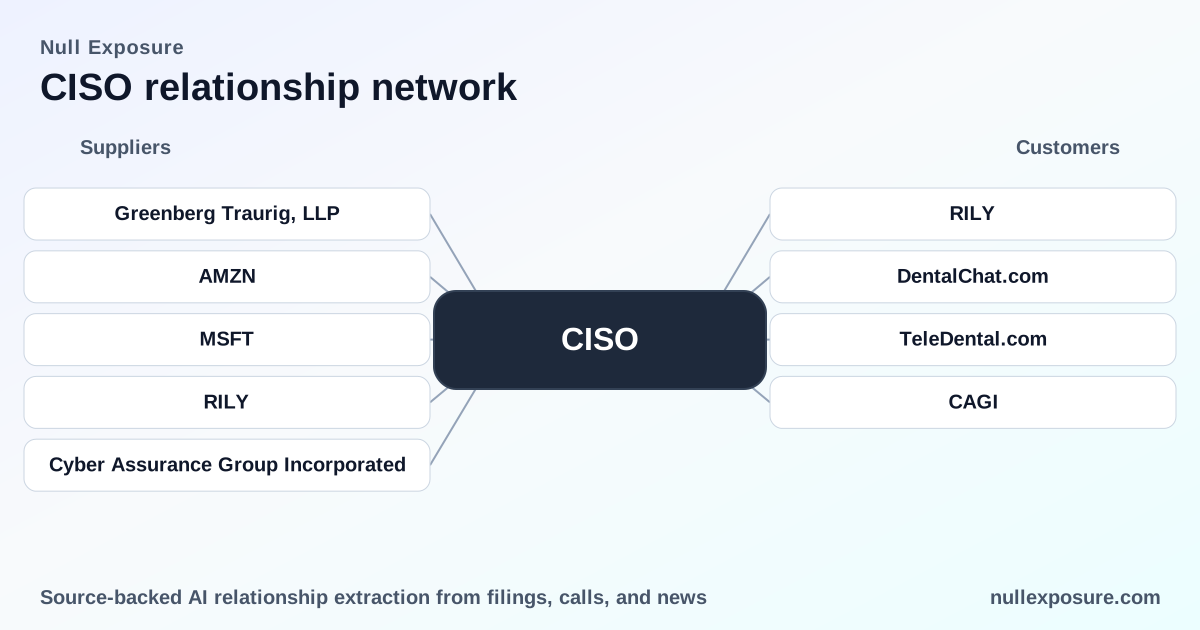
Below are the companies identified in public releases and press coverage that describe CISO’s customer and channel relationships.
B. Riley Securities Holdings, Inc. (RILY)
CISO entered a private financing arrangement giving it the right—but not the obligation—to sell up to $15 million of a new series of convertible preferred stock to a fund managed by B. Riley, providing a committed capital option to fund expansion initiatives. According to GlobeNewswire (Sep 29, 2025) and a Yahoo Finance summary (Mar 9, 2026), the facility is explicitly intended to support scaling, including software growth through insurance channels (https://www.globenewswire.com/news-release/2025/09/29/3157718/0/en/CISO-Global-Enters-Into-a-15-Million-Convertible-Preferred-Equity-Facility-to-Fund-Expansion-Initiatives.html; https://finance.yahoo.com/news/ciso-global-enters-15-million-123000944.html).
DentalChat.com
CISO announced a strategic partnership to offer a CyberSimple product built on its CHECKLIGHT platform to dental practices, using DentalChat.com as an industry-specific distribution channel to reach a fragmented market of clinics. The tie-up was described in a January 2026 GlobeNewswire release and covered by Quiver Quant (Jan 15, 2026; Mar 9, 2026), noting initial coverage of more than 358 clinics and the option to expand across the broader U.S. dental market (https://www.globenewswire.com/news-release/2026/01/15/3219545/0/en/ciso-global-partners-with-teledental-to-launch-cybersimple-powered-by-checklight-to-protect-dental-clinics-from-cyber-threats.html; https://www.quiverquant.com/news/CISO%2BGlobal%2BAnnounces%2BStrategic%2BPartnership%2Bwith%2BTeleDental.com%2Band%2BDentalChat.com%2Bto%2BEnhance%2BCybersecurity%2Bfor%2BDental%2BPractices).
TeleDental.com
TeleDental.com is the distribution partner alongside DentalChat to make CyberSimple available to dental clinics, with public statements specifying initial penetration into >358 clinics and scalable expansion potential across the U.S. dental vertical. Coverage is found in the GlobeNewswire release and corroborated in Quiver Quant reporting (Jan 15, 2026; Mar 9, 2026) (https://www.globenewswire.com/news-release/2026/01/15/3219545/0/en/ciso-global-partners-with-teledental-to-launch-cybersimple-powered-by-checklight-to-protect-dental-clinics-from-cyber-threats.html; https://www.quiverquant.com/news/CISO%2BGlobal%2BAnnounces%2BStrategic%2BPartnership%2Bwith%2BTeleDental.com%2Band%2BDentalChat.com%2Bto%2BEnhance%2BCybersecurity%2Bfor%2BDental%2BPractices).
CAGI (Cyber Assurance Group / insurance channel partner)
Management cites CAGI as a strategic insurance distribution channel to scale its software products; public commentary links the capital facility draws to funding expansion through the CAGI relationship, and recent executive hiring emphasizes driving software adoption through insurance partners including CAGI. That narrative is laid out in company releases and media summaries spanning Sep 2025 through early 2026 (GlobeNewswire Sep 29, 2025; press on executive hire Feb 18, 2026) (https://www.globenewswire.com/news-release/2025/09/29/3157718/0/en/CISO-Global-Enters-Into-a-15-Million-Convertible-Preferred-Equity-Facility-to-Fund-Expansion-Initiatives.html; https://www.globenewswire.com/news-release/2026/02/18/3240211/0/en/CISO-Global-Lands-30-Year-Sales-Veteran-Michael-Czerneda-to-Ignite-the-Next-Wave-of-Software-Growth.html).
Visit https://nullexposure.com/ for a consolidated view of partner traction and capital signals.
What the relationship map implies about how CISO operates
- Contracting posture: Public excerpts indicate a mix of short‑term service contracts (months to three years) and recurring monthly subscription arrangements for software; the business is operating in a transition from project/services delivery toward recurring licensing. The company explicitly notes that employees are “available under recurring monthly contracts,” signaling a subscription overlay to its managed services.
- Concentration and materiality: Management reports that no single customer represented over 10% of consolidated revenue in 2023–2024, which supports low customer concentration as a company‑level characteristic.
- Criticality and counterparty profile: CISO positions products for large enterprises and government entities (CISO Edge) while also selling services to smaller, fragmented verticals (dental clinics) through distribution partners; this dual profile implies a two‑track GTM where enterprise/government deals are higher criticality but dental/SMB is addressable volume.
- Maturity and stage: The software segment is early stage but growing—cybersecurity software revenue doubled year‑over‑year in 2024 from initial internal launches—while services remain the primary cash generator. Public statements and hires focused on insurance distribution suggest the company is in active commercial scaling rather than steady‑state.
- Spend and account economics: Reported annual receipts from a single identified client (Hensley Beverage Company) were roughly $2.28 million in 2024, placing some customer engagements in the $1m–$10m spend band and illustrating the company’s ability to win mid‑sized service contracts (this example is cited in the company’s disclosures).
- Geography: Commentary signals an ambition to expand internationally (references to Europe, South America) while noting support for multinational security programs; current distribution play emphasizes U.S. vertical rollouts.
Investment implications: what matters for returns
- Capital availability is pivotal. The B. Riley convertible preferred facility is a practical backstop to fund software go‑to‑market if draws are made; without committed capital, software scaling could stall.
- Channel execution drives multiple expansion. The TeleDental/DentalChat route demonstrates a focused vertical distribution strategy that can accelerate recurring revenue at low sales cost if conversion and retention are strong.
- Revenue mix transition is the key value lever. Services revenue provides cash today; margin expansion depends on migrating customers to subscription software sold through partners like CAGI.
- Risk factors are execution and concentration of go‑to‑market. While no single customer dominates revenue, outsized dependence on a few distribution partners or on the success of the insurance channel would increase execution risk.
Bottom line for operators and investors
CISO is an active services business with an early but growing software proposition being commercialized through insurance and vertical partners. Investors should track (1) draws under the B. Riley facility, (2) measurable conversion/retention metrics from TeleDental/DentalChat rollouts, and (3) sales traction via CAGI. These three signals will determine whether the company converts its current breadth of service customers into a durable, recurring software base.
For ongoing monitoring of partner developments and capital events, consult our homepage at https://nullexposure.com/ for curated coverage and relationship timelines.