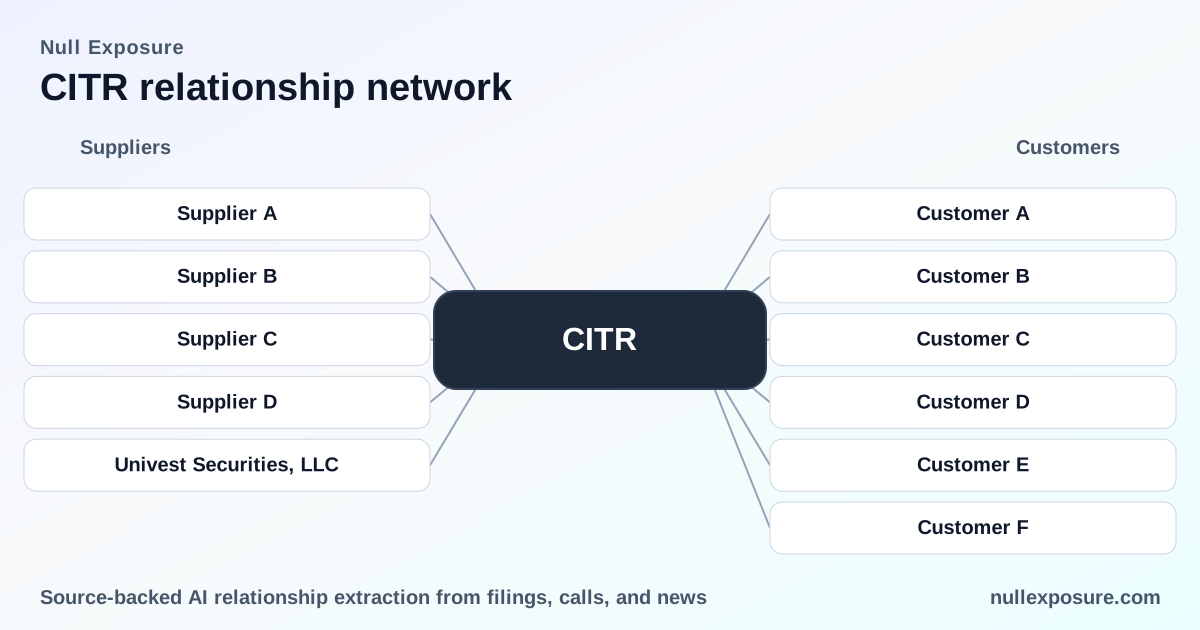
CitroTech (CITR) — Customer Map and Commercial Risks for Investors
Thesis — CitroTech operates as a single-product commercial vendor of non-toxic flame retardant and suppression solutions for residential and institutional fire protection, monetizing through direct sales, wholesale channels, and strategic partnerships with large users such as fire departments and insurers. Revenue generation is concentrated, sales are tied to pilots and proofs-of-concept, and working capital dynamics are exposed to a small set of counterparties; active monitoring of named customers and recent financing transactions is essential for credit-sensitive investors. For a consolidated view of counterparty exposures, visit https://nullexposure.com/.
How CitroTech makes money and why customer mix matters
CitroTech sells one core product line — flame retardant and suppression systems — to homeowners, fire departments and commercial buyers, and distributes through retailers and wholesalers while partnering with insurance companies for broader deployment. The company's economics are driven by a narrow commercial base and by converting pilots into repeatable, larger-scale installations; therefore customer concentration directly translates into revenue volatility and collections risk. The FY2024 financials reflect early commercialization with modest revenue and negative operating margins, so customer-level cashflows are a material determinant of near-term liquidity.
Company-level operating constraints and business model implications
The company disclosure frames a clear operating posture:
- Seller-focused contracting posture. CitroTech markets and sells products directly and via partners to large users and consumers, positioning the company as the primary revenue originator in transactions (FY2024 10‑K disclosure).
- High customer concentration is a structural risk. Management states it “has relied heavily on a few customers” for commercialization and product testing; this creates material revenue and receivables concentration that investors must underwrite as a persistent risk factor (2024 Form 10‑K).
- Geographic footprint is North America. The company targets residential and institutional markets across the United States and Canada, with an operational focus in western states for homeowners and fire department work (FY2024 10‑K).
- Early commercial maturity. CitroTech is operating in proof-of-concept and pilot phases in multiple markets, signaling revenue growth dependent on successful scale-out of pilots (10‑K commentary on MFB Ohio proof-of-concept).
- Single-line revenue exposure. Management reports one line of business centered on CitroTech products, which concentrates product, regulatory and commercialization risk at the company level (10‑K).
These constraints should be treated as company-level signals that explain why customer-level exposures in the FY2024 accounts carry outsized importance to revenue stability and cash flow.
Customer ledger: the named counterparties that drive FY2024 results
Below are the named customers and the single noted financing counterparty disclosed in the FY2024 filing and subsequent public reporting. Each entry is a plain-English takeaway followed by the primary source.
Customer A — a major revenue driver in FY2024
Customer A accounted for 30.20% of CitroTech’s reported revenue in FY2024, making it the largest single revenue source for the year. According to CitroTech’s FY2024 Form 10‑K, this customer’s share is material to top-line performance.
Customer D — significant and persistent buyer with sizable receivables
Customer D generated 19.55% of revenue in FY2024 (32.65% in FY2023) and represented 49.77% of accounts receivable at December 31, 2024 (39.77% in 2023), indicating both revenue importance and concentrated collections exposure. These figures are reported in the company’s FY2024 10‑K.
Customer B — meaningful revenue and receivable exposure
Customer B contributed 13.68% of 2024 revenue and represented 21.08% of accounts receivable at year‑end 2024, signaling a notable working-capital concentration tied to this counterparty (FY2024 Form 10‑K).
Customer C — mid-sized revenue contributor
Customer C accounted for 10.30% of revenue in FY2024, a material but smaller contributor within the narrow customer base documented by management (2024 10‑K).
Customer E — a previous-year concentration that declined in 2024
Customer E recorded 44.19% of revenue in FY2023 and 53.82% of accounts receivable at year‑end 2023, but shows no corresponding percentage in the FY2024 revenue column, indicating a shift in revenue mix year-over-year as presented in the FY2024 10‑K.
Customer F — smaller revenue share but non-trivial receivable exposure
Customer F contributed 5.79% of 2024 revenue and accounted for 15.44% of accounts receivable at December 31, 2024, creating localized credit exposure even from a relatively modest revenue slice (FY2024 Form 10‑K).
EQS — a third-party buyer of a CITR-originated promissory note
EQS purchased a one-year senior convertible promissory note from CitroTech on February 10, 2025 for $1.5 million, bearing interest at 10% per annum, a financing transaction reported by GlobeNewswire in April 2026. This note sale represents a non-operating financing relationship that affected CitroTech’s cash position in early 2025 (GlobeNewswire, April 21, 2026).
What investors should watch next
- Receivables concentration is the proximate credit risk. Customer D and B together account for a very large share of receivables; collections performance from these counterparties will materially affect near-term liquidity. The FY2024 10‑K’s receivable breakdown should be monitored each quarter for deterioration or improvement.
- Customer turnover and pilot conversion. Customer E’s drop from a dominant 2023 position to absence in 2024 revenue highlights commercial volatility; investors should prioritize updates on pilot conversions (MFB Ohio) and renewal pipelines.
- Financing cadence and covenant exposure. The $1.5m promissory note sold to EQS is an example of how CitroTech shifts counterparty risk into financing; track the maturity and any conversion or default events tied to that instrument (GlobeNewswire disclosure).
Bottom line: concentrated revenue; pilots determine trajectory
CitroTech is a concentrated seller in an early commercial phase — a binary commercialization profile where a handful of counterparties determine short-term cash flow and strategic success. For risk-adjusted investors, ongoing disclosure on receivable collectability, pilot-to-scale conversion, and the status of third‑party financings such as the EQS note are the principal data points that move valuation and credit assumptions.
For an ongoing, consolidated view of CitroTech’s counterparty map and how it changes over time, visit https://nullexposure.com/ for live tracking and deeper counterparty analytics.