CompX International (CIX): Customer relationships shape concentration and stability
CompX International manufactures safety products and marine recreational components and monetizes through direct OEM contracts and distributor channels, primarily in North America. Revenue is driven by component sales to large original equipment manufacturers and recurring safety-product contracts, with notable concentration where a single government customer accounted for 21% of sales in FY2024. For a deeper view of these customer dynamics and supplier posture, visit https://nullexposure.com/.
How CompX makes money and why customer mix matters
CompX operates two complementary businesses: Security Products (locks, locking systems, security hardware) and Marine Components (components for recreational and commercial boats). The company sells direct to large OEMs through factory sales teams supported by engineers, and it routes a substantial portion of Security Products through distributors, which gives it both direct contractual relationships and channel-based volume. Financially, CompX is a cash-generative, dividend-paying small-cap industrial: trailing revenue roughly $158 million with an operating margin near 15% and a dividend yield around 5%, indicating mature cash return policy and steady earnings conversion (public filings and company profile through the latest quarter).
North America is the business footprint — with concentrated pockets of exposure
CompX reports point-of-destination sales that are heavily skewed to North America: the company discloses $153,982 to the United States, $9,227 to Canada, and smaller amounts to Mexico and other markets in its filings, reinforcing a North American operational focus and geographic concentration in demand. This footprint underpins both supply-chain simplicity (nearby customers and OEMs) and revenue cyclicality tied to North American industrial and marine markets. (CompX Form 10‑K, FY2024 / company filings through latest quarter.)
All reported customer relationships (what’s disclosed)
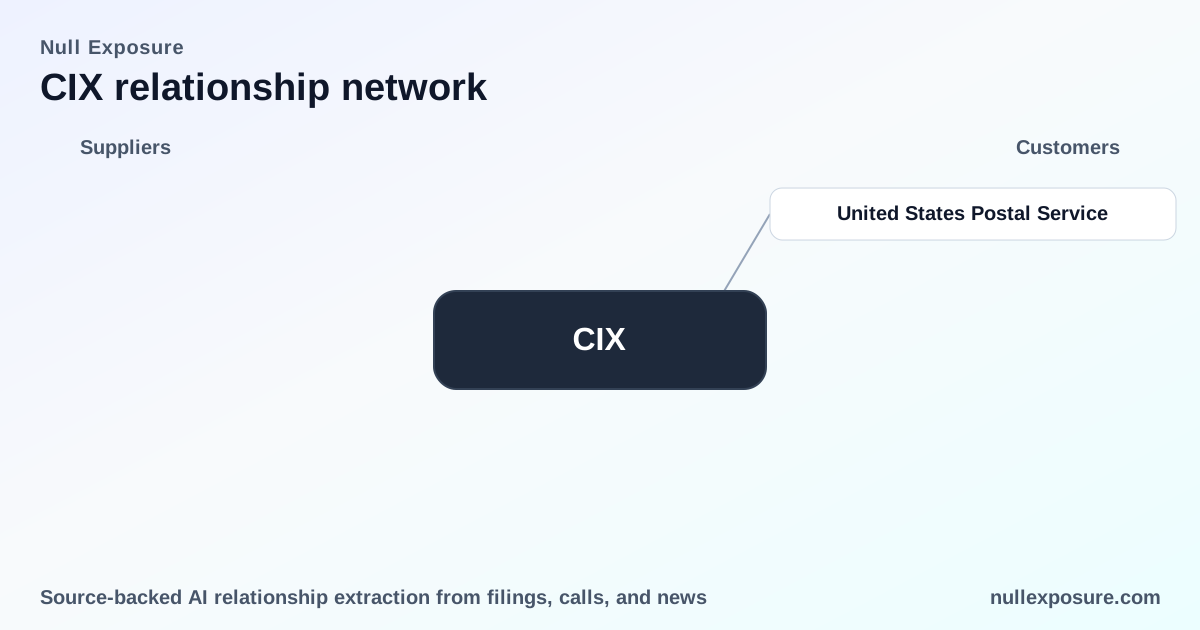
United States Postal Service
The United States Postal Service accounted for 21% of CompX’s sales in FY2024, the only single customer representing 10% or more of sales in the period. This relationship establishes a meaningful revenue concentration point and a government-contracting touchpoint for CompX. (According to CompX’s 2024 Form 10‑K, FY2024.)
What the filings and constraint signals tell investors about operating posture
The disclosures and extracted relationship signals together paint a consistent operating model and risk profile:
-
Contracting posture — hybrid direct and channel sales. CompX combines factory-based direct sales to large OEMs supported by engineers with distributor-led volume for Security Products, implying a mix of negotiated OEM contracts and reseller agreements that create both direct strategic customers and lower-margin channel distribution. (Company Form 10‑K disclosures describing factory sales staff and distributors.)
-
Concentration risk — material single-customer exposure. One government customer (the USPS) represents 21% of sales in FY2024, creating a high-concentration revenue risk in that segment; loss or step-down in USPS volumes would have a measurable impact on reported revenue. (CompX Form 10‑K, FY2024.)
-
Customer criticality — government contract importance. The presence of a major government buyer elevates contract-level scrutiny, performance standards, and potential for multi-year procurement cycles; for CompX, government revenue is sufficiently material to drive company-level sensitivity to procurement timing and program renewals. (Disclosure noting USPS share in FY2024.)
-
Geographic maturity and exposure. CompX’s sales are predominantly North American, which simplifies market dynamics but concentrates exposure to cyclical trends in the U.S. marine and industrial sectors. The geographic split in the filings confirms dominant U.S. demand with smaller footprints in Canada and Mexico. (CompX Form 10‑K net sales by destination.)
-
Business-model maturity and cash return. The combination of stable margins, positive EBITDA, and a consistent dividend indicates a mature operating profile; governance and insider ownership metrics in public filings correspond with a company returning cash to shareholders rather than pursuing aggressive growth investments. (CompX public financial profile, latest quarter.)
Operational caveats drawn from the filings
CompX explicitly tied part of the 2024 sales decline to the absence of follow-on shipments from a pilot project that shipped in late 2023, which indicates revenue volatility where pilot-to-production conversion is not guaranteed. This is a company-level signal that pilot program timing and order cadence can materially affect year-over-year sales, particularly in government/security product lines. (CompX Form 10‑K commentary on sales decreases vs. 2023.)
Additionally, CompX’s go-to-market mix—direct OEM engagements plus distributor sales—creates mixed margin dynamics and reliance on distributor inventory management, which investors should model when projecting gross margins and working capital. (Management description of factory-based sales, engineers, and distributors in filings.)
Investment implications and risk-reward view
-
Upside drivers: Stable cash flow, attractive dividend yield, and modest valuation multiples (trailing P/E mid-teens, EV/EBITDA ~9) support a total-return thesis if core OEM relationships and distributor channels remain intact and pilot programs convert to repeat orders. (Company financials and valuation metrics, latest filings.)
-
Primary risks: Customer concentration (USPS at 21%), pilot-to-production uncertainty, and North American demand cyclicality represent the most material downside vectors. A reduction in government or towboat-market demand would pressure revenue and leverage. (Form 10‑K disclosures on customer concentration and pilot shipments.)
For investors tracking customer-credit and contract risk, the CompX profile is a classic small-cap industrial case: durable core business with meaningful single-customer concentration and channel complexity. If you require a centralized view of customer-credit signals and contract posture across small industrials, consider an enterprise-level subscription; learn more at https://nullexposure.com/.
Bottom line
CompX generates predictable cash and returns but carries concentrated revenue exposure to at least one large government customer and operational sensitivity to pilot conversions and North American market cycles. Investors should underwrite scenarios where government procurement timing and distributor dynamics swing revenue, while valuing the firm’s steady margins and dividend as buffers against cyclical dips.