Colombier Acquisition Corp. II (CLBR): Active SPAC with Emerging Fintech Customer Relationships
Colombier Acquisition Corp. II (CLBR) is organized as a SPAC that creates shareholder value by sourcing and merging with high-growth targets in technology and healthcare, collecting cash in trust and monetizing through post-close equity appreciation or sponsor economics. Recent public disclosures show the company also operates or supports fintech payment solutions that are already servicing marketplace merchants and specialty buyers — an operational layer that moves CLBR beyond pure deal origination into recurring transactional revenue potential. For a focused look at the customer relationships disclosed by management, see Null Exposure’s coverage: https://nullexposure.com/.
How CLBR monetizes today — SPAC economics plus payments revenue potential
By structure, CLBR’s core business model is classic SPAC economics: raise capital via an IPO, seek a target, and capture value through a combination of transaction fees, equity rollover, and post-merger operational upside. CLBR’s public financial snapshot reflects that stage: Revenue TTM is listed at $0, consistent with a pre-deal SPAC, while market capitalization is roughly $366m and institutional ownership is high at ~85.6%, indicating concentrated professional investor interest.
Concurrently, management disclosed operational fintech activity on the 2025Q1 earnings call, where they described payment processing and cancel-proof fintech services deployed to marketplace merchants and bulk purchasers. That shift creates a dual pathway to monetization: the traditional SPAC transaction funnel plus transaction-level fees and one-off bulk sales driven by the fintech stack.
For more context on these customer relationships and how they inform CLBR’s revenue mix, see coverage at https://nullexposure.com/.
Customer roll call — who management says is transacting with CLBR
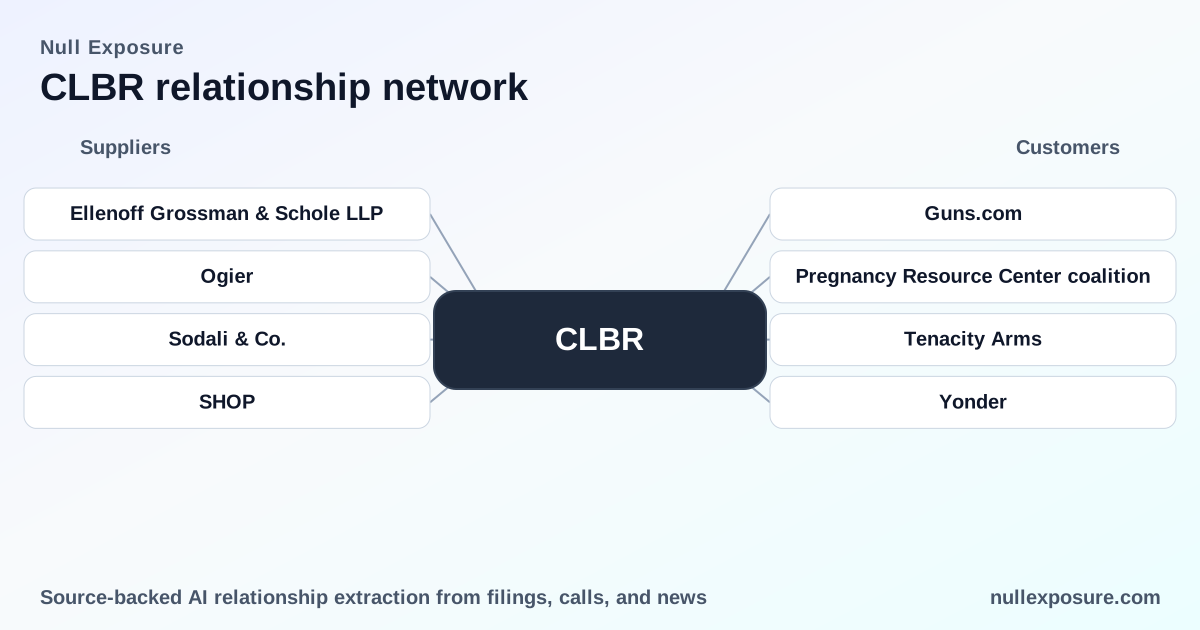
CLBR’s 2025Q1 earnings call includes four customer mentions. Each relationship below is summarized in plain language with the original disclosure source.
Guns.com
Guns.com engaged CLBR’s fintech services after being abruptly canceled by its ACH provider, and CLBR presented itself as a cancel-proof payments alternative for one of the largest digital marketplaces in the shooting-sports vertical. According to the CLBR 2025Q1 earnings call (disclosed March 7, 2026), this was highlighted as a major example of CLBR filling a market gap.
Tenacity Arms
Tenacity Arms was cited as another merchant helped by CLBR’s fintech products following a cancellation event, underscoring CLBR’s focus on highly specialized marketplace customers that require resilient payment rails. Management included Tenacity Arms in the same earnings call description of merchants that received operational assistance (CLBR 2025Q1 earnings call, March 7, 2026).
Yonder
Yonder is identified as one of the top-performing marketplace merchants for PSQ Holdings, Inc. and the first marketplace merchant fully onboarded to CLBR’s payment processing stack, indicating a deeper integration and potential for recurring transaction flows. Management referred to Yonder’s integration during the 2025Q1 earnings call (March 7, 2026).
Pregnancy Resource Center coalition
Management reported a $2 million bulk order paid in full by a Pregnancy Resource Center coalition, described as the company’s largest single bulk sale to date and a sign of demand among non-marketplace institutional buyers. This transaction was disclosed on the 2025Q1 earnings call (March 7, 2026).
Operating model signals investors should weigh
The customer disclosures, together with CLBR’s SPAC profile, reveal several company-level operating characteristics investors must factor into valuation and risk assessment:
- Contracting posture — transactional and responsive. Management describes CLBR stepping in quickly after merchant cancellations, implying short-term, service-driven contracts and an operational posture that prioritizes speed and reliability over long-term negotiated relationships.
- Concentration risk at the customer and investor level. The named customers are a small number of specialized merchants and one bulk institutional buyer, which suggests early-stage revenue concentration if these relationships scale into operational income. On the investor side, institutional ownership is high (85.589%), indicating concentrated shareholder composition.
- Criticality of services — mission-critical payment rails for niche verticals. CLBR’s value proposition is framed as cancel-proof payments; for affected merchants, that capability is operationally critical and creates stickiness if executed reliably.
- Maturity — SPAC structure with emergent operating activity. Public financials show CLBR remains a SPAC (Revenue TTM = $0) even as management discloses operational activities; this combination signals a transitional maturity profile where investment returns depend on both successful M&A execution and nascent payment revenue scaling.
Investment implications and risk checklist
Investors should treat CLBR as a hybrid exposure: a SPAC with a nascent operational payments layer that introduces new upside and distinct risks.
- Upside: If payment-processing revenues scale, CLBR could convert one-off transactional wins into recurring fee income and improve post-merger operating metrics. The Yonder onboarding suggests the company can implement deeper integrations that create recurring volumes.
- Regulatory and reputational risk: Serving firearms marketplaces and politically sensitive organizations like pregnancy resource groups places CLBR in sectors subject to rapid policy or processor changes, increasing regulatory and counterparty risk.
- Customer concentration risk: Early customer list is small; a loss or non-renewal of any major merchant would materially affect near-term revenue potential.
- Execution risk of SPAC strategy: The core SPAC playbook — finding and closing a target — remains the primary value driver; operational payments activity is supplemental until it produces measurable top-line impact.
- Balance-sheet and valuation context: CLBR’s market cap (~$366m) and trailing PE (90.74) reflect market expectations that hinge on successful transactions or rapid operationalization of payments revenue; current reported RevenueTTM is 0.
What investors should watch next
- Announcements of a target merger or evidence that disclosed customers convert to sustained transaction volumes will change the valuation calculus.
- Any regulatory scrutiny of payment arrangements for regulated verticals or merchant cancellations reported in public press will be immediate risk signals.
- Quarterly disclosures showing actual payment-processing revenue or recurring fee schedules will be the most direct confirmation of the fintech strategy.
Bottom line
Colombier Acquisition Corp. II remains a SPAC by structure but is evolving operationally into providers of cancel-proof payment solutions for niche marketplace merchants and bulk institutional buyers. The customer list disclosed on the 2025Q1 earnings call — Guns.com, Tenacity Arms, Yonder, and a Pregnancy Resource Center coalition — indicates a deliberate focus on clients with acute payment-processing needs and potential for rapid monetization if volume builds. Investors should monitor transaction-level revenue disclosures and any announced merger targets to determine whether these early commercial relationships shift CLBR from a speculative SPAC play toward a more durable operating business. For ongoing tracking and deeper relationship analytics, visit https://nullexposure.com/.