Cleveland‑Cliffs (CLF): customer relationships that move the margin needle
Cleveland‑Cliffs operates as an integrated iron‑ore miner and North America‑focused steelmaker that monetizes primarily through product sales of flat‑rolled and slab steel to large industrial customers. Revenue is driven by a mix of short‑term fixed price contracts and spot sales into the North American automotive, infrastructure and distribution channels; strategic actions such as ending low‑margin off‑take arrangements and selective partnerships are changing realized pricing and EBITDA leverage. For investors assessing client concentration and commercial risk, the company’s disclosed customer relationships reveal a deliberate shift from off‑take dependence toward higher‑margin domestic sales and targeted alliance models. For a deeper look at customer risk mapping and commercial signals visit https://nullexposure.com/.
How Cleveland‑Cliffs sells and where that creates risk and optionality
Cleveland‑Cliffs reports that it sells principally into North America, with the United States representing the vast majority of product destination revenue. The company’s commercial posture is a mix of short‑term fixed price contracts (typically one year) and spot purchases through purchase orders, which creates both nimbleness to capture higher domestic prices and exposure to cyclical demand. The automotive industry is the company’s largest end market, so counterparties are large enterprises and demand is highly correlated with light vehicle production—a concentration that makes revenue and margins sensitive to cyclical swings.
Key operating model signals for investors:
- Contracting posture: short‑term and spot. The company notes that roughly 30–35% of flat‑rolled shipments are under fixed‑price arrangements after the Stelco acquisition, and these fixed contracts are typically one year in duration. Spot market sales are transacted via purchase orders, enabling quick repricing into stronger markets.
- Geography: North America‑centric. The U.S. drove the overwhelming share of revenue in recent years, creating exposure to U.S. manufacturing cycles and domestic pricing dynamics.
- Counterparty and segment concentration: large enterprise customers in automotive, infrastructure and distribution. This is material to revenue mix and pricing power.
- Seller role and relationship stage: active commercial sales. Cleveland‑Cliffs is the selling party across these relationships and continues to transact actively in the market.
- Regulatory and legacy integration effects. The company’s Stelco acquisition introduced new contractual mixes and regional regulatory costs—explicitly including carbon pricing obligations tied to Stelco’s emissions as disclosed in its 2025 Form 10‑K.
Customer relationship breakdown — what the public record shows
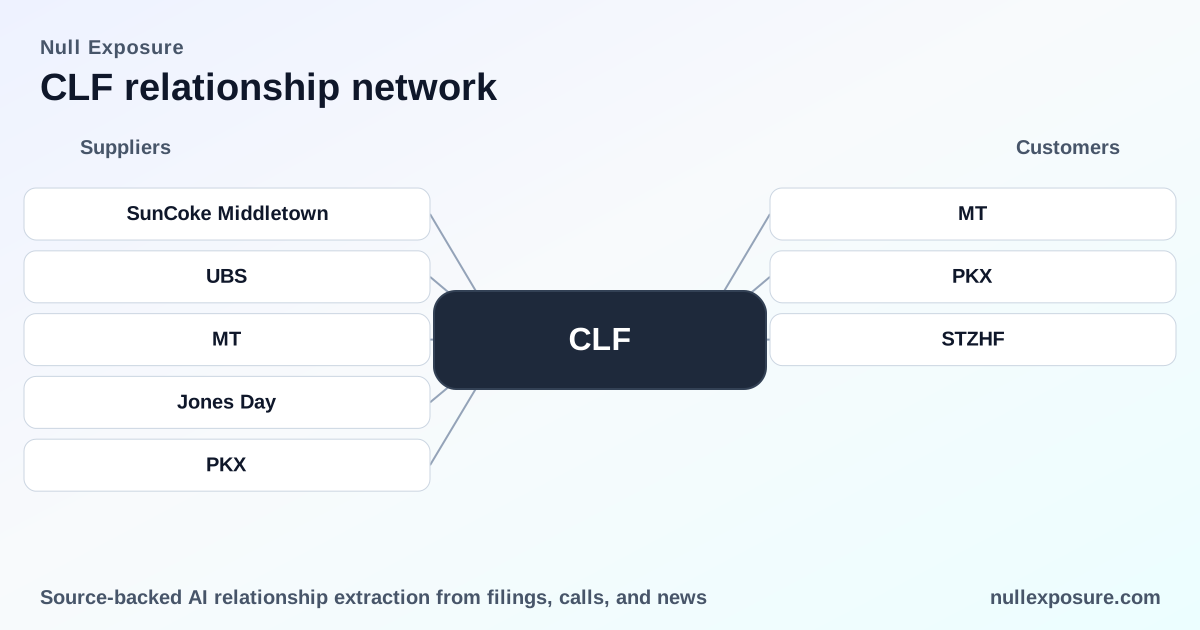
ArcelorMittal / MT — end of the slab supply contract unlocked pricing opportunity
Cleveland‑Cliffs ended a low‑margin slab supply contract to ArcelorMittal on December 9, 2025; S&P projected that selling those slabs into U.S. domestic markets could drive approximately $500 million of incremental annual EBITDA by capturing higher U.S. slab prices. A TS2 Tech report covering December 12, 2025 documented the end of the contract and the S&P estimate.
Source: TS2 Tech coverage of Cleveland‑Cliffs news and analyst commentary, December 12, 2025.
ArcelorMittal / MT — management framed the contract termination as a catalyst for 2026 margin improvement
CEO Lourenco Goncalves publicly pointed to the termination of the slab supply arrangement in early December and stated that the improvement in realized pricing was expected to accelerate into 2026, signaling management’s view that the commercial change is a structural margin lever. This comment was reported in TS2 Tech’s December 16, 2025 coverage of the company’s credit and market outlook.
Source: TS2 Tech report, December 16, 2025.
(Note: both the MT and ArcelorMittal entries in the record describe the same commercial event and are reported across multiple TS2 Tech pieces.)
POSCO / PKX — partnership to strengthen U.S. customer coverage and origin compliance
On the Q4 2025 earnings call, management described a partnership with POSCO that allows POSCO to support and grow its established U.S. customer base while ensuring products meet U.S. country‑of‑origin melted import requirements, effectively extending Cliffs’ commercial reach and addressing trade‑sensitive sourcing requirements. This arrangement functions as a strategic channel partnership that helps secure U.S. OEM and distributor business where origin rules are decisive.
Source: Cleveland‑Cliffs Q4 2025 earnings call transcript (clf‑2025q4‑earnings‑call), March 2026.
POSCO / PKX — the deal reinforces Cliffs’ distribution and compliance posture
The earnings call further frames the POSCO relationship as complementary to Cliffs’ distribution strategy: it supports customer retention and growth while preserving domestic origin credentials that are increasingly important to U.S. buyers. Investors should view the partnership as commercially defensive and distribution‑expansive.
Source: Cleveland‑Cliffs Q4 2025 earnings call (clf‑2025q4‑earnings‑call), March 2026.
Stelco / STZHF — acquisition creates new contract mix and regulatory exposures
In the company’s 2025 Form 10‑K, Cleveland‑Cliffs disclosed that the Stelco acquisition altered its contract mix such that roughly 30–35% of flat‑rolled shipments are sold under fixed‑price contracts, which are typically one year in duration and staggered over the year. The 10‑K also cites that governmental authorities may impose carbon pricing obligations or carbon taxes associated with Stelco’s emissions, flagging a direct regulatory cost line emerging from the acquisition.
Source: Cleveland‑Cliffs 2025 Form 10‑K (clf‑2025‑12‑31).
Stelco / STZHF — regulatory cost visibility tied to emissions is explicit in filings
The same 10‑K includes language that highlights the company’s exposure to potential mandatory carbon pricing mechanisms and emissions‑related taxes with respect to Stelco’s operations, making regulatory cost pass‑through and capital intensity important to model for that asset cluster. Investors should treat carbon‑costs related to Stelco as an explicit and quantifiable operational constraint disclosed by management.
Source: Cleveland‑Cliffs 2025 Form 10‑K (clf‑2025‑12‑31).
Investment implications: what these relationships mean for revenue, margin and risk
- Margin upside from contract rationalization — Ending the ArcelorMittal slab supply contract is a concrete commercial action that converts low‑margin committed volumes into higher‑priced domestic sales, producing clear EBITDA upside the market has quantified. That is a material positive for free cash flow if domestic demand holds.
- Short‑term commercial posture increases volatility — The company’s reliance on one‑year fixed contracts and spot purchase orders accelerates responsiveness to favorable price moves but also amplifies cyclicality in weaker markets given automotive exposure.
- Stelco integration introduces both diversification and regulatory cost — The acquisition shifted contract mix toward more fixed pricing and increased exposure to carbon pricing and taxes; investors must model these regulatory costs explicitly for the Stelco footprint.
- Strategic partnerships stabilize distribution channels — The POSCO arrangement strengthens U.S. customer coverage and origin compliance, which is an operationally defensive move that preserves share in trade‑sensitive segments.
For investors prioritizing customer‑level risk, the net signal is directional: Cleveland‑Cliffs is reducing low‑margin contractual drag, positioning more supply for domestic higher‑price realization, and shoring up distribution through partnerships—while absorbing regulatory and cyclical risks tied to Stelco and the automotive market.
If you want a structured, client‑level exposure map for CLF that ties counterparties to specific contract types and regulatory exposures, NullExposure offers investor‑grade relationship intelligence at https://nullexposure.com/.
Bottom line
Cleveland‑Cliffs is executing commercial moves that materially reprice inventory and contracted volumes, shifting the company toward higher‑margin domestic sales and bolstering distribution through partnerships. Investors should track realized slab pricing trends, the pace of fixed‑contract renewal, automotive demand indicators, and Stelco‑related carbon cost developments to model both upside and downside risk.