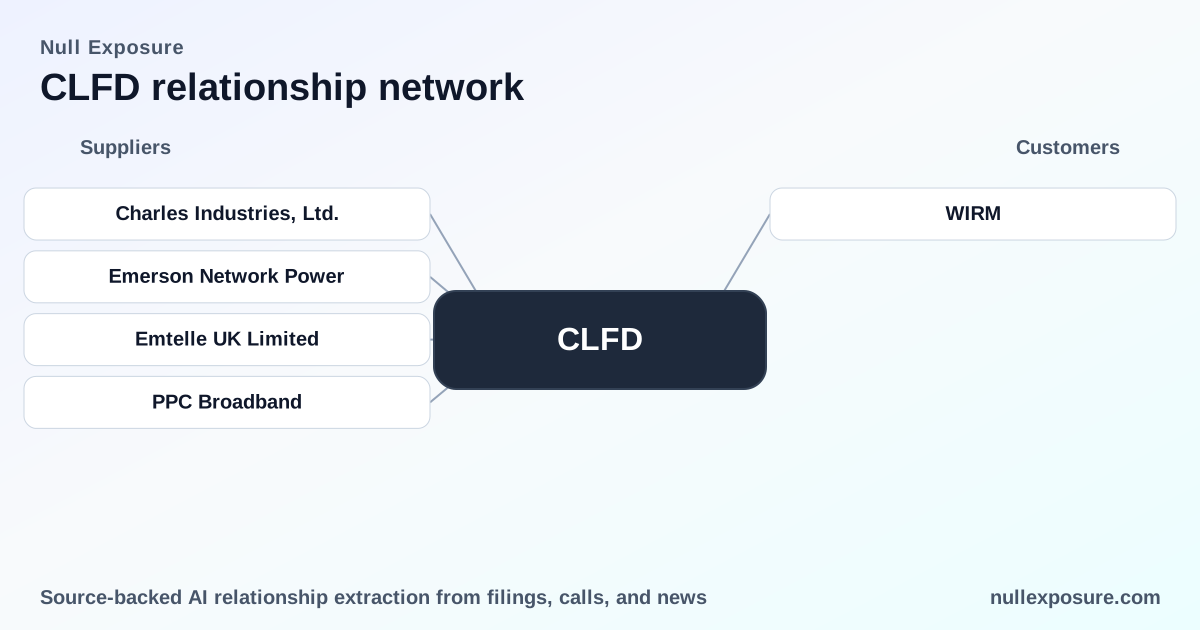
Clearfield (CLFD): Customer Footprint and What It Means for Investors
Clearfield manufactures and sells passive fiber connectivity and management products to OEMs, enterprises, broadband service providers and distributors; it monetizes through product sales across direct service-provider channels and distributor partners, with near-term revenue driven by short-term contracts and project-based demand. Investors should view Clearfield as a manufacturing-centric, channel-driven supplier whose growth is tied to broadband buildouts, tier‑one service-provider procurement cycles, and distributor relationships. For a deeper view of customer exposures and channel dynamics, see https://nullexposure.com/.
How Clearfield actually makes money and why customer relationships matter
Clearfield operates a single reportable manufacturing segment that designs and ships fiber protection, management and delivery solutions. Revenue recognition is transaction-focused: substantially all sales contracts have a single performance obligation and are short term in nature, so sales are realized quickly but are exposed to quarter-to-quarter variability. The company sells throughout North America and internationally, relying on both direct service-provider relationships and distributor channels; that hybrid model drives the tradeoff between market reach and concentration risk.
Key operating characteristics to track: short-term contracting posture (limits multi-year revenue visibility), channel concentration (distributors represent a material share of sales), geographic breadth (North America-first with international distribution), and manufacturing-centered execution (single segment simplicity). These are fundamental signals for valuation and risk assessment.
Customer landscape — who Clearfield sells to today
Below I summarize each customer relationship surfaced in the available records and provide the primary source for each mention.
CoLogic
CoLogic is cited as an example customer that requires high-density fiber solutions, indicating Clearfield’s product-market fit for complex, capacity-dense installations. According to the Q1 FY2026 earnings call transcript published on InsiderMonkey (May 2026), management referenced CoLogic in the context of customers evaluating high-density requirements.
South Dakota Networks
South Dakota Networks is named alongside CoLogic as a customer focused on high-density deployment planning, underscoring Clearfield’s relevance to regional broadband operators upgrading capacity. This mention comes from the same Q1 FY2026 earnings call transcript on InsiderMonkey (May 2026).
Verizon (VZ)
Verizon is identified as one of Clearfield’s large tier‑one customers, and management is actively working to optimize the procurement engagement with Verizon — a signal that winning deeper access to Verizon’s buying process could materially affect order patterns. This observation is taken from the Q1 FY2026 earnings call transcript published on InsiderMonkey (May 2026).
WireMasters
Clearfield recently added WireMasters as a distribution partner; WireMasters has begun distributing Clearfield’s fiber connectivity and management products with an emphasis on defense and aerospace markets, representing an expansion of Clearfield’s channel reach into specialized, possibly higher-margin end markets. This detail comes from Clearfield’s Q4 FY2025 earnings call transcript (March 2026).
WIRM (WireMasters ticker)
The same announcement is also logged under the ticker WIRM, reiterating that WireMasters (WIRM) is an active distribution partner expanding Clearfield’s global distribution footprint. The Q4 FY2025 earnings call transcript (March 2026) documents this distribution relationship.
Frontier (FRNTQ)
Frontier is described as a customer for whom Clearfield has been a key supplier, indicating ongoing order flow into the service-provider channel and exposure to Frontier’s network upgrade projects. This was noted on the Q1 FY2026 earnings call transcript published on InsiderMonkey (May 2026).
What the customer mix implies for investment risk and opportunity
- Revenue variability is structural. Because the company states that substantially all sales contracts are short-term with single performance obligations, quarter-over-quarter revenue will track project timing and procurement cycles rather than long-term contracts.
- Concentration exists through distributors. For FY2025 Clearfield disclosed two distributor customers that together accounted for roughly 31% of net sales (18% and 13%), signaling material exposure to a small number of channel partners; that is a company-level concentration signal, not tied to a named customer in the excerpts.
- Service-provider relationships are critical. Tier‑one customers like Verizon and larger service providers such as Frontier drive volume and seasonality; procurement optimization at those customers can directly influence Clearfield’s topline.
- Channel expansion into defense/aerospace is a growth vector. The WireMasters distribution arrangement targeting defense and aerospace opens non-traditional end markets and could diversify revenue mix if execution scales.
- Geographic posture is mixed but North America-first. The company sells internationally while emphasizing North America and broadband service providers, which supports steady addressable demand but concentrates regulatory/market risk in NA infrastructure cycles.
- Manufacturing simplicity reduces segment complexity. Operating a single reportable manufacturing segment simplifies cost structure analysis but increases exposure to input costs and factory utilization.
Investment takeaways
- Bull case: Broadband capex tailwinds and successful deeper penetration into tier‑one procurement processes (e.g., Verizon) or expanded defense/aerospace distribution (WireMasters) can drive durable growth without a large change in product mix.
- Bear case: Short-term contracts and distributor concentration create topline volatility; a slowdown in major service-provider spend or the loss of a large distributor would materially pressure results.
- Near-term monitoring checklist: procurement progress with Verizon, order cadence from Frontier and regional operators (e.g., South Dakota Networks), distributor order levels (Customer A/Customer B proxy), and execution within WireMasters’ defense/aerospace channel.
For a targeted dive into Clearfield’s customer signals and channel exposure, visit https://nullexposure.com/ for the full suite of relationship intelligence.
Bottom line
Clearfield is a focused manufacturer whose commercial success depends on channel management and timing of service-provider projects. Investors should price in higher short-term revenue variability but also recognize that securing deeper procurement access at tier‑one customers and scaling new distribution channels can re-rate the business. Further due diligence should prioritize order-book detail, distributor concentration trends, and the cadence of tier‑one procurement wins.