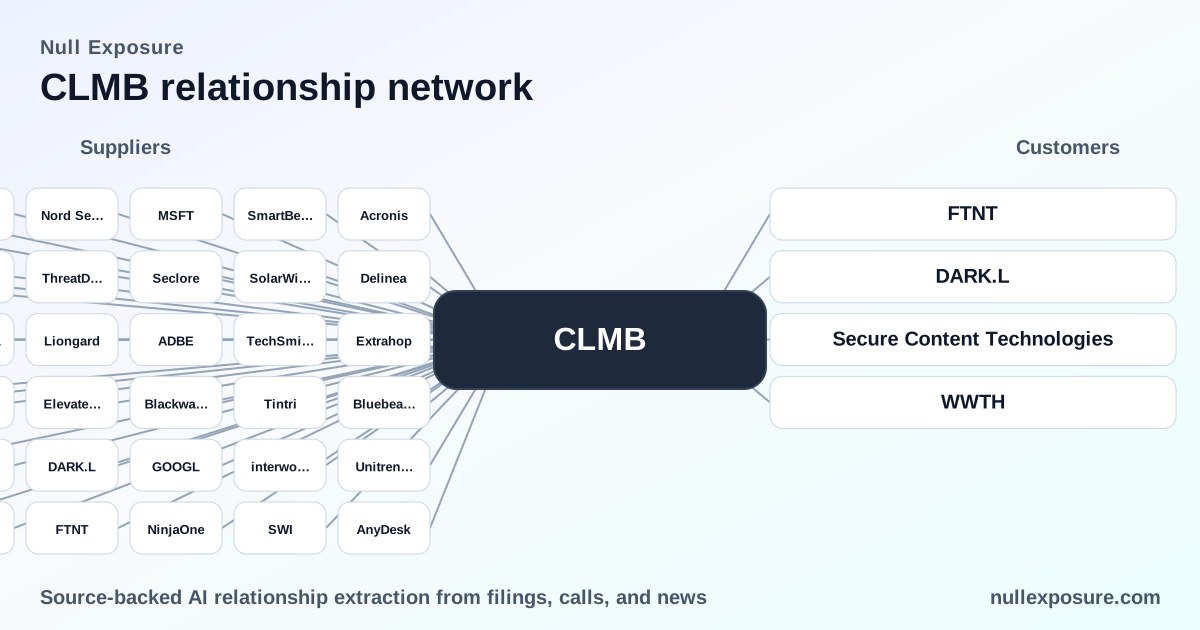
Climb Global Solutions (CLMB): Customer relationships that drive distribution economics
Climb Global Solutions is a technology distribution and supply-chain operator that monetizes by reselling third‑party software, hardware and maintenance through a mix of direct distribution and value‑added services to resellers, systems integrators and enterprise customers. Revenue flows from a combination of large recurring renewals (subscriptions and maintenance), transactional license sales, and drop‑ship hardware transactions, with the Distribution segment accounting for the vast majority of gross sales. For an investor, the thesis is simple: Climb converts vendor partnerships and channel relationships into sticky, repeated cash flows, while concentration among top customers amplifies both upside and idiosyncratic risk. Learn more at NullExposure.
How Climb actually contracts with customers — what the filings tell you
Climb’s operating model is a classic channel distribution blend rather than a pure software vendor. Company disclosures and earnings commentary show a consistent set of commercial characteristics that drive revenue recognition and risk profiles:
- Contracting posture: Climb sells a high volume of third‑party software subscriptions and maintenance where, for monthly subscription arrangements, the company acts as an agent and recognizes revenue on a net basis. Company filings describe license authorizations, maintenance contracts and vendor drop‑ship hardware as the dominant product mix.
- Revenue mix and pricing mechanics: The business combines subscription/usage‑based billing, fixed licensing and transactional hardware—the coexistence of these models creates recurring revenue while preserving large transactional spikes when resellers fulfill customer projects.
- Customer concentration and criticality: Climb discloses that its top five customers accounted for 54% of consolidated net sales in 2024, signaling that large resellers materially influence revenue volatility but also offering concentrated, contractable renewal streams.
- Channel and counterparty makeup: The customer base spans large enterprise resellers, thousands of VARs, government resellers, system integrators and national IT superstores, indicating wide industry reach and multiple buyer archetypes.
- Geography and segment dominance: The Distribution segment drives roughly 95% of consolidated net sales and operates worldwide, while Solutions (Grey Matter) represents services-led, value‑added delivery.
- Relationship maturity: A significant portion of revenue arises from annual recurring renewals of maintenance and subscription agreements, indicating renewal dynamics and embedded installed bases are central to predictability.
These are company-level signals drawn from filings and recent earnings commentary and should frame any client‑level analysis of Climb’s customers.
The customer relationships that matter (what Climb names and what that implies)
Fortinet — strategic cybersecurity vendor partnership
Climb publicly launched a partnership with Fortinet in December, positioning Fortinet’s network and security solutions into Climb’s channel distribution footprint. According to Climb’s Q4 2025 earnings call transcript, the Fortinet alliance is described as a recently launched partnership that expands Climb’s cybersecurity offering to resellers and government customers. (Q4 2025 earnings call, March 2026)
Secure Content Technologies — long‑standing VAR relationship with strategic tone
Secure Content Technologies, a cybersecurity VAR, has worked with Climb for several years; the VAR’s CEO characterized the relationship as a true business partnership, signaling a deeper reseller‑distributor engagement beyond simple order flow. This coverage was reported in Channel Insider in FY2024 when discussing Climb’s channel reach and recent acquisitions. (Channel Insider, FY2024)
Darktrace — early‑stage but material cybersecurity distribution
Climb noted that Q4 2025 was only the second full quarter since kicking off its relationship with Darktrace, the AI‑driven cyber detection vendor, marking the introduction and initial scale of that partnership through the distribution channel. That timeline was discussed during Climb’s Q4 2025 earnings call. (Q4 2025 earnings call, March 2026)
World Wide Technology (WWT) — large reseller counted among strategic customers
Climb’s management explicitly referenced WWT—a $30 billion reseller—as one of our customers and “one we have great relationships with,” underlining WWT’s role as a strategic, large‑enterprise reseller client referenced in Q4 2025 commentary and captured by media transcripts. (Earnings transcript coverage in InsiderMonkey and The Globe and Mail, Q4 2025 / FY2026 reporting)
What these relationships imply for revenue quality and risk
Together, the relationships above outline a clear operating dynamic:
- Upside via cybersecurity vendors. Partnerships with Fortinet and Darktrace expand Climb’s addressable market in high‑value security software and managed services, improving gross margin mix over time as subscription and maintenance revenue grows.
- Distribution stickiness through resellers. Long‑standing VAR partnerships like Secure Content Technologies and anchor reseller relationships with WWT demonstrate the channel model’s embeddedness—resellers rely on Climb for vendor access and logistics, which supports renewal economics.
- Concentration amplifies both predictability and volatility. With top customers representing a large share of sales, success in scaling new vendor relationships will materially improve revenue if adopted by those large resellers; conversely, any contract loss would be immediately meaningful.
- Contract mix dictates cash conversion. The coexistence of subscription/usage‑based, licensing and drop‑ship hardware sales means cash flow timing is lumpy but underpinned by recurring maintenance and subscription renewals.
Portfolio implications and what to watch next
For investors and operators evaluating CLMB customer relationships, prioritize these monitoring points:
- Track renewal rates and reported share of subscription/maintenance revenue in quarterly filings; renewal cadence is the clearest signal of revenue durability.
- Watch vendor onboarding timelines (e.g., Fortinet, Darktrace) and reseller adoption rates—management commentary on “full quarters” since relationships began is a primary forward indicator of scale.
- Monitor top‑customer concentration trends in the 10‑K/10‑Q disclosures; any movement away from or toward concentrated customer exposure will materially change risk profile.
- Observe margin mix shifts between Distribution and Solutions segments to see whether higher‑margin services scale.
If you want periodic, relationship‑level alerts and deeper signal extraction for CLMB, visit NullExposure for structured monitoring and transcript capture.
Bottom line — concentrated channel strength with cyber tailwinds
Climb’s commercial model is a highly channelized distribution engine: it packages vendor products for resellers, monetizes through a blend of subscriptions, licenses and hardware, and leverages deep reseller relationships to drive recurring renewals. The company’s strategic onboarding of cybersecurity vendors like Fortinet and Darktrace, combined with enduring reseller partnerships such as Secure Content Technologies and WWT, positions Climb to increase recurring revenue mix and margin quality. At the same time, top‑customer concentration and mixed contract mechanics create idiosyncratic exposure that demands active monitoring by investors. Overall, Climb’s customer relationships are a clear source of both strategic leverage and measurable risk.