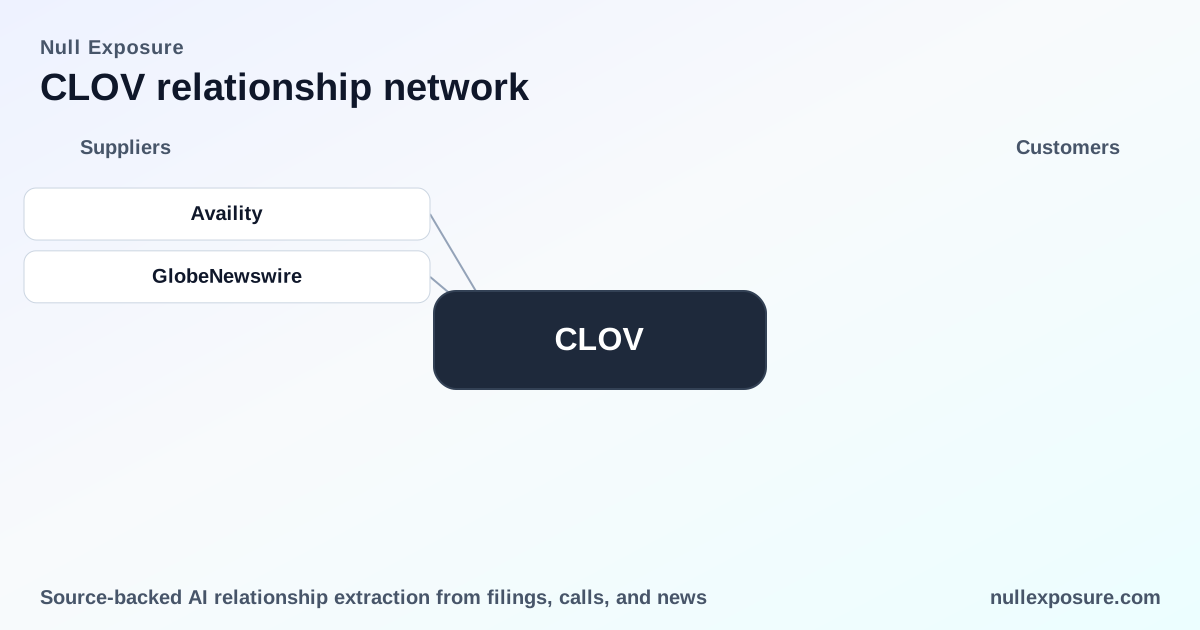
Clover Health (CLOV): Customer Relationships that Define Revenue Streams and Operational Risk
Clover Health operates Medicare Advantage plans and sells related software-enabled services to payors and providers; it monetizes through insurance premiums for PPO/HMO plans and an emerging SaaS and tech-enabled services business (Counterpart Health) that licenses the company’s clinician-facing AI (Clover Assistant) to external customers. Revenue is therefore a mix of government-funded premium flows and commercial software/service contracts, with Medicare collections and B2B licensing shaping cash flow stability and strategic optionality. For a concise view of counterparties and implications, see https://nullexposure.com/.
High-level investment thesis
Clover’s core insurance business generates scale revenue from Medicare Advantage members in a limited number of states and counties, while Counterpart Health represents a higher-margin, faster-scaling revenue vector as the company licenses clinical decision tools externally. The business blends the stability of government-backed premium receivables with the growth and margin optionality of SaaS licensing, but political/regulatory exposure and concentration in MA are material risk factors.
Visit https://nullexposure.com/ for additional counterparty and exposure analytics.
Customer relationships identified in external coverage
The coverage set is small but instructive: one reseller/partner referenced in a corporate call transcript and two press mentions tying a regional bank to use of Clover’s business management technology. Each relationship is summarized below.
PRTH — Priority Technology Holdings, Inc. (reference in FY2025 transcript)
Priority Technology’s public remarks identify itself as “one of [Clover’s] larger resellers” and note stable point-of-sale trends specific to Clover, implying an ongoing reseller/channel relationship that helps distribute Clover’s products or services through third-party sales channels. Source: Q3 2025 earnings call transcript published on InsiderMonkey (first seen 2026‑03‑10): https://www.insidermonkey.com/blog/priority-technology-holdings-inc-nasdaqprth-q3-2025-earnings-call-transcript-1641887/
Takeaway: This disclosure supports the presence of reseller/channel distribution for Clover’s commercial offerings (likely Counterpart Health/SaaS), which broadens go-to-market reach but introduces third-party concentration and execution risk.
WASH — Washington Trust Bancorp (two press references; FY2025 & FY2026 context)
Washington Trust announced use of Clover’s business management technology in press releases, with references across two articles citing an adoption decision (documents surfaced in materials tied to FY2025 and FY2026 periods). The language indicates a customer deployment of Clover’s external-facing technology offering rather than an insurance relationship. Source examples: Marketscreener items noting Washington Trust’s planned use of Clover’s business management technology (first seen 2026‑03‑10):
- FY2026 reference: https://www.marketscreener.com/news/washington-trust-announces-date-of-fourth-quarter-2025-earnings-release-conference-call-and-webcast-ce7e58ded088f721
- FY2025 reference: https://www.marketscreener.com/news/washington-trust-bancorp-keeps-quarterly-dividend-at-0-56-a-share-payable-jan-14-to-shareholders-ce7d50dcde80f52c
Takeaway: Washington Trust’s adoption underscores Clover’s traction selling technology and services to non-healthcare institutions or cross‑industry partners, supporting the growth thesis for Counterpart Health but signaling that early commercial wins are institutionally concentrated and discrete.
How these relationships map to Clover’s operating model
The relationships above are consistent with Clover’s stated strategy to commercialize its clinical intelligence through Counterpart Health and to distribute via resellers and direct institutional customers. From a contracting and operational posture perspective, the company exhibits the following characteristics:
- Contracting posture — hybrid: government and commercial. The company’s top-line relies on premium payments for Medicare Advantage members (government-funded), while Counterpart Health contracts are commercial software or tech-enabled service agreements with payors, providers, and non-traditional buyers. This mix yields predictable revenue from CMS receivables alongside growth-dependent, contractually varied software revenue.
- Counterparty concentration and criticality. Company-level signals show significant reliance on government payors, with the majority of receivables linked to CMS, indicating very limited credit risk on collections but high regulatory and reimbursement concentration. Commercial relationships (resellers like PRTH and institutional customers like WASH) provide distribution and expansion, but are fewer and more concentrated at this stage.
- Geographic and customer base focus. Clover operates Medicare Advantage plans in a limited set of states and ~200 counties, concentrating insurance risk regionally while its software is positioned for broader adoption. This geography limits diversification of insurance premium risk but focuses operating scale.
- Product maturity gradient. The Insurance segment is mature as the company’s flagship revenue engine (PPO/HMO), while Counterpart Health (launched in 2024) is an earlier-stage, higher-margin software and tech-enabled services line that licenses Clover Assistant externally — a licensor role that increases recurring, SaaS-like revenue potential as adoption broadens.
- Revenue stream characteristics. Insurance revenue is recurring and heavily tied to government flows; software/services revenue is contract-driven, scalable, and dependent on channel partners and direct enterprise sales effectiveness.
Investment implications: where upside and risk live
- Upside: Successful commercialization of Counterpart Health would materially improve margins and diversify revenue away from MA premium cyclicality; reseller partnerships (PRTH) and institutional adopters (WASH) validate go-to-market channels.
- Risk: High regulatory and reimbursement concentration through CMS introduces policy sensitivity to margins and cash flow. Early-stage software adoption creates customer concentration risk and execution dependence on resellers and enterprise sales. The balance of government-backed receivables and nascent SaaS revenue makes near-term EBITDA improvement possible but not guaranteed.
- Operational priorities to watch: contract terms and renewal cadence for SaaS agreements, reseller pipeline and concentration metrics, geographic expansion of MA plans, and any CMS regulatory changes affecting MA reimbursement.
Bottom line and how to monitor next moves
Clover combines a stable, government-funded insurance core with a high-potential but nascent SaaS/service arm that sells clinical intelligence externally through resellers and direct institutional customers. Investor focus should center on growth and margin trajectories for Counterpart Health, the durability and scale of reseller channels, and any changes to CMS collection dynamics.
For a structured counterparty map and to track how these and other relationships affect exposure and revenue composition, consult our coverage at https://nullexposure.com/.
Bold takeaway: Clover’s valuation hinges on executing software commercialization while preserving margin stability in a government-concentrated insurance book; the PRTH and WASH references are early confirmations of that strategic pivot.