Clipper Realty (CLPR) — Tenant concentration, lease drama, and what it means for investors
Clipper Realty is a New York City–focused residential REIT that monetizes through rental income from multifamily apartments and commercial leases, and by actively managing and repositioning properties to boost net operating income. The company's cash flow is rental‑driven, with about three quarters of revenue from residents and a meaningful slice from municipal commercial tenants, making tenant mix and lease renewals primary drivers of near‑term valuation. For background research or portfolio monitoring, see NullExposure’s coverage at https://nullexposure.com/.
The operating profile investors need to hold front of mind
Clipper runs a highly concentrated, urban portfolio limited to Manhattan and Brooklyn, creating exposure to local economic cycles and municipal tenancy decisions. Apartment leases are predominantly short‑term (one‑year), which supports pricing flexibility but increases churn and leasing cost risk. Commercially, Clipper is both landlord and service operator—it records lease income as lessor under ASC 842, and government tenants are material: the City of New York has historically accounted for around a fifth to a quarter of revenues. These are company‑level signals drawn from SEC filings and company commentary; where the record explicitly names New York City, that detail is reflected below in the relationship entries.
Detailed relationship log (each result in the record)
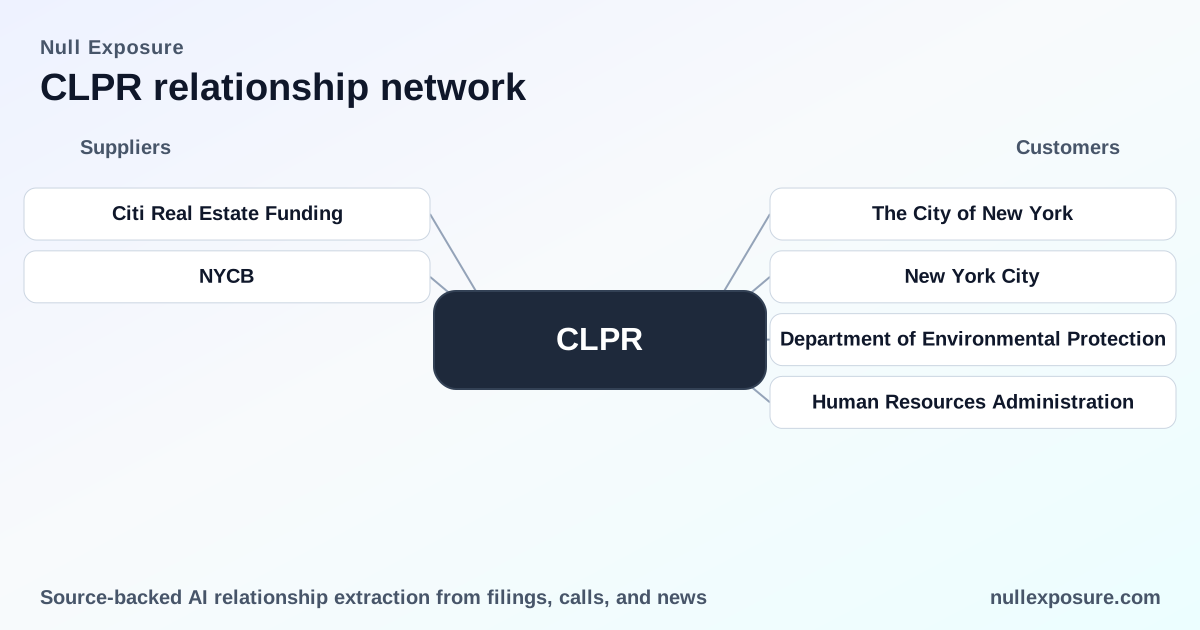
The City of New York — FY2024 (10‑K)
Clipper disclosed in its FY2024 10‑K (Note 5) that two commercial leases with The City of New York comprised approximately 22% of total revenues for the year ended December 31, 2024. This is a material concentration, directly called out in the company filing. (Source: Clipper Realty 2024 Form 10‑K, Note 5)
New York City — FY2025 (TradingView news item)
TradingView reported that Clipper is pursuing solutions for the vacated 250 Livingston Street property while securing a five‑year renewal at 141 Livingston Street, indicating an active shift in the company’s municipal tenancy profile. (Source: TradingView news report on Clipper Q3 2025 results, published May 2026)
New York City — FY2026 (StockTitan / Q4‑2025 coverage)
A StockTitan item noted that after New York City terminated its lease at 250 Livingston Street in mid‑August, the building’s principal remaining revenue shifted to 36 residential units, underscoring revenue loss at that specific office asset. (Source: StockTitan news item covering Clipper Q4 2025, March 2026)
New York City — FY2024 (TheRealDeal)
TheRealDeal reported that the City was set to vacate 93% of the net rentable area at 250 Livingston Street, a development that Fitch Ratings also flagged and that precipitated re‑underwriting of that asset’s income profile. (Source: TheRealDeal, April 25, 2024)
New York City — FY2025 (InsiderMonkey transcript of Q2‑2025 earnings)
An earnings‑call transcript published by InsiderMonkey records management saying New York City renewed a lease at 141 Livingston Street for five years while vacating 250 Livingston, and that Clipper was negotiating with its lender on options for the vacated asset. (Source: InsiderMonkey Q2‑2025 earnings call transcript)
New York City — FY2026 (InsiderMonkey transcript of Q4‑2025 earnings)
Management confirmed during the Q4‑2025 call that lender claims at 141 Livingston Street were settled and lender approval was obtained for a five‑year extension with New York City, validating that asset’s immediate cash‑flow recovery. (Source: InsiderMonkey Q4‑2025 earnings call transcript)
Department of Environmental Protection — FY2024 (TheRealDeal)
TheRealDeal noted Clipper had signed leases with the city’s Department of Environmental Protection less than four years before the city announced terminations at 250 Livingston, indicating the REIT’s prior success placing municipal agencies in its buildings. (Source: TheRealDeal, April 25, 2024)
Human Resources Administration — FY2024 (TheRealDeal)
TheRealDeal also reported that Clipper had inked leases with the Human Resources Administration in recent years, demonstrating that multiple municipal agencies were tenants across the Livingston portfolio. (Source: TheRealDeal, April 25, 2024)
New York City — FY2026 (Investing.com transcript coverage)
Investing.com’s transcript of Clipper’s Q4‑2025 earnings reiterated that lender claims at 141 Livingston Street were resolved and a five‑year lease extension with New York City was approved by lenders—concrete progress on stabilizing that asset. (Source: Investing.com earnings‑call transcript, Q4‑2025)
New York City — FY2026 (m.in.investing.com AMP)
An alternate Investing.com AMP feed repeats management’s statement on lender settlement and lender‑approved five‑year extension at 141 Livingston Street, corroborating the prior transcript and showing consistent public messaging. (Source: m.in.investing.com AMP earnings‑call transcript)
Equinox Tribeca Inc. — FY2025 (TradingView / 10‑Q)
Clipper amended the lease with Equinox Tribeca Inc. at the Tribeca House property on September 25, 2025, extending the term to August 31, 2040, increasing rent and granting a renovation allowance—a long‑dated, income‑enhancing commercial lease amendment. (Source: TradingView summary of Clipper SEC 10‑Q, September 2025)
What these customer relationships imply for valuation and risk
-
Concentration risk is real and measurable. The City of New York historically accounted for roughly 16–23% of revenues across reported periods, and the 250 Livingston vacancy removed a large, concentrated income stream. That single‑tenant shift materially alters near‑term cash flow assumptions and increases leasing and redevelopment risk for that asset. (Source: Clipper 10‑K FY2024; company earnings calls Q2 and Q4 2025)
-
Lease maturity mix is mixed: short‑term residential cash flows vs. long‑dated commercial anchors. Residential leases are largely one‑year terms, which supports rent reversion but increases turnover costs; commercial tenants like Equinox (now extended to 2040) provide long‑dated visibility and counterbalance churn. (Source: Clipper 10‑K FY2024; TradingView 10‑Q summary)
-
Lender dynamics are influencing outcomes. Management repeatedly referenced lender approvals and settlements tied to 141 Livingston, indicating that asset management is operating within a negotiated lender framework that constrains optionality until claims are resolved. (Source: Q4‑2025 earnings transcripts)
-
Municipal tenants are both a strength and an operational headwind. Government occupancy provides credit strength while exposing Clipper to political and budgetary decisions—illustrated by the City’s termination at 250 Livingston and simultaneous renewal at 141 Livingston. (Source: TheRealDeal; company filings and calls)
Practical guidance for investors and operators
-
Monitor lease roll and rent roll detail monthly. The delta in cash flow from the City vacancy at 250 Livingston versus the 141 Livingston extension is the dominant near‑term driver of valuation revisions.
-
Track lender communications and forbearance terms. Lender approvals have directly enabled the 141 Livingston outcome; any future asset remediation will hinge on similar negotiations.
-
Underwrite both scenarios for 250 Livingston: re‑let as office, convert to residential, or sell. Management’s mention of “actively seeking solutions” implies multiple strategic paths; valuation should reflect the probability and timing of each. (For deeper analysis and asset‑level monitoring see https://nullexposure.com/.)
Bottom line
Clipper’s business is rental income layered with active asset management in a concentrated NYC footprint. Investor returns will be driven by the pace of commercial re‑leasing or repurposing at Livingston properties, the stability of municipal tenancy at 141 Livingston, and the company’s ability to translate short‑term residential lease flexibility into durable NOI growth. Stay focused on lease‑by‑lease disclosures and lender filings as the primary early indicators of upside or downside to the stock.