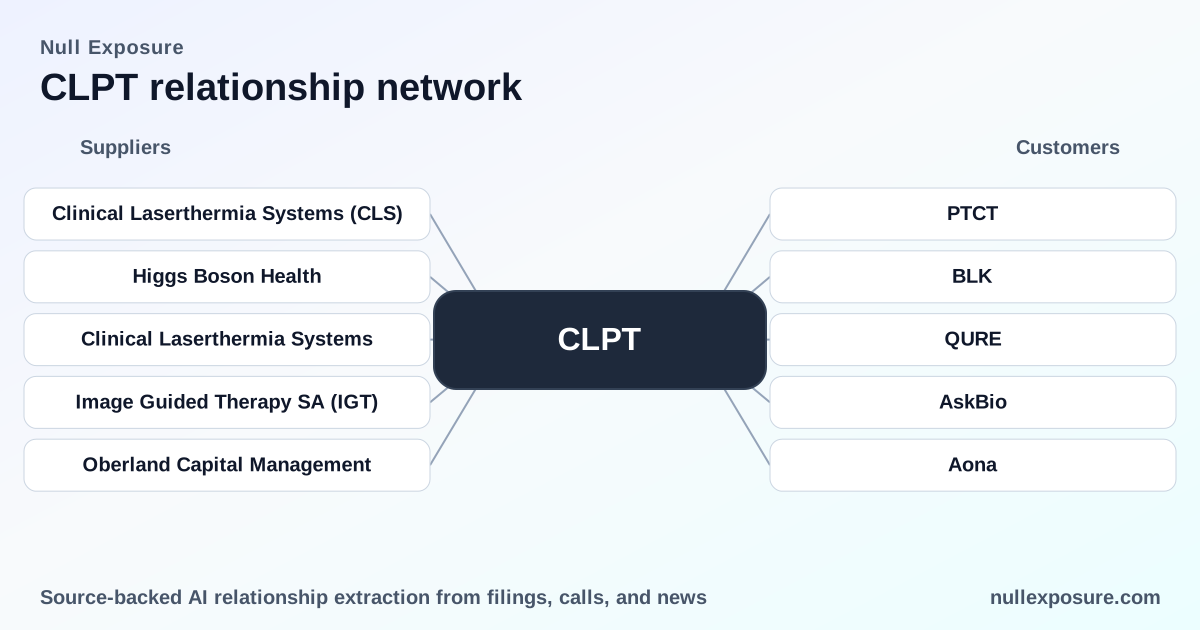
ClearPoint Neuro (CLPT): Partner Map and Customer Risks for Investors
ClearPoint Neuro commercializes an integrated neurosurgical platform — hardware, disposable components and intuitive software — and monetizes through a mix of capital equipment sales, annual service/subscription fees and consulting/clinical partnership agreements with biopharma companies pursuing gene and cell therapies. The company’s revenue profile blends one-time equipment receipts with recurring maintenance and software access, and a services business that partners with drug developers for delivery and protocol consulting. For a concise, investor-focused dossier on partner exposure and customer signals, visit https://nullexposure.com/.
Executive takeaway: what the partner list actually means for revenue and risk
ClearPoint sells and supports medical systems worldwide while also contracting with biopharma partners on therapy delivery workflows. That hybrid model creates recurring revenue upside through annual contracts and software support, but leaves ClearPoint exposed to partner clinical timelines and regulatory outcomes — management has already removed near-term revenue assumptions tied to certain partner launches after FDA guidance. According to ClearPoint’s Q4 2025 earnings call transcripts (May 2, 2026), management explicitly excised revenue tied to potential commercial launches for two partners in response to regulatory positioning.
Partner-by-partner notes (each mention in sources is covered)
PTC (mentioned in Globe and Mail earnings transcript, May 2, 2026)
ClearPoint highlighted PTC as an example of a partner that has progressed to commercialization, used to illustrate the staging of partner programs from preclinical to commercialized products. (The Globe and Mail, earnings call transcript, May 2, 2026)
PTC Therapeutics / PTCT (AccessWire press release on SmartFlow, March 9, 2026)
ClearPoint’s SmartFlow cannula was cleared via FDA De Novo for intraputaminal administration of PTC Therapeutics’ gene therapy KEBILIDI, indicating a commercially aligned device-to-therapy use case between the companies. (AccessWire, March 9, 2026)
PTCT (duplicative mention in the same AccessWire release, March 9, 2026)
The AccessWire release reiterates the SmartFlow cannula’s intended use with PTC Therapeutics’ therapy, underscoring that regulatory clearance links ClearPoint products to specific biopharma commercial programs. (AccessWire, March 9, 2026)
uniQure / QURE (Globe and Mail, May 2, 2026)
Management said they removed expected revenue tied to uniQure’s potential launch pending regulatory clarity, indicating direct revenue sensitivity to uniQure’s development and FDA positioning. (The Globe and Mail, May 2, 2026)
REGENXBIO / RGNX (Investing.com transcript, May 2, 2026)
ClearPoint’s management removed projected revenue associated with REGENXBIO launches after the FDA signaled a more rigorous trial strategy for rare diseases, directly affecting revenue modeling. (Investing.com, earnings transcript, May 2, 2026)
uniQure (Investing.com transcript, May 2, 2026)
The investing.com transcript repeats management’s position that potential revenue from uniQure is excluded from near-term guidance, reflecting regulatory-driven conservatism in topline forecasting. (Investing.com, May 2, 2026)
BlackRock (Insidermonkey coverage, Q3 2025 transcript reference)
Management listed BlackRock among existing partners that have provided program updates, signaling that ClearPoint’s partner list includes large institutional or corporate collaborations that publicize progress to investors. (Insidermonkey, Q3 2025 earnings summary, Mar 9, 2026)
QURE (Insidermonkey Q3 2025 mention)
Insidermonkey noted uniQure among partners updating stakeholders, reinforcing that uniQure is repeatedly referenced across quarters as a material collaborator. (Insidermonkey, Q3 2025, Mar 9, 2026)
uniQure (Insidermonkey Q3 2025 mention)
Insidermonkey’s Q3 transcript coverage again flags uniQure as a named partner, indicating ongoing investor focus on that relationship’s timeline and outcomes. (Insidermonkey, Q3 2025, Mar 9, 2026)
REGENXBIO (Insidermonkey Q4 2025 earnings transcript)
Insidermonkey’s Q4 2025 coverage echoes management’s decision to remove revenue tied to REGENXBIO launches in current guidance due to FDA clinical expectations. (Insidermonkey, Q4 2025, May 2, 2026)
REGENXBIO (The Globe and Mail, May 2, 2026)
The Globe and Mail transcript also records management saying they would revisit guidance only if regulatory developments create a clear path to launch for partners like REGENXBIO. (The Globe and Mail, May 2, 2026)
PTC (Investing.com earnings transcript, May 2, 2026)
Investing.com captured management noting a new investor deck intended to clarify program staging and the presence of at least one partner (PTC) that has a commercial program. (Investing.com, May 2, 2026)
Neurona (Insidermonkey Q4 2025 transcript)
Management declined to provide specific timing on Neurona programs, highlighting that partner-led communications dictate public timing and that ClearPoint respects partner disclosure practices. (Insidermonkey, Q4 2025, May 2, 2026)
Neurona (The Globe and Mail, May 2, 2026)
The Globe and Mail transcript lists Neurona as a near-term market opportunity expected to demonstrate value once programs progress. (The Globe and Mail, May 2, 2026)
Neurona (Investing.com, May 2, 2026)
Investing.com records the company’s statement that timing for Neurona advances is managed by partners and not disclosed by ClearPoint. (Investing.com, May 2, 2026)
AskBio (Insidermonkey Q3 2025 mention)
AskBio is listed among partners that have recently provided progress updates to investors, indicating active collaborative programs in the biologics/drug delivery space. (Insidermonkey, Q3 2025, Mar 9, 2026)
PTC / PTCI (Insidermonkey Q4 2025 mention – variant symbol)
Insidermonkey’s Q4 coverage repeats management’s investor-deck commentary, showing consistent emphasis on PTC-related staging across reporting platforms. (Insidermonkey, Q4 2025, May 2, 2026)
BlueRock / BLRK (Insidermonkey Q4 2025 mention)
BlueRock is referenced as a partner whose assets could drive near-term market opportunities, positioning it as part of ClearPoint’s anticipated commercial catalyst list. (Insidermonkey, Q4 2025, May 2, 2026)
BlueRock (Investing.com transcript, May 2, 2026)
Investing.com captures management’s statement that BlueRock’s programs — like others — publicly stage status updates but do not commit to firm timing. (Investing.com, May 2, 2026)
BlueRock (The Globe and Mail, May 2, 2026)
The Globe and Mail transcript groups BlueRock among the next likely near-term opportunities that should demonstrate the value of ClearPoint’s diversified partner base. (The Globe and Mail, May 2, 2026)
Aona (Insidermonkey Q3 2025 mention)
Aona is listed among partners updating investors, reinforcing that ClearPoint’s partner roster spans multiple emerging biopharma and research-stage companies. (Insidermonkey, Q3 2025, Mar 9, 2026)
Operating-model constraints and what they signal for investors
- Contracting posture: ClearPoint’s contracts include short-term (1–3 year) equipment/service agreements and annual subscription-style maintenance and upgrade bundles, indicating revenue that blends upfront capital receipts with recurring annual fees. This is company-level disclosure about contract liabilities and billing cadence.
- Geography and footprint: Products are in commercial use globally, but operations and revenue are predominantly U.S.-based, so investors should model a global install base with U.S. revenue concentration.
- Materiality and concentration: ClearPoint disclosed that partner-related activity accounted for ~17% of biologics and drug delivery revenues in 2024, a company-level signal that partnerships are commercially meaningful within that segment.
- Role and product mix: ClearPoint operates as the seller of hardware, software and services, with loaned systems used as pilot evaluations at customer sites — that supports both sales conversion and service revenue expansion.
- Segment mix: The business combines hardware, software and services, which creates diversified revenue streams but links topline to partner clinical and regulatory timelines.
Investment implications and risk summary
- Upside: Recurring annual fees and software upgrades provide a path to higher margin, predictable revenue as installed base grows. Strategic device clearances linked to commercial therapies (e.g., PTC Therapeutics) illustrate potential for direct commercial use cases.
- Downside: Revenue is sensitive to partner clinical outcomes and FDA positioning; management has already removed projected launch revenue for key partners from guidance. Regulatory shifts for rare-disease trial design represent a clear demand shock to modeled partner launches.
- Concentration: The partner list is diverse across multiple biopharma names, which reduces single-customer concentration, but the company still carries material exposure to successful commercialization by a subset of partners.
For a focused investor brief and ongoing partner-tracking designed for portfolio and operations teams, explore the ClearPoint relationship dashboard at https://nullexposure.com/.