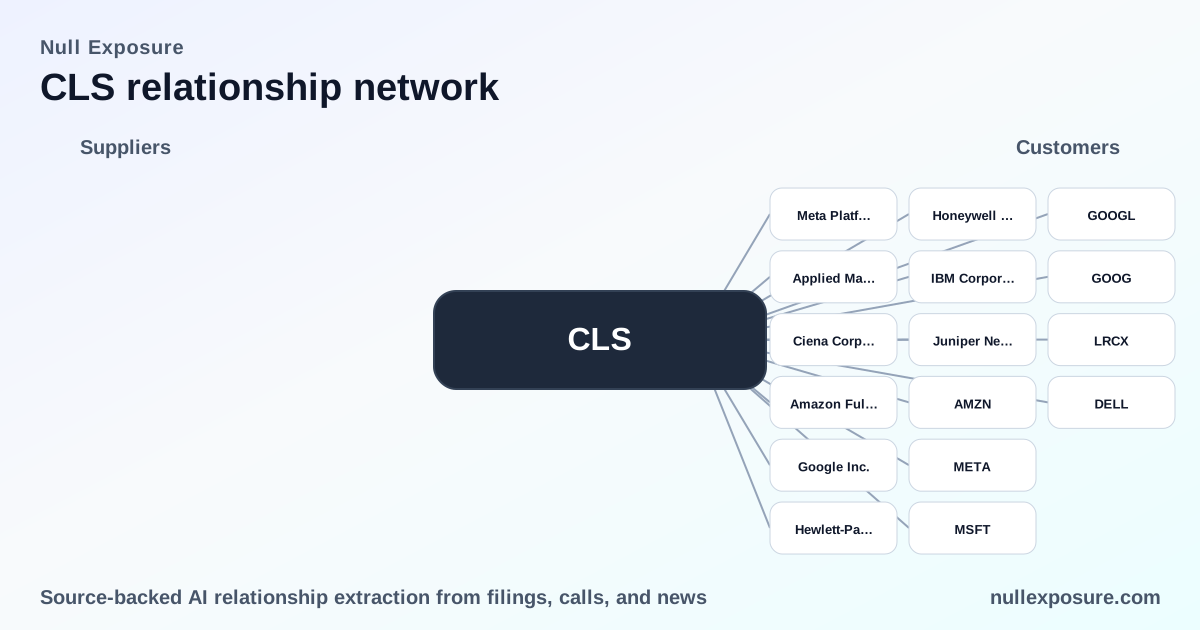
Celestica’s customer map: hyperscalers, OEMs and the concentration trade-off
Celestica is a contract manufacturer and supply‑chain services provider that monetizes through end‑to‑end hardware production, engineering and after‑market services for OEMs and hyperscalers. The company sells manufactured systems, integration and logistics services under master supply frameworks and short‑duration program contracts, collects receivables through customer financing programs, and captures margin through scale in high‑performance systems and data‑center hardware. For a compact view of relationship intelligence, visit https://nullexposure.com/.
Business model in plain English: where the money comes from and how relationships drive it
Celestica operates as a manufacturer and services provider to large enterprise OEMs and cloud hyperscalers, generating the majority of revenue from product sales and customer‑specific services. The firm typically uses master supply agreements that set the terms of engagement but do not guarantee volumes, and most contracts are short‑term (about one year or less)—an operating posture that trades flexibility for recurring program revenue. Celestica’s go‑to‑market centers on hardware (networking switches, rack integration, thermal and power systems) and supply‑chain services (component sourcing, NPI, testing, logistics and aftermarket), and it uses accounts‑receivable facilities and customer sale‑forward programs to manage working capital.
Key company‑level signals:
- High revenue concentration: Celestica’s top 10 customers accounted for 73% of 2024 revenue, with two customers individually representing 28% and 11% of total revenue in 2024 (company filing). This is a material dependency that affects valuation and negotiating leverage.
- Geographic concentration in APAC: Roughly 70% of revenue is produced in Asia, with North America at ~20% across 2022–2024 (company filing).
- Delivery posture: Framework agreements exist but do not guarantee volumes; contracts are typically short, supporting program agility but increasing exposure to capex timing at large customers.
- Active program stage and scale: The company reports active programs with major customers and participates in receivable financing arrangements to accelerate cash collection.
For a deeper look at client relationships and program exposure, see https://nullexposure.com/.
Customer roster — concise takeaways for every cited relationship
Meta Platforms, Inc.
- Celestica lists Meta among its current CCS segment customers, positioning Celestica as a supplier into Meta’s data‑center and networking programs. (Celestica FY2024 10‑K, cls‑2024‑12‑31)
Alphabet / Google (Google Inc. / Alphabet Inc. / GOOGL)
- Celestica lists Google as a CCS customer and public reporting in 2026 cited Celestica’s role as a preferred manufacturing partner for Google TPUs and expansion of U.S. capacity; later press coverage flagged industry reports suggesting a potential shift of some TPU assembly to other suppliers. (Celestica FY2024 10‑K; TS2.tech and GlobeNewswire reporting, Mar–Apr 2026)
Amazon / Amazon Fulfillment Services, Inc.
- Amazon Fulfillment Services is named in Celestica’s CCS customer list, reflecting work for Amazon’s fulfillment and infrastructure programs. (Celestica FY2024 10‑K, cls‑2024‑12‑31)
IBM Corporation
- Celestica includes IBM among its CCS customers, indicating engagement on networking, compute or systems integration programs. (Celestica FY2024 10‑K, cls‑2024‑12‑31)
Hewlett‑Packard Enterprise
- Hewlett‑Packard Enterprise (HPE) appears in the CCS customer list, consistent with Celestica’s role supplying enterprise networking and hardware services. (Celestica FY2024 10‑K, cls‑2024‑12‑31)
Dell Technologies / DELL
- Dell Technologies is listed as a CCS customer, reflecting Celestica’s OEM relationships in enterprise compute and networking supply chains. (Celestica FY2024 10‑K, cls‑2024‑12‑31)
Ciena Corporation
- Ciena is cited among CCS customers, pointing to Celestica’s exposure to optical and networking equipment programs. (Celestica FY2024 10‑K, cls‑2024‑12‑31)
Juniper Networks, Inc.
- Juniper Networks appears in the CCS roster, confirming program work in routing and switching systems. (Celestica FY2024 10‑K, cls‑2024‑12‑31)
Applied Materials, Inc.
- Applied Materials is named in the ATS segment customer list, reflecting Celestica’s role supplying capital‑equipment or subsystem work for semiconductor tooling. (Celestica FY2024 10‑K, cls‑2024‑12‑31)
LAM Research / LRCX
- LAM Research is listed among ATS customers, underscoring exposure to semiconductor equipment manufacturing programs. (Celestica FY2024 10‑K, cls‑2024‑12‑31)
Honeywell Inc.
- Honeywell is included in the ATS segment customer list, signaling industrial and embedded systems work. (Celestica FY2024 10‑K, cls‑2024‑12‑31)
Advanced Micro Devices, Inc. (AMD)
- Multiple March–May 2026 reports document a collaboration between Celestica and AMD on the Helios rack‑scale AI platform, with Celestica leading design and production of scale‑up networking switches for the architecture. (TradingView / The Globe and Mail / InsiderMonkey reporting, Mar–May 2026)
Microsoft
- Industry commentary lists Microsoft among the large, sticky hyperscaler relationships supporting Celestica’s HPS growth thesis and margin expansion in 2026. (Finviz sector commentary, Mar 2026)
Bell / BCE
- Canadian press and market notices highlight a collaboration between Bell and Celestica to develop a Canadian sovereign AI infrastructure stack—hardware, integration and national‑scale services. (CanadianManufacturing and MarketBeat reporting, 2026)
OpenAI
- Analyst and sell‑side notes reference OpenAI in the ecosystem of customers whose capex plans feed Celestica’s near‑term visibility, cited by CIBC coverage in 2026. (InsiderMonkey / CIBC coverage, 2026)
What that roster means for investors: upside and risks
- Upside: Celestica is positioned as a beneficiary of hyperscaler and AI infrastructure capex (networking switches, TPU systems and rack‑scale integration), which is driving HPS revenue growth and expanding gross margin in recent quarters (news coverage March 2026). Collaboration with AMD on Helios is an explicit growth vector for high‑margin hardware programs.
- Concentration risk: Top‑10 customers account for 73% of revenue and two customers exceed 10% individually (company filing), which creates meaningful revenue volatility tied to a small set of counterparties.
- Contracting posture: Framework agreements give Celestica commercial access but do not guarantee volumes; contracts are typically short‑term, creating sensitivity to capex timing at large customers—an important risk for revenue predictability.
- Geographic and operational exposure: Approximately 70% of output is produced in Asia, which concentrates supply‑chain, labor and geopolitical exposure even as Celestica expands U.S. capacity for strategic programs.
- Cash flow mechanics: The company uses receivable financing and customer SFPs to optimize cash flow; investors should monitor receivables concentration and program‑level deposits disclosed in filings.
Bottom line and next steps
Celestica sits at the intersection of contract manufacturing and hyperscaler hardware demand: high upside from AI and data‑center capex, balanced by high customer concentration and short contract tenors. Investors should track program‑level disclosures, TPU/Helios manufacturing updates, and customer receivable facilities to assess revenue durability and working‑capital risk.
For ongoing relationship monitoring and structured exposure analysis, see https://nullexposure.com/.