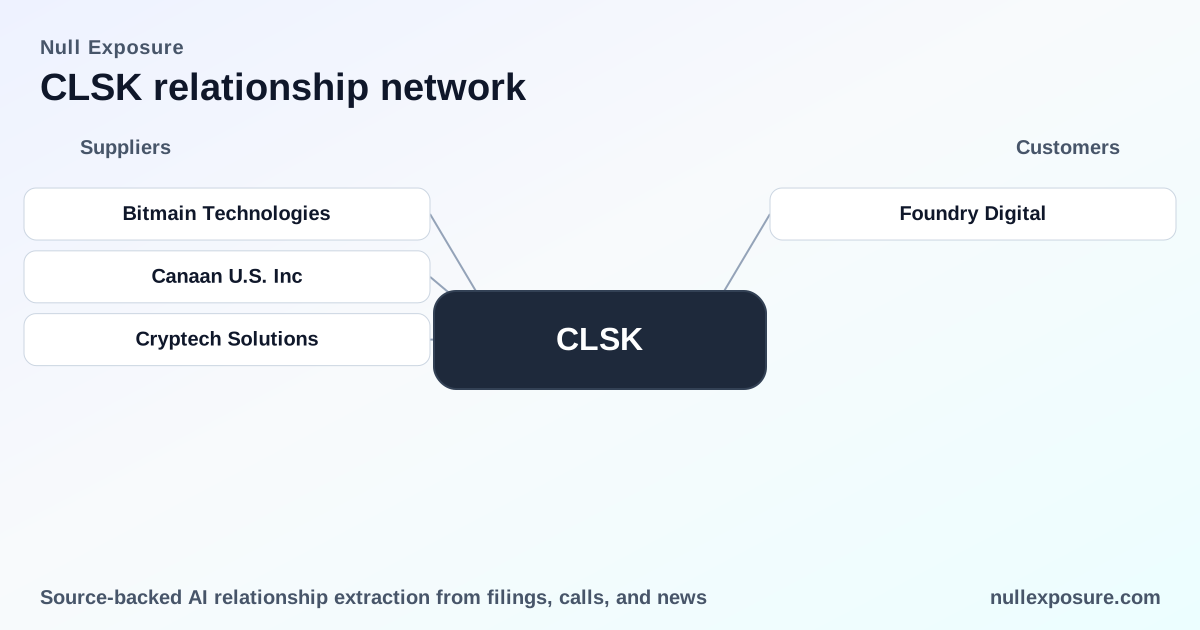
CleanSpark (CLSK): Single-pool economics, short-term contracts, and concentrated counterparty risk
CleanSpark operates as a hybrid energy-software and bitcoin-mining company that monetizes through two principal activities: selling energy software and control technology and operating bitcoin mining capacity that is pooled and settled daily in bitcoin. The economics of the business are driven by mining rewards routed through a third-party mining pool, while software and hosting services provide incremental revenue and operational optionality. For investors, the critical lens is counterparty concentration and contract posture: CleanSpark’s mining rewards are materially dependent on a single mining pool operator and settled on a short-term, usage-based basis, which directly links cash flow timing and custody risk to that counterparty.
Discover structured customer intelligence at https://nullexposure.com/ for deeper counterparty mapping.
How CleanSpark makes money and why counterparty mechanics matter
CleanSpark’s public profile combines product revenue (energy software and controls) with the proceeds from bitcoin mining. The company reports substantial revenue — roughly $785 million TTM — but operating losses and negative EPS reflect heavy investment and the volatile nature of mining economics. Mining proceeds are not recognized as traditional cash receivables; instead CleanSpark receives bitcoin as non-cash consideration and values those receipts at a daily UTC timestamp, which creates direct exposure to cryptocurrency price movements and custody arrangements.
The company’s SEC filing discloses several contract and relationship characteristics that define the operating model:
- Short-term, terminable contracts: contracts with the mining pool are terminable at any time by either party and are continuously renewed, defining a transactional, usage-based commercial posture rather than long-term committed off-take.
- Usage-based settlements: mining rewards are settled daily to CleanSpark based on hash contribution; the company measures fair value at the close of each day.
- High concentration and criticality: for FY2025, 100% of mining rewards were routed through a single mining pool operator, which the company explicitly names in its filings.
- Role and activity: CleanSpark functions both as a seller (it contributes hashing power and receives bitcoin) and as a service provider to pool operations via hash calculations.
Together these characteristics produce a business that is operationally flexible but financially exposed to single-counterparty risk and crypto-price volatility.
What the filings say about the dominant mining counterparty
According to CleanSpark’s Form 10‑K for the fiscal year ended September 30, 2025, Foundry Digital was the company’s sole mining pool operator and represented 100% of the company’s revenues from mining rewards for FY2023–FY2025, because all bitcoin mining rewards were received through the Foundry mining pool. The 10‑K also states the contract with the mining pool is terminable at any time by either party, and daily settlements determine the bitcoin paid. This confirms both the concentration and the short-term, usage-based settlement mechanics disclosed in the filing.
Relationship profiles — every customer relationship disclosed
Foundry Digital
CleanSpark contributes all of its computing power to a single mining pool operator — Foundry Digital — and all bitcoin mining rewards are received through that pool, making Foundry the de facto sole customer for mining proceeds in FY2025; the company discloses this in its 2025 Form 10‑K. According to the 10‑K (fiscal year ended September 30, 2025), revenues from Foundry Digital represented 100% of CleanSpark’s total revenues from mining rewards for the referenced years.
Mawson Infrastructure Group (MIGI)
CleanSpark provided short-term hosting capacity to Mawson Infrastructure Group as part of an asset acquisition/transition arrangement, agreeing to host up to 30 MW of capacity for up to 180 days while Mawson transferred miners into its Pennsylvania operations, according to a 2022 news report on ESGNews. The arrangement demonstrates CleanSpark’s operational role in temporary hosting and capacity turn-key transfers rather than long-term off-take in that instance.
Why these relationships alter the risk-return profile
CleanSpark’s counterparty structure produces a distinct set of investment implications:
- Revenue concentration is a primary risk: the company’s FY2025 filing explicitly states single-pool concentration and that all bitcoin are received via one operator, making CleanSpark’s revenue stream sensitive to the commercial decisions of that counterparty. This is a structural revenue risk that affects valuation upside and downside.
- Contracting posture limits long-term revenue visibility: because mining settlement contracts are terminable at any time and are usage-based with daily settlements, future revenue continuity depends on continuing operational participation and commercial terms that are not locked long-term.
- Custody and settlement mechanics increase operational fragility: the company notes that all bitcoin reside with a single custodian and that receipts are measured at a daily UTC close, concentrating both price and custody risk.
- Operational optionality through hosting and services: temporary hosting arrangements like the Mawson agreement indicate the company can monetize spare capacity and provide turn-key hosting services, diversifying revenue mix on a transactional basis.
Practical signals for monitoring
Investors should track a narrow set of leading indicators:
- Changes in mining pool diversification: any shift away from a single pool or the addition of alternative settlement pathways materially reduces counterparty concentration.
- Custody arrangements and any movement of bitcoin holdings between custodians or to self-custody.
- Frequency and terms of hosting agreements, like those with Mawson, which signal emphasis on services-led revenue versus pure mining yield.
- Operational scale (MW deployed), and capital expenditures that increase dependence on pooled settlement vs. direct marketing of mined bitcoin.
Investment takeaway and next steps
CleanSpark is a high-beta exposure to bitcoin mining economics with structural counterparty concentration and short-term, usage-based contracts that amplify both upside and downside. For investors evaluating CLSK as an operator or partner, the core questions are whether management can diversify pool and custody counterparty risk and whether software and hosting revenues scale enough to smooth mining revenue volatility. CleanSpark’s FY2025 disclosures make counterparty risk a first-order investment variable.
For a focused counterparty risk review and ongoing monitoring of CleanSpark’s customer and custody relationships, see the structured intelligence available at https://nullexposure.com/.
Key documents referenced include CleanSpark’s Form 10‑K for the fiscal year ended September 30, 2025 (company filing) and a 2022 coverage of CleanSpark’s agreement with Mawson Infrastructure Group reported by ESGNews.