Clearwater Paper (CLW) — customer relationships, the Sofidel exit, and what buyers tell investors
Clearwater Paper manufactures and sells private-label bleached paperboard and tissue products, monetizing through B2B sales of Solid Bleached Sulfate (SBS) paperboard to packaging converters and (until recently) private‑label tissue sold through grocery chains and mass distributors. The company has executed a major strategic monetization — a $1.06 billion cash sale of its tissue business — and now runs a concentrated, manufacturing‑centric revenue base with significant North American customer exposure. For continued primary analysis and customer intelligence, see https://nullexposure.com/.
The headline: a cash sale that reshapes customer risk and focus
Clearwater completed the sale of its tissue business to Sofidel’s U.S. arm for $1.06 billion in cash, removing the retail-facing tissue customer set from Clearwater’s operating footprint and concentrating the company on paperboard and pulp-related manufacturing and sales. That divestiture materially changes revenue mix, reduces downstream retail exposure, and creates near-term liquidity that can be deployed on the balance sheet, capital projects, or shareholder returns. According to the company announcement covered by industry press on March 9, 2026, the sale closed subject to typical purchase price adjustments (see StockTitan and Tissue Online coverage on March 9, 2026).
Customer relationships called out in coverage — who matters now
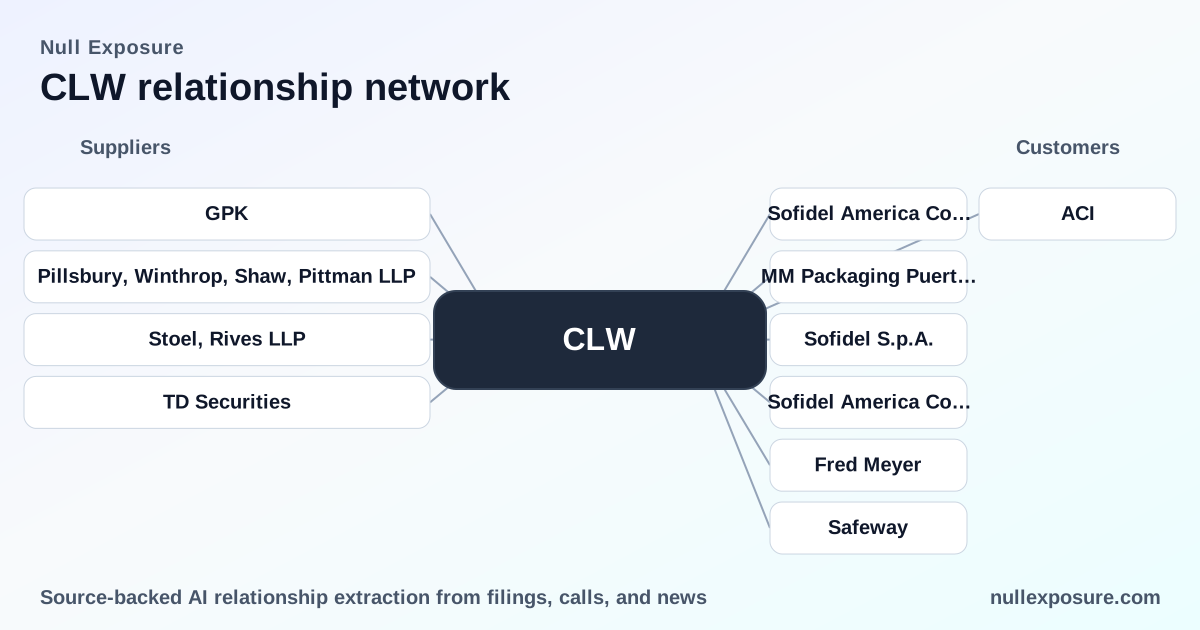
The press mentions a set of customers, partners and commercial counterparts that investors should track. Each relationship below is summarized in plain English with a source reference.
Sofidel America Corp.
Clearwater sold its tissue business to Sofidel America Corp., receiving $1.06 billion in cash as announced at close; Sofidel will operate the tissue business going forward. (StockTitan news release, March 9, 2026 — https://www.stocktitan.net/news/CLW/clearwater-paper-announces-the-closing-of-the-sale-of-its-tissue-ju3bpa9ptegq.html)
Sofidel America Corporation (alternate naming in press)
Prior to the closing, Clearwater entered a definitive agreement to sell its tissue business to Sofidel America Corporation for the same $1.06 billion headline value, subject to adjustments for debt, cash, transaction expenses and working capital. (BigCountryNewsConnection report, March 9, 2026 — https://www.bigcountrynewsconnection.com/idaho/clearwater-paper-enters-agreement-to-sell-tissue-business-for-1-06-billion/article_7a17248c-4834-11ef-b828-af92168b40fd.html)
Sofidel S.p.A.
The buyer is controlled by Sofidel S.p.A., the Italian parent; press coverage identifies Sofidel S.p.A. as the ultimate corporate owner of the U.S. buyer. (StockTitan coverage referencing Sofidel S.p.A., March 9, 2026 — https://www.stocktitan.net/news/CLW/clearwater-paper-announces-the-closing-of-the-sale-of-its-tissue-ju3bpa9ptegq.html)
Sofidel (industry press confirmation)
Industry outlets in tissue and papermaking reproduced the closing announcement and noted that the purchase price was paid in cash and that customary purchase price adjustments apply. (TissueOnlineNorthAmerica and TissueOnline Brazil coverage, March 9, 2026 — https://tissueonlinenorthamerica.com/clearwater-paper-completes-us1-06-billion-sale-of-tissue-business-to-sofidel/ and https://tissueonline.com.br/sofidel-conclui-compra-do-negocio-de-tissue-da-clearwater-paper-por-us-106-bilhao/)
MM Packaging Puerto Rico
Press reporting on related commercial disputes mentions MM Packaging Puerto Rico as a customer in the SBS paperboard channel; coverage indicates exclusive representation rights for sales of SBS paperboard to MM Packaging and that the relationship has been the subject of litigation. (NewsIsMyBusiness coverage of contract dispute referencing FY2025 activity — https://newsismybusiness.com/american-paper-sues-clearwater-over-alleged-unjust-end-of-contract/)
Fred Meyer
Historically, Clearwater’s private‑label tissue products were sold through grocery chains such as Fred Meyer; that retail distribution characterized the tissue footprint that has now been divested to Sofidel. (Spokane Journal article referencing the company’s retail presence, FY2013 reporting on channels — https://www.spokanejournal.com/articles/6792-spokane-based-clearwater-paper-expects-big-returns)
Safeway
Safeway was listed historically as a retail outlet carrying Clearwater private‑label tissue, reflecting the legacy retail channels removed by the Sofidel sale. (Spokane Journal historical coverage, FY2013 — https://www.spokanejournal.com/articles/6792-spokane-based-clearwater-paper-expects-big-returns)
Albertsons / ACI
Albertsons (listed in press with ticker ACI) was cited alongside other grocery chains as part of Clearwater’s former retail distribution footprint for private‑label tissue products. That retail exposure has been transferred to Sofidel under the transaction. (Spokane Journal coverage, FY2013; press first seen March 9, 2026 — https://www.spokanejournal.com/articles/6792-spokane-based-clearwater-paper-expects-big-returns)
What corporate constraints tell investors about operating posture
Clearwater’s public disclosures and press coverage produce a set of company-level signals about contracting, geography, concentration, criticality and maturity:
- Contracting posture: short‑term transition focus. Clearwater is operating under a Transition Services Agreement to provide back‑office services through October 31, 2025, signaling a limited-duration operational interface with the tissue buyer and a rapid handoff of retail operations to Sofidel.
- Geographic footprint: North America dominant with some global sales. Net sales are primarily in the United States, with international shipments noted; the company emphasizes selling to independent converters in North America, making the business regionally concentrated.
- Customer concentration: material. Clearwater’s top 10 paperboard customers represented 45% of sales in 2024, a high concentration that creates counterparty risk if large converters change sourcing.
- Relationship role and segment: seller to converters, manufacturing core. Clearwater is primarily a manufacturer and supplier of SBS paperboard to folding carton converters, merchants and printers — a B2B manufacturing relationship profile.
- Maturity and criticality: divestiture plus retained pulp links. While the tissue business was sold, pulp operations in Lewiston were not part of the sale, and Sofidel will buy pulp for Lewiston, showing ongoing commercial interdependence for feedstock despite the divestiture.
Investment implications: balance-sheet optionality vs. concentrated counterparty risk
The $1.06 billion cash sale creates immediate liquidity and strategic optionality, allowing Clearwater to reduce leverage, invest in paperboard capacity, or return capital to shareholders. Financially, the company’s TTM revenue ($1.54 billion) and modest EBITDA ($78.3 million) imply margin pressure in a commodity cycle; EV/EBITDA of 12.9 suggests a valuation that rewards operational improvement or successful redeployment of sale proceeds.
On the risk side, customer concentration (45% from top 10) and North American focus elevate exposure to a handful of large converters and regional demand cycles. The short‑term Transition Services Agreement limits prolonged execution risk tied to the tissue exit but also signals a compressed timeline to normalize operations post‑divestiture.
If you want a deeper drill into counterparties, contract timing, and revenue attribution, signaled customer movement after the Sofidel transaction is the immediate priority. Explore our detailed coverage at https://nullexposure.com/.
Bottom line
Clearwater Paper has materially reshaped its customer profile through the Sofidel transaction: the company becomes a more concentrated, manufacturing‑centric enterprise with significant North American exposure and a meaningful top‑customer concentration, while holding substantial cash proceeds to address balance‑sheet and growth priorities. Investors should weigh the balance‑sheet benefits of the sale against the elevated counterparty concentration and the near‑term execution risks inherent in a post‑divestiture transition.