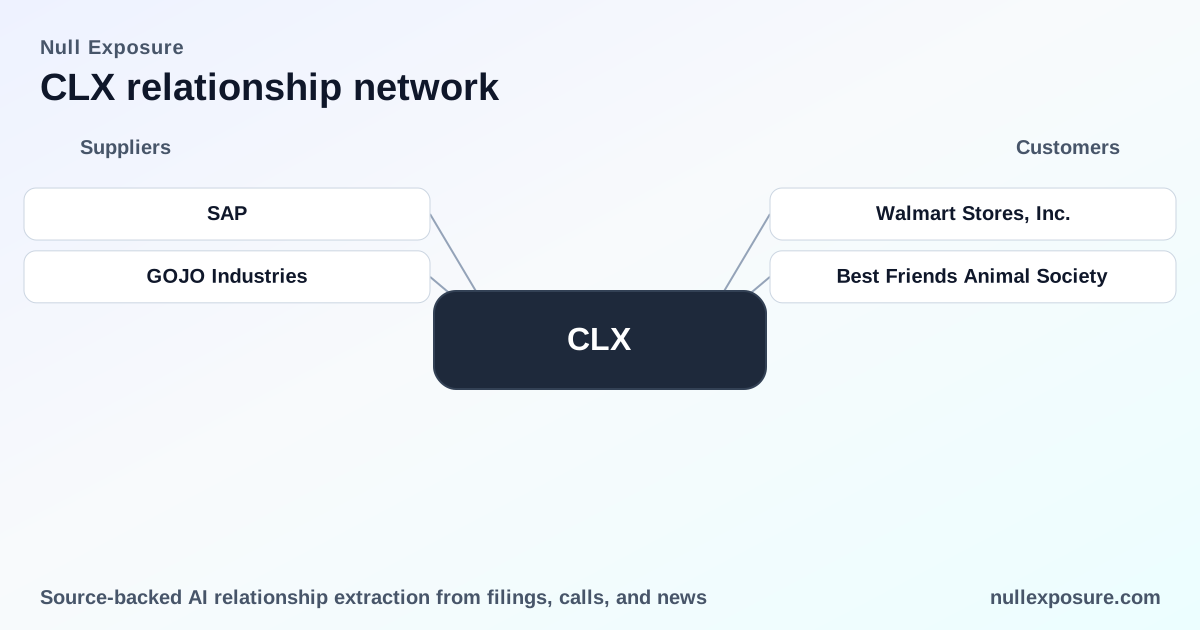
CLX Customer Map: Concentration, Licensing, and Partner Promotions that Drive the Business
The Clorox Company is a branded consumer-products manufacturer that monetizes primarily through product sales to large retail channels and selective brand licensing, supplemented by marketing partnerships that drive trial and shelf velocity. The firm sells household and personal-care goods across mass retailers, grocery, warehouse clubs, dollar channels and e‑commerce, while licensing relationships extend the Clorox brand into adjacent product categories. Investor focus should be on counterparty concentration, channel leverage, and the economics of licensing versus core product margins. For a deeper look at counterparty exposures and downstream signals, visit https://nullexposure.com/.
Why customer structure matters for valuation and execution
Clorox operates under a commercial model built around high-volume, transactional sales rather than long-term take-or-pay contracts. This spot-sales posture creates predictable retail execution needs — shelf space, promotions, inventory — but also concentrates commercial risk in a handful of large buyers. The company reports substantial U.S. exposure and customer concentration, which amplifies both scale advantages and negotiating pressure.
Key company-level signals:
- Spot contracting and transactional sales: The company states it typically does not enter long-term contracts with customers, which formalizes a high degree of volume flexibility but limited lock-in.
- Large-counterparty orientation: Sales are routed primarily through mass retailers and large distributors, consistent with an enterprise buyer profile.
- U.S. revenue concentration: During FY2025, 86% of net sales were attributable to U.S. markets, making domestic retail dynamics the primary driver of revenue.
- Material customer concentration: The five largest customers together accounted for nearly half of consolidated net sales in each of FY2023–FY2025.
- Active seller role: Clorox is an active market seller across 100 markets and roughly 25 countries, relying on its branded portfolio and route-to-market capabilities.
These operating characteristics translate into a revenue base that is resilient to end-market downturns owing to essential-category positioning but sensitive to retail price promotion, slotting decisions and large-buyer negotiation dynamics. Investors should couple margin and cash-flow analysis with close monitoring of retail account dynamics and licensing renewals.
The relationships you need to know
Walmart Stores, Inc.
Walmart is Clorox’s single largest customer, accounting for 27% of consolidated net sales in FY2025 and representing a consistent share around the mid‑20s over the prior two years; those sales occur across all of Clorox’s reportable segments. According to the company’s FY2025 10‑K filing, Walmart and its affiliates accounted for 27%, 25% and 26% of consolidated net sales for fiscal years 2025, 2024 and 2023, respectively. This level of concentration is a primary commercial risk and a central input to revenue forecasting (source: Clorox FY2025 10‑K).
Hamilton Beach Brands (HBB)
Hamilton Beach Brands entered a multiyear, exclusive trademark licensing and product development agreement with Clorox in 2021 to develop and market air purifiers under the Clorox® brand, establishing a third‑party licensing channel for the brand into small appliances. A Licensing International release covering the 2021 agreement documents the structure and exclusivity of that partnership, which converts brand equity into incremental revenue streams outside Clorox’s manufacturing footprint (source: Licensing International announcement, 2021 / reported in FY2022 coverage).
Best Friends Animal Society
Clorox has used promotional partnerships with animal-welfare organizations to drive trial of its pet-category brand Fresh Step, including programs that provided free litter with cat adoptions in February promotions; media coverage detailed the Fresh Step tie‑in with Best Friends Animal Society during Valentine’s Day weekend adoption events. This is an example of marketing-driven, cause-aligned promotion that supports brand affinity and trial (source: BuzzFeed coverage, February 2026).
What these relationships imply for risk and upside
The Walmart relationship is both a strength and a vulnerability. Walmart’s scale guarantees shelf presence and volume, underpinning Clorox’s revenue and manufacturing throughput; however, the retailer’s purchasing leverage compresses margins during periods of aggressive pricing or promotional intensity. Licensing agreements like the HBB deal represent high-margin, low-capex brand-leveraging opportunities that diversify revenue sources and reduce reliance on manufactured goods, but their economic scale is smaller and sensitive to renewal terms and co‑branding execution. Promotional partnerships with nonprofits and advocacy groups are effective for customer acquisition and CSR alignment, but impact is episodic and marketing-driven rather than a steady revenue stream.
Operational consequences for investors and operators:
- Working capital management is critical: Spot sales combined with promotional cadence require tight inventory and trade-funds control to preserve operating margins.
- Contracting posture reduces revenue visibility: The absence of large long-term customer contracts demands active forecasting and scenario planning around retail reorders and promotional calendars.
- Geographic concentration elevates domestic retail cycles: With 86% of FY2025 sales in the U.S., macro U.S. retail trends and consumer staples spend elasticity drive near-term topline risk.
- Customer concentration needs active mitigation: The five-largest-customer concentration means any account share shift (pricing, delisting, promotion loss) materially moves consolidated revenue.
How investors should read the numbers
Clorox’s FY‑TTM figures show revenue of roughly $6.76 billion and operating margin near 17%, with EBITDA around $1.29 billion — a solid cash-generative profile for a branded consumer-goods company. Market valuation metrics (trailing P/E ~14.2, EV/EBITDA ~10.6) reflect a combination of stable cash flow and limited growth upside inherent to mature household categories. The company’s high institutional ownership (about 85%) indicates the stock is widely followed and priced for consistent cash generation rather than rapid expansion.
If your thesis centers on steady cash return and defensive exposure to household categories, Clorox’s broad retail penetration and brand durability support that view. If you underwrite margin expansion or multiple re-rating, you must model improvements in retail terms, successful licensing scale-up, or cost-structure changes that offset promotional pressure.
For a concise view of counterparty concentration and customer relationships, explore the CLX customer map at https://nullexposure.com/.
Final takeaways for operators and investors
- Walmart dominance is the primary commercial lever and risk; sustained share with Walmart underpins volumes but creates bargaining exposure.
- Brand licensing is a strategic hedge against manufacturing cyclicality, enabling monetization of brand equity without heavy capital investment.
- Promotional partnerships drive marketing ROI but do not substitute for large-account retail execution.
Bold, focused monitoring of retail account terms, licensing renewal cadence, and U.S. retail trends is essential to any investment or operational play on Clorox.