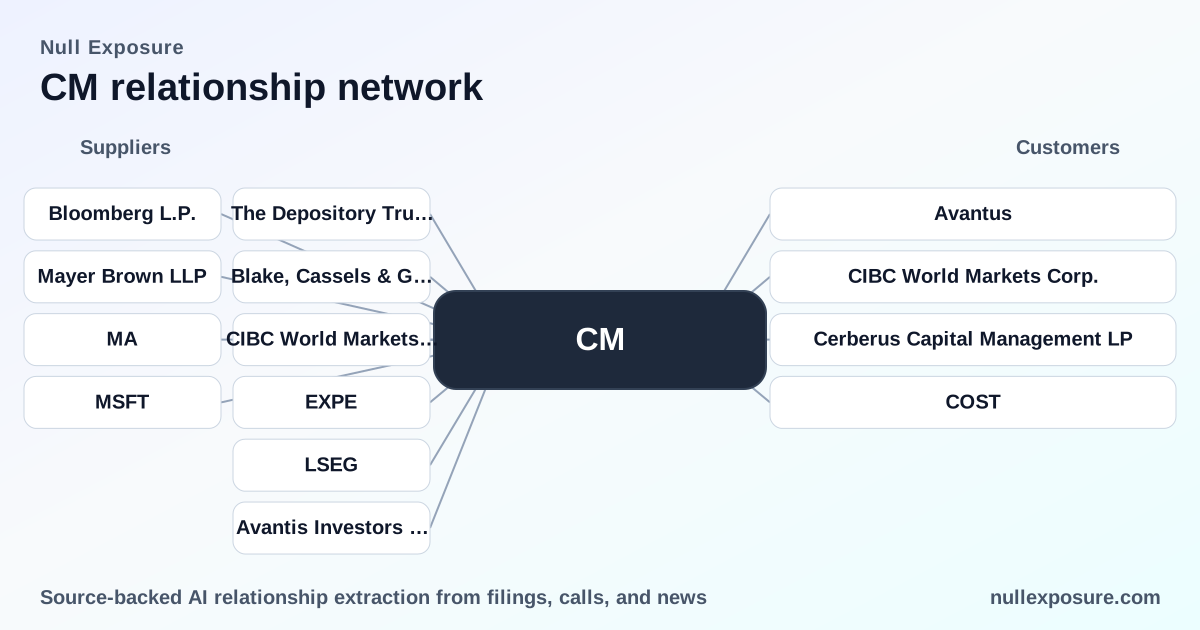
CIBC’s Customer Map: Where Canadian Imperial Bank of Commerce Wins Business and How It Monetizes It
Canadian Imperial Bank of Commerce (CM) operates as a diversified commercial and capital markets bank that monetizes through lending, deposit-taking, underwriting and advisory fees, and treasury/transaction services across retail, commercial, and institutional clients in North America and select international markets. The bank’s economics combine steady net interest income from term and revolving credit facilities with higher-margin capital markets fees when CIBC serves as bookrunner or financial advisor. For investors evaluating CM’s customer relationships, the mix of loan commitments, letters of credit, and underwriting mandates visible in recent filings and press releases shows a strategy that balances fee income with recurring lending revenue. Explore a concise relationship map below and how each tie contributes to CM’s revenue profile.
Learn more about the coverage and signals that inform this map at https://nullexposure.com/.
How CIBC earns from customers — the operating model in plain terms
CIBC’s customer interactions fall into four monetizable buckets: commercial lending (revolvers, term loans), structured and project finance (construction and development lending), capital markets services (underwriting, bookrunning, syndication), and day-to-day banking services (lines of credit, letters of credit). Contracting posture is conventional for a bank: credit facilities typically include standard covenants and draw schedules, underwritings follow market syndicate protocols, and advisory mandates are fee-for-service. Concentration is moderate—CIBC works with both small issuers and large corporates—so no single counterparty dominates public signals. Criticality to borrowers is high where CIBC is sole lender or sole bookrunner; maturity of relationships ranges from short-term revolvers to multi-year term loans and underwriting engagements. No explicit corporate constraints were flagged in the data feed as company-level signals.
Relationship map — line-by-line coverage
Below I enumerate every customer relationship surfaced in the dataset with a concise description and source reference.
Alliance Laundry Systems (ALH)
CIBC Capital Markets acted as a co-manager on Alliance Laundry’s public registration and later on the upsized IPO pricing, indicating active equity underwriting participation in FY2025. Source: StockTitan press notices covering the registration and pricing (March 2026).
Lifeway Foods (LWAY)
Lifeway executed a Sixth Modification to its Amended and Restated Loan and Security Agreement with CIBC Bank USA, demonstrating an ongoing lender-borrower relationship and facility amendments in FY2025. Source: TradingView news report (March 10, 2026).
GreenPower Motor Company (GP)
GreenPower closed a new banking relationship with CIBC comprising a $3 million revolving line and a $2 million three-year term loan—CIBC provided new working capital and term funding in FY2026. Sources: company filings and press releases (SEC exhibit and PR Newswire, March–May 2026).
Vista Gold Corp. (VGZ)
CIBC Capital Markets served as sole bookrunner on Vista Gold’s ~US$39 million equity offering in late Feb–Mar 2026, placing CIBC squarely in lead underwriting and distribution duties. Sources: GlobeNewswire press release and Globe and Mail coverage (Feb–Mar 2026).
Expensify (EXFY)
Expensify entered into a Letter of Credit Facility and Security Agreement with Canadian Imperial Bank of Commerce in October 2025, replacing its prior loan structure and indicating CIBC’s role as a credit provider for corporate clients. Source: TipRanks company announcement summarizing the October 2025 facility agreement (reported May 2, 2026).
Pulmonx (LUNG)
Pulmonx refinanced its capital structure and repaid an earlier facility with CIBC without fees, consolidating liquidity under a new lender; this signals CIBC had been a prior lender but was replaced in a refinancing transaction in FY2026. Source: TradingView coverage of Pulmonx refinancing (March 2026).
Winmark Corp. (WINA)
Winmark maintains a line of credit with CIBC Bank USA that provides up to $20 million in revolving loans and $30 million in delayed draw term loans, with $30 million drawn as reported—an example of larger corporate working-capital provisioning. Source: Winmark’s SEC 10‑K disclosure summarized on TradingView (FY2026 filing).
Avantus (unnamed ticker)
Avantus secured over $300 million in construction funding for the Kitt solar and storage project from BBVA and CIBC, demonstrating CIBC’s participation in large syndicated project financing. Source: Intellectia summary of the financing announcement (reported March 2026).
Athene / Petros Pace Finance (ATH‑P‑A)
CIBC Capital Markets served as financial advisor to Athene in an acquisition related to Petros Pace Finance, evidencing strategic advisory revenue in M&A work (historical FY2021 noted in press coverage). Source: CityBiz article referencing CIBC advisory role (coverage March 2026).
CIBC World Markets Corp. (internal)
CIBC World Markets Corp. is used operationally to purchase and distribute notes under CIBC prospectuses, reflecting internal syndication and distribution flows within the CIBC group for public offerings in FY2026. Source: CIBC prospectus supplement filings summarized by StockTitan and SEC-hosted pricing supplements (March 2026).
TransCanada Pipelines Ltd. (TCPA)
CIBC acted as sole manager on one bond issuance and as lender on multiple loans to TransCanada, illustrating long-term relationships with infrastructure issuers and underwriting roles (historical activity cited from 2018). Source: RAN.org investigative reporting and historical bond/lending records (cited March 2026).
Greenlight Capital Re (GLRE)
A Greenlight Capital Re unit entered a master letter of credit agreement with CIBC Bank USA on April 1, 2026, showing CIBC’s role in backstopping reinsurance-related liquidity and credit instruments. Source: Marketscreener announcement of the letter of credit (May 3, 2026).
Cerberus Capital Management LP
Cerberus publicly alleged that CIBC defaulted on payments under a limited recourse note dating to 2008, referencing litigation and contested legacy structured transactions reported in FY2026 media. Source: The Globe and Mail coverage of the Cerberus dispute (March 2026).
Costco (COST)
Morningstar highlights CM’s Costco card relationship acquired in 2022 as part of CIBC’s affluent client strategy in Canada, indicating durable retail-card and co-branding revenue streams. Source: Morningstar company report on CIBC’s strategy (FY2026 analysis).
What this relationship map means for investors
- Diversified fee and interest revenue: CIBC’s mix of underwriting mandates (VGZ, ALH), advisory roles (Athene), and recurring lending (GP, WINA, Expensify) supports a balanced revenue profile across fees and net interest income.
- Commercial and capital-markets footprint: The bank is active across small-cap equity placements, project financing, and corporate lines—this broad coverage reduces single-segment dependence while creating pockets of higher revenue volatility tied to underwriting cycles.
- Concentration and criticality pockets: Where CIBC is sole bookrunner or sole lender (Vista Gold, certain GreenPower facilities), those relationships are material for the client and commercially meaningful for CIBC, but the reported universe shows no single counterparty concentration that dominates the public signals.
- Operational risk and legacy exposures: Litigation referenced by Cerberus signals that legacy structured transactions can surface as headline risks, and refinancings (Pulmonx) show the bank can be replaced in competitive debt processes.
Governance note and constraints signal
There were no explicit relationship constraints provided in the dataset; accordingly, no specific contractual limits, covenant breaches, or formal restrictions were flagged in the public excerpts supplied. Treat that as a neutral company-level signal rather than evidence of absence of credit terms.
For a deeper dive on these customer links and to monitor how new deal flow impacts CIBC’s revenue mix, visit https://nullexposure.com/ for ongoing coverage and signal tracking.