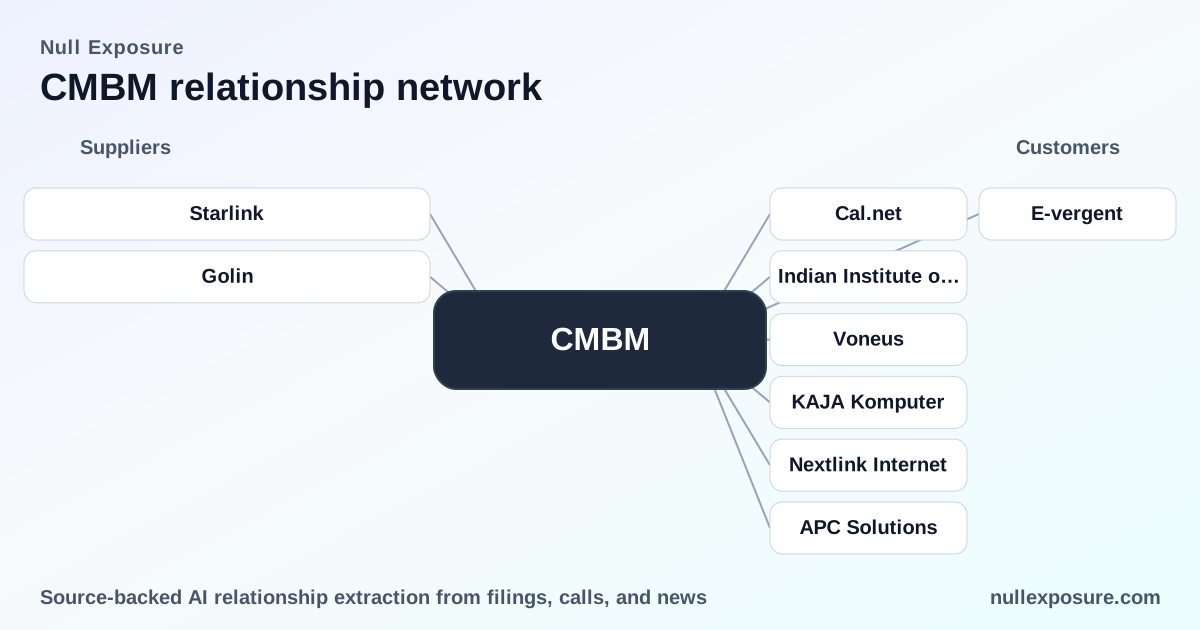
Cambium Networks (CMBM) — customer relationships that drive recurring services and global hardware sales
Cambium Networks sells wireless broadband and Wi‑Fi infrastructure hardware bundled with embedded software, and it monetizes through a mix of spot hardware shipments, perpetual software licensing, and recurring subscriptions and services for network management (cnMaestro X / ONE Network) and support. Investors should value Cambium as a hybrid vendor: hardware-led revenue with an accelerating annuity stream from subscriptions and managed services, concentrated on service providers, mid-market enterprises, and government accounts across North America, EMEA, APAC and LATAM. Explore more context at https://nullexposure.com/.
What the customer list reveals about Cambium’s go-to-market
Cambium’s customer signals reflect a dual strategy: sell high-volume radios and repeat with cloud and managed services that improve stickiness. The relationships span rural ISPs deploying fixed wireless, campus and enterprise Wi‑Fi projects, and managed-service partners packaging Cambium’s cloud capabilities into offerings for business customers. That mix produces capital intensity on initial installs and higher-margin, recurring revenue over time, while geographic diversity reduces single-region concentration risk.
- Contract mix: Product revenue is primarily recognized at shipment (spot), perpetual software licenses are recognized at delivery, and subscription services are recognized ratably over the contract term.
- Customer types: The base includes governments, service providers, and mid-market enterprises (education, multi‑dwelling, hospitality).
- Geographic reach: Revenue skews to North America but includes meaningful EMEA, APAC and LATAM exposure.
- Segments: Hardware remains the primary revenue engine; services and subscription solutions comprise the growth vector, anchored by cnMaestro X/ONE Network.
These characteristics create both upside—through repeatable service revenue—and operational constraints: hardware shipment timing drives quarter-to-quarter revenue volatility, while subscription uptake governs margins and longer-term visibility.
Full relationship coverage — who’s buying Cambium and what they’re doing
Below are concise, source‑backed summaries for every customer relationship surfaced in public filings and news.
-
Voneus: In 2024 Cambium’s cnWave 60 GHz solution was deployed by Voneus to deliver gigabit access to Walney Island, with follow-up disclosures across 2024Q2 and 2024Q3 describing the same rural broadband deployment. According to Cambium’s 2024Q3 and 2024Q2 earnings calls, Voneus leverages Cambium’s 60‑GHz mesh technology to extend gigabit services to low-density communities on Walney Island, England (earnings calls, 2024Q2 & 2024Q3).
-
Indian Institute of Technology (Dhanbad): The Indian Institute of Technology in Dhanbad selected Cambium’s Enterprise Solutions to connect multiple academic and housing blocks on campus, representing a mid‑market education deployment using Cambium’s campus Wi‑Fi and switching portfolio (Cambium 2024Q2 earnings call).
-
Cal.net: Cal.net, a regional broadband provider serving California’s Central Valley and rural Northern California, deployed Cambium’s ePMP 4600 to deliver residential and commercial service levels reported as 400 Mbps down / 200 Mbps up, highlighting fixed‑wireless capacity for regional ISPs (Cambium 2024Q2 earnings call).
-
KAJA Komputer: KAJA Komputer publicly endorsed Cambium’s ePMP 4000 Series and Force 4518 subscriber modules for FY2025, citing compact form factor, installation ease, and ROI alignment as drivers for continued deployments in their network (press releases and news coverage, FY2025).
-
Nextlink Internet: Nextlink placed significant orders to expand rural coverage using Cambium’s ePMP 6 GHz fixed wireless solution; Nextlink’s public announcement and subsequent coverage document the vendor relationship and orders to scale low‑density area service (press release, FY2023; news summaries, FY2024).
-
APC Solutions: APC Solutions in the UK publicly highlighted Cambium NSE capabilities in FY2026, noting that Cambium NSE enabled static public IP assignment for customers on satellite or 5G links—critical for remote visibility and equipment management in edge deployments (news coverage and industry summaries, FY2026).
-
Elauwit Connection (ELWT): Elauwit Connection deployed an end‑to‑end managed Wi‑Fi solution using the Cambium ONE Network platform across national portfolios managed by property operator Thompson Thrift, with case studies and press releases documenting multiple FY2026 implementations and executive commentary (newsfile releases and Yahoo/News coverage, FY2026).
-
E‑vergent: E‑vergent’s earlier deployment feedback (documented in a Cambium press release dating to FY2016) emphasized improved uplink performance following deployments of Cambium’s ePMP platform, illustrating multi‑year customer relationships and product evolution (press release archive, FY2016).
Key takeaways for investors and operators
- Hardware remains the revenue anchor, but Cambium’s explicit subscription and services revenue recognition through cnMaestro X and ONE Network converts installations into recurring cash flows. This dynamic implies improving revenue quality as subscription penetration increases.
- Customer mix drives resilience: a blend of service providers (Nextlink, Voneus, Cal.net), managed-service partners (Elauwit, APC Solutions), and mid‑market/government accounts (IIT Dhanbad) reduces reliance on any single vertical or region.
- Product lifecycle and shipment timing are material drivers of reported results because hardware revenue is recognized on shipment (spot contracts), creating quarterly volatility that is offset over time by ratable subscription revenue.
- Technical differentiation supports upsell: high‑capacity 60 GHz cnWave and 6 GHz ePMP solutions position Cambium for rural gigabit projects, while ONE Network adds managed Wi‑Fi and edge device control that increases customer stickiness.
Operational constraints and risk signals
Cambium’s operating model highlights several practical constraints investors must price into the valuation:
- Shipment‑timed recognition: Hardware revenue is recognized upon transfer of control, producing lumpy quarter-to-quarter top‑line swings.
- Mixed contract economics: Revenue streams include spot hardware sales, perpetual software licenses recognized at delivery, and ratable subscription services—each requiring different cost allocation and margin profiles.
- Customer and regional complexity: Serving governments, service providers and mid‑market enterprises across NA, EMEA, APAC and LATAM creates execution complexity and FX exposure.
- Service maturity curve: Services and subscription offerings are growing but represent a smaller, evolving share relative to hardware; successful margin expansion depends on scaling these annuities and managed offerings.
What to watch next
- Subscription ARR growth and churn metrics from cnMaestro X / ONE Network, and margin expansion as services scale.
- Order momentum from rural ISPs (Voneus, Nextlink, Cal.net) for 60 GHz and 6 GHz product lines—these signal near‑term hardware demand and future service attachments.
- International partner adoption (APC Solutions, KAJA Komputer, Elauwit) that expands managed services revenue and supports cross‑sell to mid‑market and public sector accounts.
For a deeper read on customer relationships and how they translate into recurring revenue and installation cycles, visit https://nullexposure.com/. For tailored intelligence on supplier concentration, contract posture, and revenue recognition impacts, contact our research team through the site.