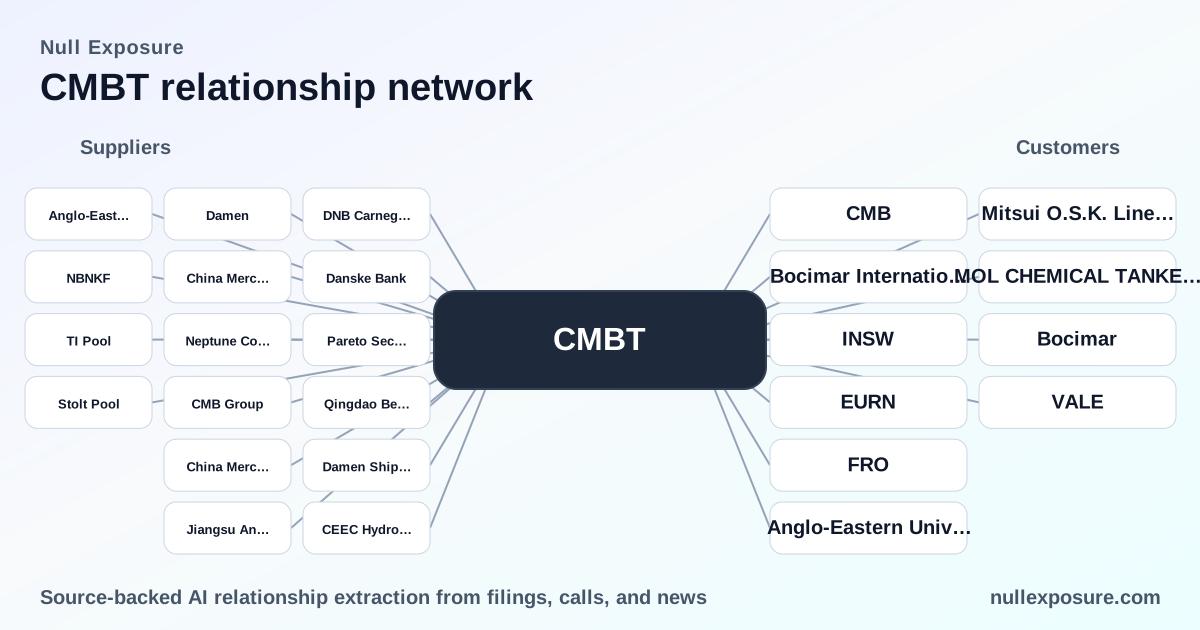
CMB.TECH customer relationships: commercial footprint, revenue drivers and counterparty map
CMB.TECH operates as an asset-owner and shipowner-operator that monetizes through a mix of long-term charters, short-term time charters, pool participation and selective asset sales to related and third-party buyers. The company’s commercial strategy is built on two revenue engines: charter income from multi-year agreements (providing revenue visibility) and capital recycling through vessel sales and fleet renewal (delivering one‑off gains and balance-sheet flexibility). This review maps every disclosed customer or counterparty link observed in public filings and press coverage, and explains what each relationship signals for earnings stability, concentration and strategic direction.
For a concise map of CMB.TECH’s commercial counterparties and related announcements, visit https://nullexposure.com/.
How these relationships define CMB.TECH’s operating model
CMB.TECH’s relationship set reveals a deliberate contract posture: the company is shifting from pool exposure and spot-dependent VLCC economics toward long-term, contracted charters and joint ownership of ammonia‑capable newbuilds. That posture increases revenue predictability and supports the company’s pivot into decarbonized shipping assets.
- Contracting maturity: Several agreements carry multi-year terms (10–12 years) that lock in cashflows and amortize newbuild investment over long horizons.
- Concentration and counterparty quality: CMB.TECH partners with large industry names (MOL, Fortescue, Frontline/International Seaways, Vale), concentrating counterparties but with high-credit, strategic counterparties that enhance cashflow visibility.
- Commercial criticality: Long charters for ammonia‑capable and dual‑fuel vessels position CMB.TECH as a strategic supplier to customers pursuing decarbonization targets, increasing contract stickiness.
- Capital recycling: Sales to related parties and third parties demonstrate active fleet renewal and opportunistic monetization of older tonnage; these transactions are material to near‑term reported gains and liquidity.
If you want deeper signal coverage and timeline views, explore the platform at https://nullexposure.com/.
Relationship roll call — what each counterparty means for investors
CMB / CMB NV
Euronav sold two Suezmax tankers (Sapphira and Statia) to a wholly‑owned subsidiary of CMB NV, representing intergroup asset transfers that support fleet rejuvenation and realized capital gains. Source: Breakbulk (Mar 9, 2026) and ShippingTelegraph (Mar 9, 2026) reporting on the sale and the expected capital gain of $61.38m.
Bocimar International NV (BOI) / Bocimar
The vessel sale included a short‑term time charter agreement with Bocimar International NV, indicating continued operational interlinks between CMB.TECH’s assets and Bocimar for immediate employment of transferred tonnage. Source: Breakbulk (Mar 9, 2026) and CMB.TECH press release (Oct 20, 2025).
Fortescue (FMG)
CMB.TECH signed an agreement to charter a new ammonia‑powered vessel with Fortescue, reflecting direct exposure to decarbonization demand from large mining and materials customers and supporting earnings durability under long charters. Source: GlobeNewswire (Mar 31, 2026).
Mitsui O.S.K. Lines, Ltd. (MOL)
CMB.TECH executed agreements with MOL for nine ammonia‑powered vessels and joint ownership arrangements on ammonia‑fitted Newcastlemax newbuilds, signaling deep strategic cooperation with a major liner/charterer on energy‑transition tonnage. Source: GlobeNewswire (Mar 31, 2026) and CMB.TECH FY2025 release (Mar 2025).
MOL CHEMICAL TANKERS PTE. LTD. (MOLCT)
Six chemical tankers (two ammonia‑fitted, four ammonia‑ready) ordered by CMB.TECH are chartered to MOLCT on multi‑year contracts, demonstrating product‑specific chartering that diversifies contract profiles beyond crude and dry bulk. Source: GlobeNewswire (Mar 31, 2026) and FY2025 results (Mar 2025).
International Seaways (INSW)
CMB.TECH sold its share in the Tankers International (TI) pool to International Seaways, completing an exit that reduces pool revenue exposure and crystallizes proceeds from previous fleet disposals. Source: GlobeNewswire (Feb 26, 2026).
Frontline (FRO)
CMB.TECH disclosed the sale of a significant portion of its VLCC fleet to Frontline in 2024, a strategic de‑risking move away from large crude tanker exposure and into contracted tonnage and newbuilds. Source: CMB.TECH Q4 2025 results (Feb 26, 2026).
INSW (ticker shorthand for International Seaways)
The shorthand INSW entries reiterate the confirmed transaction: the TI stake sale closed on 27 January 2026, reinforcing the company’s move to monetize pool positions. Source: GlobeNewswire (Feb 26, 2026).
Euronav (EURN) / EURN
CMB.TECH (Euronav references in releases) sold the VLCC Dalma and other older tankers as part of portfolio optimization; these disposals contributed to realized gains and a leaner asset base. Source: CMB.TECH trading update (Oct 20, 2025) and press releases (FY2025).
Anglo‑Eastern Univan Group
CMB.TECH sold Euronav Ship Management Hellas (ESMH) to Anglo‑Eastern Univan Group, indicating a consolidation of third‑party ship management and a possible shift toward asset ownership over in‑house management. Source: CMB.TECH FY2025 results (Mar 2025).
Vale (VALE)
CMB.TECH reports an ongoing spot‑market relationship with Vale using Newcastlemax vessels, demonstrating that the company retains selective spot exposure for bulk customers even as it increases long‑term chartered assets. Source: CMB.TECH Q4 2025 earnings call (2025Q4).
VALE (ticker shorthand)
The VALE shorthand entries correspond to the same Newcastlemax spot engagements cited on the Q4 earnings call, confirming continued commercial contact on bulk trades. Source: CMB.TECH earnings call (2025Q4).
Strategic implications and risk considerations for investors
- Revenue visibility is increasing: multi‑year charters to MOL, MOLCT and Fortescue materially raise predictable contracted revenues and support debt service on newbuild commitments.
- Concentration risk is elevated but counterparties are large and strategic: concentration toward a few major charterers reduces diversification but increases booking reliability. Monitor counterparty credit and contract terms.
- Capital‑gain dependency is non‑trivial: recent asset sales (to Frontline, CMB subsidiaries, and third parties) have generated one‑off gains that boost near‑term profitability; investors must separate recurring charter income from transactional gains.
- Transition‑led growth: the pipeline of ammonia‑capable and dual‑fuel vessels aligns CMB.TECH with customers’ decarbonization plans, creating a competitive niche for vessel supply and long‑term employment.
- Residual spot exposure: relationships such as with Vale indicate selective spot-market operations continue, preserving upside in cyclical freight markets while the charter book provides downside protection.
Key takeaway: CMB.TECH is reshaping its commercial footprint toward long‑term, decarbonization‑aligned contracts while actively recycling older assets — a mix that improves earnings predictability but concentrates counterparty exposure. For ongoing monitoring, track charter commencements, counterparty credit developments, and any further disposals or related‑party transactions.
For a timeline of these transactions and ongoing counterparty signal coverage, see https://nullexposure.com/.