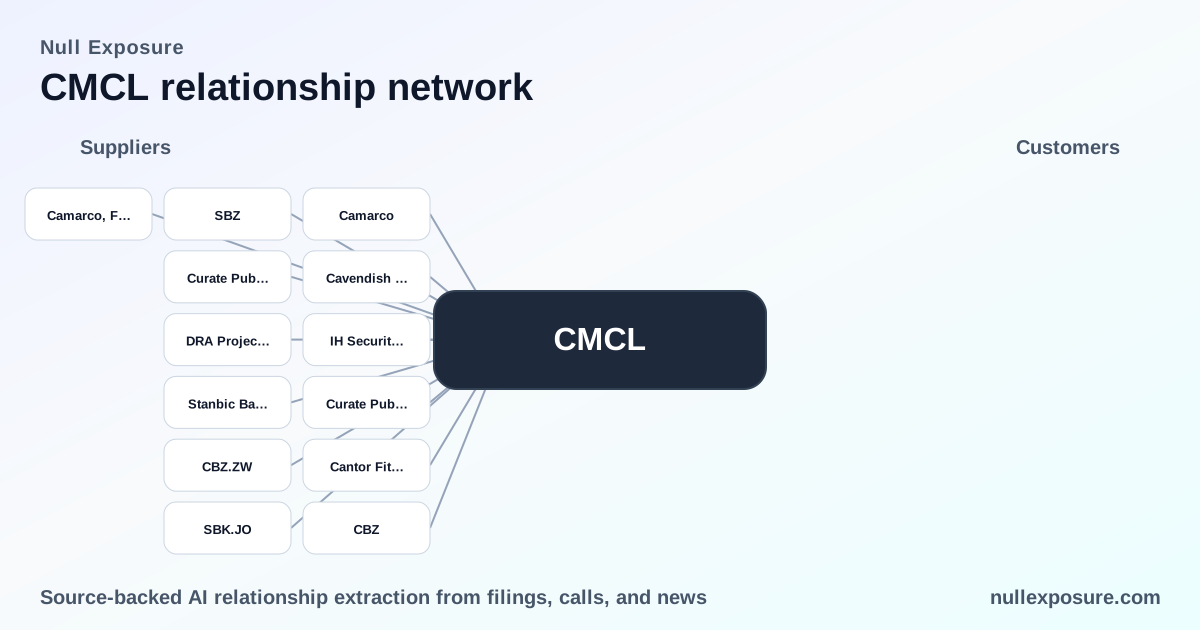
Caledonia Mining (CMCL): Customer relationships and the strategic tilt toward core mining economics
Caledonia Mining operates and monetizes as a focused gold producer: it extracts and sells gold from its operating mine and selectively monetizes non-core service assets, generating cash flow and returning capital to shareholders through dividends. Recent corporate actions — including the conditional sale of its mining-services arm — sharpen that focus and alter the company’s customer and counterparty footprint in ways investors must price into valuation and operational risk. For a concise view of relationship-level intelligence and implications, visit the firm homepage: https://nullexposure.com/.
The high-level investor snapshot you need first
Caledonia is a single-asset-style gold operator with a profitable operating profile. Latest public financials through the March 31, 2026 quarter show trailing revenue of $254.1M, EBITDA of $120.2M, and a profit margin of 21.7%, underpinning a dividend program (dividend per share $0.56; yield ~2.6%). Market capitalisation sits near $412M and trailing P/E is 7.5, signaling the market values the company on cash-generative mining economics rather than growth multiples. These figures are drawn from the company’s FY2026 disclosures and the latest quarterly reporting cycle.
How Caledonia’s customer and counterparty posture shapes business risk
Caledonia’s commercial profile has four practical implications for investors:
- Contracting posture — asset-level seller, not a broad industrial contractor. Revenue is primarily generated from the sale of physical metal rather than long-term off-take contracts or diversified product lines; that makes commodity price exposure and mine operating performance the dominant drivers of cash flow.
- Concentration — single-mine exposure increases counterparty sensitivity. A concentrated asset base compresses the universe of meaningful customers and service counterparties, so changes in relationships (for example, divestments) have outsized impact on operational flexibility.
- Criticality — services and internal capabilities are important but non-core. The recent disposition of a mining-services subsidiary signals management treats ancillary service lines as fungible when they can unlock shareholder value.
- Maturity — cash flow positive and shareholder-return oriented. Consistent EBITDA, a dividend program, and a relatively low EV/EBITDA multiple reflect a mature producer stance where capital allocation and steady production are priorities.
There are no explicit contractual constraints or third‑party caveats disclosed in the relationship constraints feed for FY2026; that absence itself is a company-level signal implying conventional, undisclosed commercial terms rather than embedded contingent liabilities.
Material customer / counterparty action: CrossBoundary Energy acquisition of Caledonia Mining Services
CrossBoundary Energy signed a conditional sale agreement to acquire Caledonia Mining Services Limited from Caledonia Mining Corporation Plc for $22.4 million. According to a Simply Wall St report dated May 2, 2026, the transaction is structured as a conditional sale and is intended to transfer the services business away from Caledonia as part of a strategic simplification.
This divestment reduces Caledonia’s exposure to service‑provider revenues and concentrates the company on gold production and bullion sales, while delivering a one-time cash inflow of $22.4M to the corporate balance sheet (Simply Wall St, May 2026).
Why that relationship change matters for investors
Selling Caledonia Mining Services to CrossBoundary Energy is a tactical move with strategic consequences:
- Improves balance sheet and liquidity optionality. The $22.4M proceeds are non-trivial relative to capital structure for a mid-cap miner and can fund near-term maintenance capex, repay short-term obligations, or support the dividend if needed.
- Reduces operational complexity and counterparty dispersion. Offloading a services arm shrinks the vendor/customer map and simplifies management focus; investors should price lower operational diversification and higher reliance on core mining cash flows.
- Shifts counterparty credit profile. CrossBoundary Energy becomes the post-transaction owner of the services business; any future services tie-ups or back-to-back arrangements will route through that new owner rather than Caledonia, changing credit and operational dependencies.
These outcomes derive from the stated transaction terms and the firm’s public financial profile in FY2026.
Relationship-level checklist: what investors and operators should track next
- Monitor confirmation and closing conditions for the CrossBoundary sale and any transitional services agreements that would preserve short-term operating continuity.
- Watch for redeployment of proceeds: capital allocation decisions (capex, debt paydown, buybacks, dividends) will materially affect return profiles.
- Track production guidance and unit costs, since the company’s revenue sensitivity to gold prices becomes the primary valuation lever once non-core services are divested.
- Evaluate counterparty concentration metrics post-sale to quantify the change in supplier and customer risk.
Investment implications and risk framing
- Upside case: Streamlined operations, steady free cash flow, and a strong dividend support a value-based re-rating if metal prices hold and production is steady. Analyst consensus target price (~$42.73) reflects upside from current levels if management executes capital allocation prudently.
- Downside case: Single-mine concentration and commodity exposure remain the principal risks; any production hiccup or adverse gold-price movement will compress margins quickly given limited revenue diversification.
- Catalysts to watch: closing of the CrossBoundary deal, capital redeployment announcements, quarterly production reports, and any new offtake or hedging programs.
Final read: what this relationship tells you about Caledonia’s strategy
The conditional sale to CrossBoundary Energy is a deliberate move to concentrate Caledonia’s economic exposure on gold production and shareholder returns. For investors focused on cash generation and dividend yield, that clarity is a positive; for those requiring diversification or a services-driven growth story, the company’s profile has just narrowed. Detailed monitoring of how proceeds are used and whether the company replaces lost service capabilities through third-party contracts will define short‑to‑medium-term risk-return dynamics.
If you want a structured tracker and ongoing relationship intelligence for Caledonia and its evolving counterparty map, explore strategic coverage at https://nullexposure.com/.