Cheetah Mobile (CMCM): Platform Exposure Defines the Investment Case
Cheetah Mobile is a China‑headquartered internet company that builds and distributes mobile applications globally and monetizes primarily through advertising inventory inside its apps and related app-services. For investors, the core thesis is straightforward: CMCM is a high‑revenue, low‑margin app publisher whose earnings and growth trajectory are tightly coupled to the health of app distribution channels and advertising platforms rather than to a proprietary SaaS contract book.
For a concise, data‑driven read on CMCM relationships and platform risk, visit https://nullexposure.com/ for additional context and screening tools.
How Cheetah Mobile makes money and where the risk lives
Cheetah Mobile generates the bulk of its reported revenue from advertising served inside its portfolio of mobile apps, supplemented by in‑app monetization and app‑service products. Revenue is large for a company of its market cap — roughly $1.15 billion trailing twelve months against a market capitalization near $162 million — which signals that market pricing discounts the company for earnings quality and platform dependence. Gross margins are high relative to peers, but operating and net margins are negative, reflecting heavy operating costs or restructuring that compress profitability even with substantial top line.
- Concentrated distribution and monetization: The business is structurally dependent on third‑party app stores and ad networks for distribution and ad buy flows. That posture creates leverage for platform owners and rapid downside when enforcement or policy changes occur.
- Financial posture: The company reports a positive gross profit of about $834 million but negative operating margins (around -33.7%) and negative EPS, indicating profitability is fragile and sensitive to revenue shocks.
- Investor base and liquidity signals: Institutional ownership is low and volatility is elevated (beta ~1.84), which increases idiosyncratic trading risk and puts more weight on material operational disclosures to reprice the security.
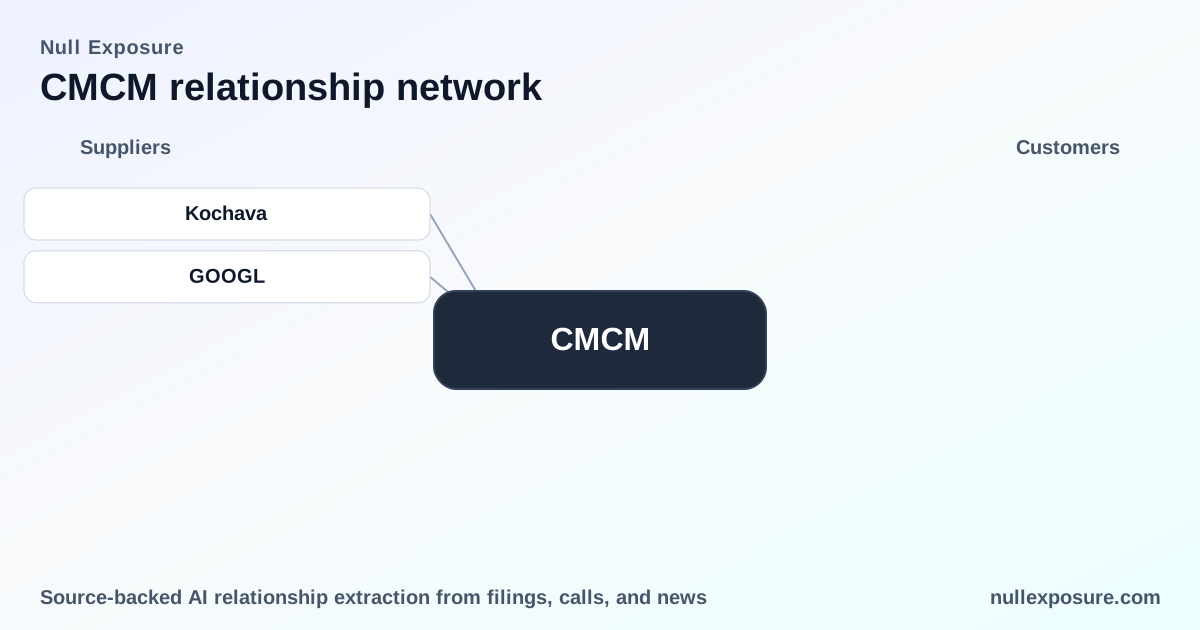
Documented customer relationship: Google — a defining counterparty event
In May 2026, BuzzFeed News reported that Google removed Cheetah Mobile’s suite of roughly 45 Android apps from the Google Play Store, and those apps no longer offered advertising inventory into Google’s ad networks. This action directly severs a primary distribution and monetization channel for Cheetah’s mobile ad inventory (BuzzFeed News, May 2, 2026).
Why this matters: removal from Google Play disrupts both app downloads and a programmatic path for selling advertising inventory into Google’s ad ecosystem, compressing ad impression supply and creating an immediate monetization gap.
Relationship implications and short, plain-English summaries
- Google (GOOGL) — BuzzFeed News reported that Google removed Cheetah Mobile’s full suite of apps from the Play Store in early May 2026, stopping those apps from offering inventory to Google’s ad networks and cutting off a major advertising distribution channel (BuzzFeed News, May 2, 2026).
What the Google event implies for revenues, contracts, and execution
The Google removal is not merely a headline; it is an operational shock that demonstrates counterparty concentration risk as a business constraint. For an app publisher that relies on scale of impressions and programmatic buyers, losing access to a dominant ad network and app store has four clear effects:
- Immediate revenue shock: ad impressions flow where distribution exists; removing apps from Play reduces impression volumes and shortens the sales funnel into major ad exchanges.
- Negotiation leverage shifts to platforms: platform owners can enforce policy and effectively delist products, which reduces the bargaining power of large app publishers in monetization disputes.
- Re‑distribution and remediation costs: reinstatement, appeals, or migration to alternative stores and ad exchanges requires time, product changes, and marketing spend, all of which compress near‑term margins.
- Signaling to advertisers and partners: a widely publicized enforcement action affects advertiser willingness to commit to future campaigns, raising buyer churn and reducing yield.
All four effects are directly visible in a balance sheet context where high revenue coexists with negative operating margins and razor‑thin EBITDA, intensifying the impact of any durable impression loss.
Company‑level operating characteristics investors should internalize
Because no explicit contractual constraints were provided in the source material, the following are company‑level signals derived from the operating and financial profile:
- Contracting posture: CMCM functions as a supplier of ad inventory and user attention rather than as a long‑term contracted vendor; counterparties (platforms and ad exchanges) control access and terms.
- Concentration: Distribution and monetization exhibit platform concentration risk; a small set of platforms and major ad networks control a substantial portion of reachable users.
- Criticality: To advertisers, CMCM is one channel among many; to Cheetah, those same platforms are critical for reach — an asymmetry that increases downside exposure to platform enforcement.
- Maturity: The company runs a mature product portfolio (established apps) but is operating with negative margins, which signals either investment in transition or structural pressure on the legacy monetization model.
Valuation context and investor readout
CMCM’s market numbers reflect a risk‑discounted valuation: low price‑to‑sales and price‑to‑book ratios sit alongside a relatively large revenue base and weak profitability. Institutional ownership is minimal, and trading volatility is elevated. Investors are effectively compensated for revenue scale but penalized for sustainability and platform dependence.
If partners like Google remain unavailable or if advertisers pull back, the earnings impact will be immediate and visible given current margin structure. Conversely, a rapid remediation with reinstatement or successful migration of inventory to alternative exchanges would restore the revenue base, but execution risk is material.
For a deeper behavioral read on platform enforcement trends and how peers respond, see analysis and screening at https://nullexposure.com/.
What investors should monitor next (catalysts and red flags)
- Company filings and interim disclosures explaining the scope and expected revenue impact of the Google removal.
- Traffic and download metrics across alternative app stores, plus changes in ad‑inventory supply and eCPMs reported in quarterly commentary.
- Any third‑party remediation or compliance confirmations that address the policy reasons cited by platform owners.
- Advertiser demand signals and whether programmatic buyers reduce bids or reallocate spend away from Cheetah properties.
Final takeaway
Cheetah Mobile trades as a large revenue, high‑risk media asset defined by platform access. The BuzzFeed News report that Google removed the company’s apps is a material customer/partner relationship event that magnifies the company’s intrinsic exposure to distribution and ad network counterparty power. The investment opportunity hinges on management’s ability to restore distribution and ad flows quickly or to re‑engineer monetization away from a single dominant platform; until that happens, the market will price CMCM as a revenue‑rich but structurally risky asset.
For an up‑to‑date tracking of platform enforcement events and their financial implications, visit https://nullexposure.com/ for focused monitoring and alerts.