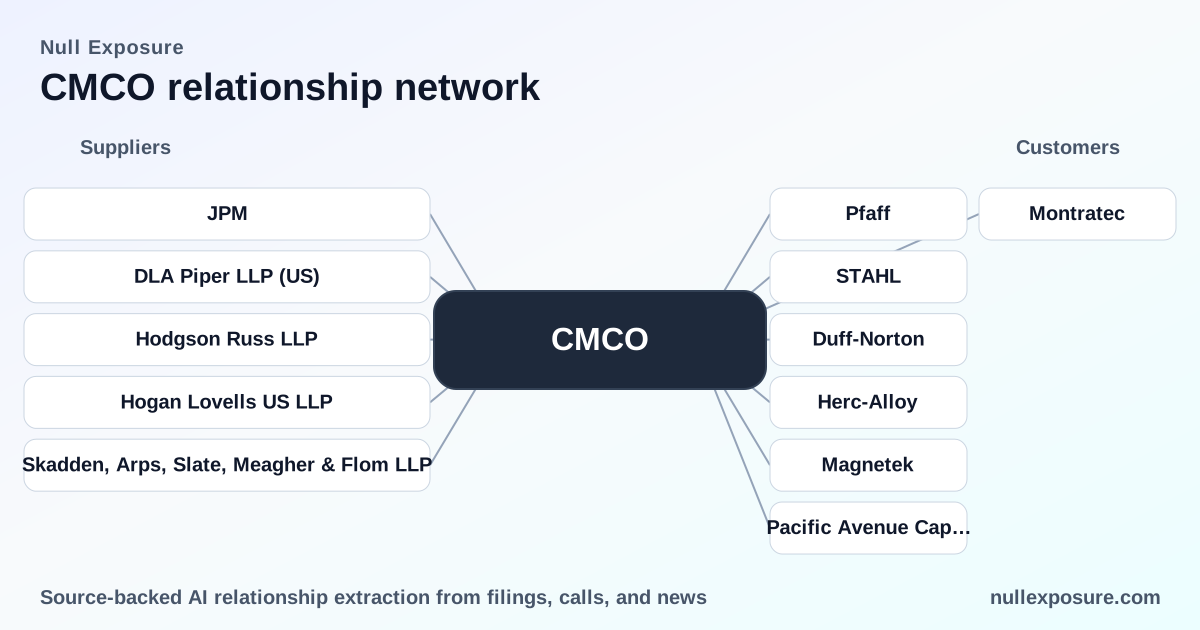
Columbus McKinnon (CMCO): Customer Map and Commercial Implications for Investors
Columbus McKinnon designs, manufactures and sells motion and lifting solutions—hoists, rigging, drives and controls—principally through third‑party distributors, brand channels and OEM crane builders, monetizing via product sales, aftermarket parts and service support. The company’s revenue profile is distribution‑led, U.S.‑biased and driven by a mix of legacy brands and targeted divestitures, making channel health and brand licensing central to valuation. For a concise view of customer exposures and partner flow, visit https://nullexposure.com/ for more analysis.
Why this matters: CMCO’s commercial strength is a function of branded channel reach (STAHL, Magnetek, Duff‑Norton, Pfaff and others), the profitability of aftermarket parts, and the stability of large institutional and government buyers that purchase load‑securing equipment. Recent corporate actions reshape those relationships and therefore near‑term revenue composition.
How Columbus McKinnon sells and what that means for cash flow
Columbus McKinnon operates as a manufacturer and seller that primarily routes volume through industrial distributors and crane builders, retaining direct sales only for select end‑user accounts. This contracting posture creates an operational profile where margins and growth depend on distributor inventory turns and backlog conversion rather than direct retail footprint. The company reports one operating segment and discloses a material U.S. revenue concentration—approximately 56% of fiscal 2025 sales originated in the United States—while maintaining global distribution reach.
Key operating signals investors should read into:
- Channel concentration: Distribution and OEM channels are the dominant go‑to‑market pathway for new equipment and aftermarket parts, creating dependency on distributor inventory cycles.
- Geographic profile: Meaningful U.S. exposure (majority share) combined with global operations reduces single‑market risk but amplifies U.S. economic sensitivity.
- Customer mix and criticality: Government accounts (including U.S. and Canadian Navies and Coast Guards) purchase securing chains and forged attachments, providing a steady, mission‑critical revenue stream.
- Scale and maturity: Founded in 1875 and reporting one segment, the business is mature and brand‑driven; revenue bands indicate material top‑line scale in the hundreds of millions.
These observations inform both growth prospects and cyclical vulnerability: when distributor restocking lags, revenue growth decelerates; when aftermarket demand is strong, margins expand.
The partner and brand relationships that define sales routes
Below I run through every customer and partner mention surfaced in the collected results. Each entry includes a one‑to‑two sentence plain‑English take and a concise source reference.
STAHL
STAHL is cited as one of the branded channels through which Columbus McKinnon distributes hoists and crane systems, signaling a branded reseller route for safety‑critical lifting equipment. Information on STAHL’s distribution role was noted in TradingView’s overview of CMCO (March 2026).
Source: TradingView analysis overview (March 2026).
Pfaff
Pfaff is another brand listed among distribution channels for hoists, chain and elevator drive systems, indicating that Columbus McKinnon leverages established brand names to reach OEM and end‑user markets. This distribution listing is documented in the TradingView company analysis (March 2026).
Source: TradingView analysis overview (March 2026).
Duff‑Norton
Duff‑Norton appears as a branded channel in Columbus McKinnon’s commercial mix, reflecting the company’s strategy of delivering specialized actuation and positioning solutions through legacy product brands. The association is referenced in TradingView’s CMCO overview (March 2026).
Source: TradingView analysis overview (March 2026).
Herc‑Alloy
Herc‑Alloy is included among the brands used to distribute chain, rigging tools and hoists, which underlines the company’s reliance on networked brand distribution for components that feed industrial and marine customers. This is noted in TradingView’s analysis (March 2026).
Source: TradingView analysis overview (March 2026).
Magnetek
Magnetek is cited alongside other brands as part of Columbus McKinnon’s distribution footprint for control systems and drive solutions, illustrating a go‑to‑market built on several specialized product lines. The relationship is described in TradingView’s overview (March 2026).
Source: TradingView analysis overview (March 2026).
Pacific Avenue Capital Partners
Pacific Avenue Capital Partners announced an agreement to acquire CMCO’s U.S. power chain hoist and chain business and related international sales support, a strategic carve‑out that will remove a piece of CMCO’s branded product offering from the corporate balance sheet and alter distribution responsibilities. The press release was published by TimesOnline and reproduced by Jacksonville (March 2026).
Source: TimesOnline press release (March 2026); Jacksonville press release (March 2026).
Montratec
Management commentary cited a significant backlog tied to prior orders from Montratec, indicating that third‑party purchase commitments are materially impacting backlog conversion and near‑term revenue recognition. The backlog reference appears in a Q3 FY2026 earnings call transcript published on InsiderMonkey (March 2026).
Source: InsiderMonkey earnings call transcript (Q3 FY2026).
Commercial risks and concentration—what investors should watch
The relationship map above leads to a concise set of investment‑relevant conclusions:
- Channel dependence is high. Selling primarily through distributors and branded channels concentrates commercial risk in the hands of a relatively small set of distribution partners and OEM buyers; inventory cycles will drive revenue volatility.
- U.S. exposure is meaningful. With roughly 56% of sales in the United States (fiscal 2025), macro conditions in North America disproportionately influence near‑term results, although the company maintains global sales channels.
- Government buyers are a stability anchor. Procurement by U.S. and Canadian naval and coast guard agencies for securing chains and forged attachments supplies a steady, non‑discretionary revenue lane that supports downside resilience.
- Divestiture reshapes product mix. The carve‑out of the U.S. power chain hoist and chain business to Pacific Avenue will materially reconfigure CMCO’s product portfolio and distribution economics; investors should model the impact on revenue, gross margin mix and aftermarket service revenues.
- Order backlog matters. Reported backlog tied to third‑party orders (for example, Montratec) indicates potential near‑term revenue visibility but also dependence on a handful of large orders for throughput.
Tactical monitoring checklist for analysts
- Track Q‑to‑Q distributor inventory turns and backlog conversion metrics.
- Monitor the integration and carve‑out timeline with Pacific Avenue Capital Partners and the residual international sales support transition.
- Watch government procurement schedules for load‑securing equipment as a countercyclical revenue element.
- Review quarterly commentary for any changes in branded distribution agreements with STAHL, Pfaff, Magnetek, Duff‑Norton and Herc‑Alloy.
For investors building a relationship‑aware model of Columbus McKinnon, the combination of mature branded channels, U.S. concentration and an active carve‑out program creates both near‑term modeling complexity and long‑term optionality. Explore deeper customer linkage analysis and primary source tracking at https://nullexposure.com/ if you want a tailored exposure map and ongoing alerts.