Costamare Bulkers (CMDB): Customer relationships reshape a small-cap bulker play
Costamare Bulkers owns and operates dry-bulk vessels and generates revenue by chartering those ships to commodity traders, charterers and spot markets while selectively trading time-charters and forward freight agreements. Recent disclosures show Costamare Bulkers is deliberately shifting away from a trading-heavy platform toward core vessel operations, monetizing through charter income and asset sales while farming out trading exposures to large counterparties. For a concise dashboard of related signals and to track counterparties, visit https://nullexposure.com/.
Why the Cargill tie-up materially changes the revenue mix
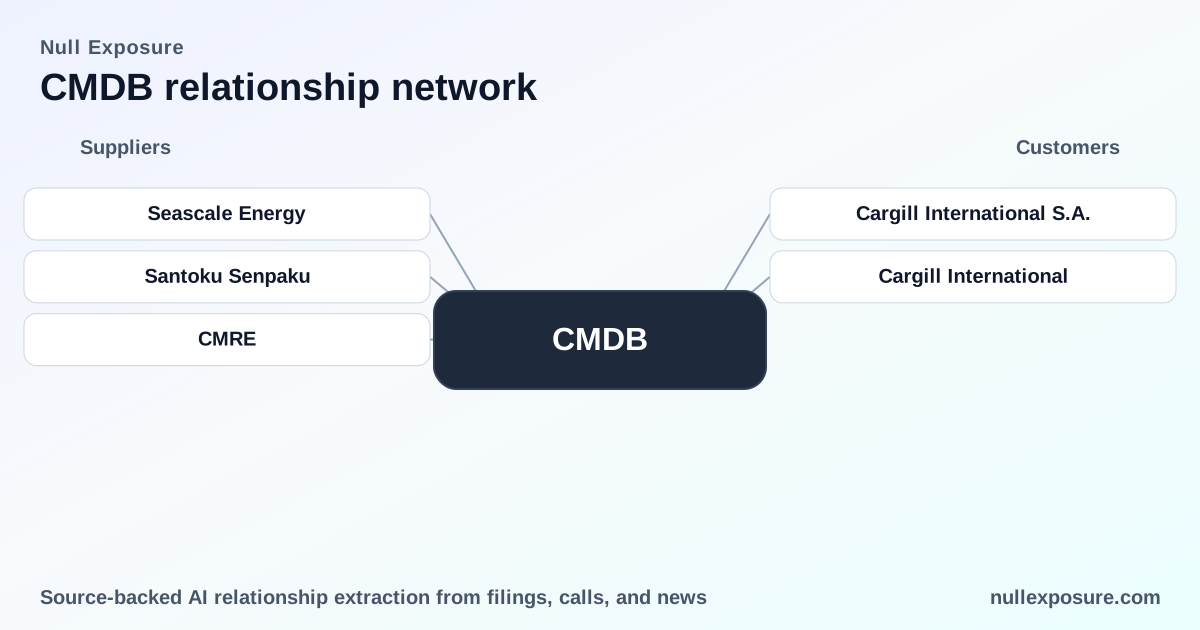
Costamare Bulkers announced a Strategic Cooperation Agreement with Cargill that repositions the company’s commercial exposure. The deal includes the short-term charter of four Supramax vessels to Cargill for four to six months and the transfer of the majority of Costamare Bulkers’ third‑party trading book — including FFA positions, forward cargo commitments and certain chartered‑in vessels — to Cargill, enabling management to redeploy resources into owning and operating vessels directly. According to Dry Bulk Magazine (announcement dated Sept. 29, 2025) and corroborated by the company’s Q4 2025 remarks captured in earnings transcripts in May 2026, the transaction is both tactical (short-term charters) and strategic (platform realignment). (Source: Dry Bulk Magazine, Sept. 29, 2025; Investing.com earnings transcript, May 2026)
What investors need to know about the Cargill relationship
- The Cargill arrangement delivers immediate charter revenue from four Supramax vessels and removes a large portion of trading volatility from Costamare Bulkers’ P&L. Multiple trade press outlets reported the four‑vessel charter and the transfer of the trading book, underscoring a one‑time structural change to the company’s commercial operations. (Source: Shipping Telegraph and gCaptain reports, March 2026)
- Management has completed the transfer of the majority of the trading book and charter investors to Cargill, with one remaining ship scheduled for transfer within the following year, per the company’s Q4 2025 commentary. This reduces the company’s trading counterparty exposure and concentrates revenue on charter income and asset rotation. (Source: Investing.com earnings transcript, May 2026)
Anbros Maritime: asset disposal and fleet pruning
Costamare Bulkers’ FY2025 reporting notes the sale of an en‑bloc package of four Handysize vessels — Verity, Parity, Acuity and Equity — which trade press linked to Anbros Maritime’s acquisitions; these asset sales are consistent with the company’s fleet renewal and capital redeployment strategy. This indicates active asset rotation to refresh fleet mix and strengthen the balance sheet. (Source: Riviera Maritime, May 2026)
CAIL: an additional cooperation channel reported in earnings highlights
Earnings call highlights and investor coverage referenced a cooperation agreement with an entity labelled CAIL that included the disposal of the company’s trading portfolio, a complementary disclosure to the Cargill transaction that emphasizes a corporate decision to exit trading exposures and streamline commercial operations. (Source: Investing.com coverage of Q4 2025 highlights, May 2026)
Operating model signals and business constraints (company-level view)
No formal constraints list was supplied, but company-level data and the foregoing transactions reveal four actionable operating characteristics:
- Contracting posture — increasingly owner‑operator: The company is shifting from a mixed trading/charter model toward core ownership and time/spot-charter operations; the transfer of FFAs and chartered‑in vessels to Cargill signals a move to simplify commercial engagements and reduce derivatives exposure.
- Counterparty concentration risk: Transferring a substantial portion of the trading book to a single global commodity player like Cargill concentrates strategic counterparties, which gives Costamare Bulkers a stable large‑customer relationship but increases dependency on the terms negotiated with a dominant counterparty.
- Criticality of assets: Vessels are capital‑intensive, immobile assets whose economic value depends on freight rates and charter coverage; Costamare Bulkers’ model now leans on asset utilization and sale/lease timing to deliver returns.
- Maturity and capital structure: With a market cap of roughly $413 million, FY‑TTM revenue around $597 million but negative net income and slim margins (Profit Margin -6.25%, Operating Margin -12.2%, Diluted EPS -2.3), the company presents as a small-cap operator in transition rather than a mature, stable cash generator. Insider ownership is high (about 65.7%), the public float is limited, and institutional ownership is modest (~20.2%), which affects liquidity and governance dynamics. (Source: company overview metrics, latest quarter FY2025/FY2026)
Relationship-by-relationship summary (plain English, one or two sentences each)
- Cargill/Cargill International S.A.: Costamare Bulkers entered a Strategic Cooperation Agreement that includes chartering four Supramax vessels for four to six months and transferring the majority of its trading book (FFAs, forward cargoes, and some chartered‑in vessels) to Cargill, refocusing the company on vessel ownership and core charter operations. (Source: Dry Bulk Magazine announcement, Sept. 29, 2025; Investing.com earnings call coverage, May 2026)
- Anbros Maritime: Costamare Bulkers sold an en‑bloc package of four Handysize vessels (Verity, Parity, Acuity, Equity), a set of disposals reported as acquired by Anbros Maritime and consistent with fleet pruning and asset recycling. (Source: Riviera Maritime report, May 2026)
- CAIL: Costamare Bulkers’ Q4 2025 highlights note a cooperation agreement with CAIL that included disposal of the trading portfolio, aligning with the firm‑wide strategic move away from trading exposures. (Source: Investing.com company highlights, May 2026)
Investment implications: risk and reward in a re‑centered strategy
Costamare Bulkers’ pivot to core vessel operations creates a cleaner earnings profile that is less volatile from derivatives and forward cargo positions but simultaneously more dependent on charter market cycles and a tighter set of major counterparties. Key takeaways:
- Potential upside: A streamlined model reduces trading drawdowns and could improve operating focus; asset sales free capital for fleet renewal or debt reduction.
- Material risks: Concentration on one or a few large counterparties (e.g., Cargill) and exposure to freight cycle downturns imply earnings sensitivity; high insider ownership and a small float create liquidity and governance considerations.
- Valuation context: At a market cap of roughly $413M and negative margins, the company trades like a transitional operator rather than a stabilized cash generator; investors should price in cyclical volatility and execution risk on fleet renewal.
For analysts tracking counterparty exposures and to compare counterparties across small-cap maritime operators, see deeper signals at https://nullexposure.com/.
Bottom line
Costamare Bulkers is restructuring commercial exposure by offloading trading positions and chartered‑in risks to major commodity players while continuing to monetize through charter revenues and targeted asset sales. That repositioning reduces headline volatility but reassigns risk to charter markets and counterparty negotiation — an outcome that changes the investment case from trading upside to asset-management execution.