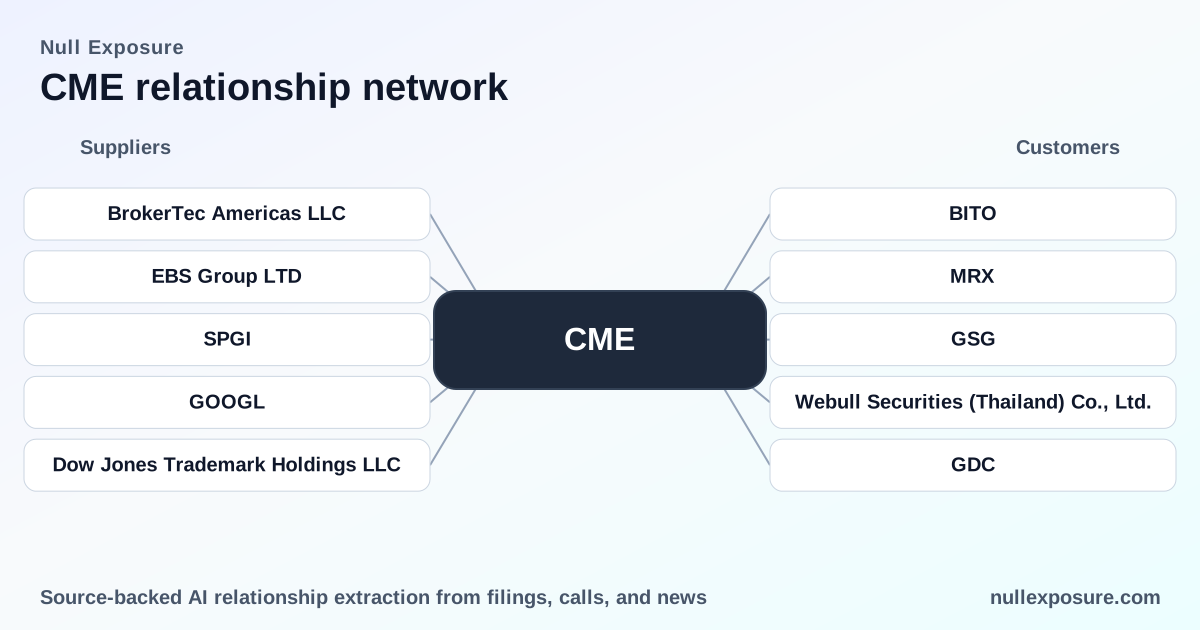
CME Group (CME) — customer relationships that define market reach and revenue quality
CME Group operates the world’s largest derivatives marketplace, monetizing through transaction and clearing fees, subscription market-data sales, and licensing of benchmark rates and reference data; its business model combines high-margin data and fee-based revenue with network-driven clearing economics. For investors evaluating CME’s customer fabric, the critical questions are concentration of market-data resellers, clearing counterparty exposure, and the breadth of end-users that drive transactional volumes across asset classes. For a quick look at the platform implications and partner set, visit https://nullexposure.com/ for deeper relationship mapping.
How CME gets paid: the practical mechanics investors should track
CME’s cash generation is anchored in three durable levers: per-trade and per-contract fees, recurring market-data subscriptions and reseller licenses, and clearing services where the exchange functions as central counterparty. Market data is billed on a subscription or device basis and recognized monthly; clearing and transaction fees flow through clearing firms who are billed for the trades they clear. This mix produces a high-margin revenue profile and creates dependency on both institutional flow providers and a small set of distribution partners.
Key implication: recurring market-data revenue plus concentrated resellers amplify operating leverage but raise vendor-counterparty concentration risk.
Operating constraints and business-model signals
CME’s disclosed customer constraints are instructive for risk and strategy assessment:
- Subscription-heavy market-data model is the norm: market data is generally billed monthly and priced by reportable devices and subscribers, making data revenue predictable and recurring.
- Global counterparty base includes governments, central banks, institutions and retail, underscoring geographic diversification and systemic importance.
- Concentration risk is real: about 30% of market-data revenue in 2024 derived from the two largest resellers — that is a material reseller concentration and a reseller relationship role at scale.
- Clearing concentration: at least one clearing firm represented ≥10% of clearing and transaction fees in 2024, signaling single-counterparty exposure that is material to fee income.
- Customer mix and lifecycle: 85% of contract volume in 2024 was from member trades, indicating an active, member-driven trading base; the business sits in the “services” segment with mature, high-margin offerings.
- Counterparty types span governments to individuals, which increases network stickiness but requires robust risk and regulatory controls.
These constraints should inform diligence on renewal terms with resellers, the stability of top clearing relationships, and the ongoing licensing value of CME benchmarks.
Customer relationships: who the market cites using CME
Below is a concise, source-linked run-through of every relationship record surfaced in the provided results.
TOP
TOP offers clients access to major global exchanges, including CME, via low-latency trading platforms and 24-hour support, positioning CME as a core venue for futures and options access. Source: TipRanks company announcement (May 4, 2026).
MRX (Marex Group / MRX)
Marex states it clears crypto futures for clients primarily on CME, and plans to extend 24/7 clearing capability to those offerings, signalling CME’s central role in institutional crypto derivatives clearing. Source: Marex Group Q4 & FY2025 results and earnings call transcript (March 2026).
HOOD (Robinhood Markets)
Robinhood’s product rollout referenced the upcoming CME Group 100-ounce silver futures contract launch for 2026, indicating direct product-level integration between CME new contracts and retail derivatives platforms. Source: Sahm Capital coverage on Robinhood (Jan 16, 2026).
Marex Group plc (duplicate record)
Marex reiterates it clears crypto futures primarily on CME, reinforcing the firm-level relationship with CME for digital-asset clearing services. Source: The Globe and Mail / Marex Q4 call transcript (March 2026).
FanDuel
CME noted a marketing partnership launched mid‑March with FanDuel, signifying an effort to broaden retail-facing awareness for exchange-traded derivatives or related products. Source: CME Group Q1 2026 earnings call transcript (April 22, 2026).
BITO (ProShares Bitcoin Strategy ETF)
ProShares’ BITO gains bitcoin exposure via Bitcoin futures contracts traded on CME, underlining CME’s role as the principal venue for institutional bitcoin futures. Source: Bitget ETF primer explaining BITO structure (March 2026).
ProShares Bitcoin Strategy ETF (BITO) (duplicate)
The ProShares ETF uses CME-traded bitcoin futures as its exposure mechanism, confirming multiple ETF issuers route futures flow through CME. Source: Bitget academy page on BITO (March 2026).
GSG (iShares S&P GSCI Commodity‑Indexed Trust)
GSG confirms its index futures are listed on CME, and the trust notes credit exposure to CME’s clearing house as counterparty, highlighting clearing counterparty risk from an ETF perspective. Source: iShares S&P GSCI annual report filing (FY2026).
iShares S&P GSCI Commodity‑Indexed Trust (duplicate)
The trust’s filing again ties its index futures positions to CME listing and clearing counterparty exposure, restating regulatory and operational reliance on CME clearing. Source: StockTitan reproduction of the trust’s FY2026 report (March 2026).
VIASP (Via Renewables Series A Preferred)
Via Renewables’ preferred-stock floating-rate benchmark shifted from LIBOR to Three-Month CME Term SOFR, administered by CME Group Benchmark Administration, demonstrating CME’s role beyond trading into benchmark administration. Source: Via Renewables dividend/preferred-stock disclosure (May 2026).
Webull Securities (Thailand) Co., Ltd.
Webull Thailand lists CME Group for futures market data among its data relationships, indicating the exchange’s global market-data distribution to retail trading platforms. Source: Market profile on Webull Thailand (March 2026).
BITO (additional duplicate entries)
Additional reporting reiterates BITO’s exposure-through-CME-futures structure, supporting the broader ETF-to-CME pipeline for bitcoin futures. Source: Bitget academy (March 2026).
The ProShares Bitcoin Strategy ETF (BITO) (additional duplicate)
A reiteration that ProShares routes bitcoin futures exposure via CME, reflecting repetitive confirmations across sources. Source: Bitget academy (March 2026).
GD Culture Group Limited (GDC)
GDC ties its repurchase timing and sizing to bitcoin pricing measured by the CME CF Bitcoin Reference Rate - New York Variant, reinforcing CME benchmarks’ use for corporate treasury decisions. Source: Company 8‑K / SEC filing (March 2026).
CBOO (Calamos / protected bitcoin instrument)
Calamos’ product references the CME CF Bitcoin Reference Rate – New York Variant as an index input for its outcome-oriented fund, showing CME pricing is embedded in structured ETF products. Source: ETF Trends coverage of Calamos product launch (2025 filing referenced).
MIAX
MIAX’s financials noted the elimination of expenses related to CME Globex, implying one-time cost and operational linkage between MIAX participants and CME’s previous platform arrangements. Source: Miami International Holdings Q4 & FY2025 results (March 2026).
GUG (Guggenheim fund filing)
Guggenheim’s filings show potential cash-settled exposure via derivatives traded on CME, indicating the exchange’s footprint within listed crypto or derivatives fund strategies. Source: Blockworks reporting on Guggenheim fund plans (2026 article summarizing filings).
BTCW (WisdomTree Bitcoin Trust)
WisdomTree indicated its NAV calculation ties to the CME CF Bitcoin Index, emphasizing CME’s role in index construction and ETF NAV frameworks. Source: ForkLog coverage of WisdomTree filing (2021 filing cited).
EZBC
EZBC’s index-tracking reference specifically cites the CME CF Bitcoin Reference Rate - New York Variant as the benchmark, reaffirming the reference-rate use across smaller index products. Source: TradingView index description (2024–2026).
VIASP (duplicate entry)
A second notice reiterates Via Renewables’ replacement benchmark using CME Term SOFR, again underscoring CME’s benchmark administration role. Source: Access Newswire release on Via Renewables (2025).
ETOR (eToro)
eToro launched spot-quoted futures “brought to market in collaboration with CME Group,” indicating product-level collaboration to bring futures to retail investors with spot-like pricing. Source: Markets Media coverage of eToro product roll-out (2025).
Bottom line for investors
CME’s footprint extends beyond execution to data licensing, benchmark administration, and cleared product plumbing. The customer map shows heavy usage by institutional brokers, ETF issuers, retail platforms and structured-product managers, and a significant dependency on a small group of resellers and large clearing firms—both material concentration factors. For relationship-level intelligence and to model counterparty concentration into forecasts, see the detailed mapping at https://nullexposure.com/.
For investors, the most salient risk vectors are reseller concentration of market-data revenue and clearing-firm dependence for transaction fee flow; both validate premium valuation if managed, but require monitoring as part of any CME thesis.