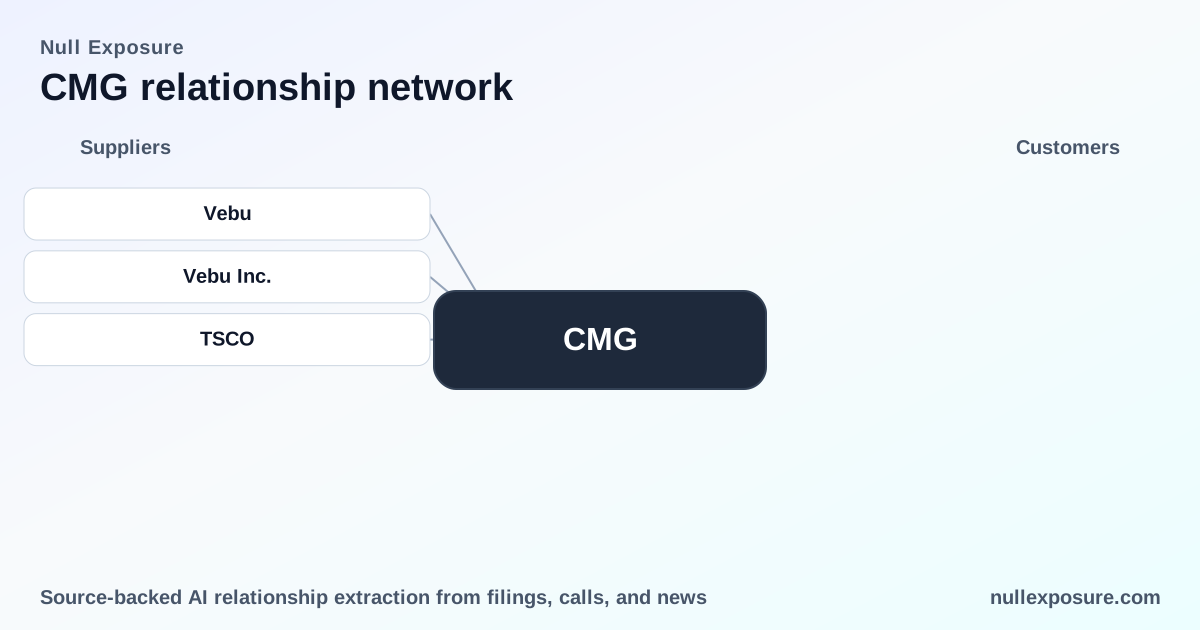
Chipotle (CMG) — Customer Partnerships and What They Signal for Investors
Chipotle monetizes a large, primarily U.S.-based fast-casual restaurant network by selling made-to-order Mexican-style food directly to consumers across company-operated restaurants and a growing digital channel; incremental revenue and brand value are generated through promotional partnerships and co-branded merchandising rather than large, contractually recurring customer accounts. Revenue concentration is low and promotional partnerships are strategically marketing-led, so investors should evaluate customer relationships through the lens of brand reach, customer acquisition ROI, and operational leverage rather than supplier-style contract risk. For a concise overview of how we build these customer views, visit https://nullexposure.com/.
A quick reading: what this customer data set tells you about Chipotle
Chipotle’s customer relationships in the available results are promotional and retail-collaboration oriented, not enterprise procurement contracts. The single observed relationship is a co-branded consumer product partnership with Urban Outfitters (URBN) that drives brand visibility and limited merchandise revenue. This is emblematic of a low-concentration, marketing-led customer posture rather than dependence on a small number of large customers.
One partnership worth noting: Chipotle × Urban Outfitters
Chipotle’s only listed customer relationship in the results is with Urban Outfitters (URBN). According to a Simply Wall St news item on May 4, 2026, Chipotle and Urban Outfitters launched a “Little Extra Dorm” collection featuring menu-inspired products, a collaboration positioned around branded merchandise timed to the back-to-college season. This is a short-form retail collaboration that boosts brand relevance and drives ancillary sales rather than core restaurant revenue. (Source: Simply Wall St, news item, May 4, 2026.)
Why this type of relationship matters to investors and operators
Promotional retail tie-ins like the URBN collaboration are valuable for brand extension, incremental revenue, and top-of-funnel customer acquisition, but they are not a substitute for same-store sales growth or digital mix improvements. These partnerships are:
- Low revenue criticality: They do not represent material line items—Chipotle’s public filings state that no single customer accounts for 10% or more of revenues, which is a company-level signal of low customer concentration and low counterparty revenue risk.
- High marketing utility: Co-branded merchandise reinforces brand affinity among younger demographics and can drive customer visits indirectly.
- Short-to-medium term in nature: These arrangements are promotional and episodic, rather than long-term operating contracts.
Constraints that define the customer profile
Two company-level constraints from the source material frame Chipotle’s customer posture and should be read as structural characteristics of the business:
- Geographic concentration: Chipotle reports a single reportable operating segment—U.S.—which is a signal that its customer base and revenue generation are predominantly domestic. That concentration amplifies the importance of U.S. consumer trends, labor markets, and regulatory dynamics for revenue performance.
- Customer immateriality: The company explicitly discloses that no customer accounts for 10% or more of revenues, which indicates a deliberate operating model focused on high-volume, low-concentration retail sales rather than dependence on a few large buyers.
These constraints imply a contracting posture that favors standard consumer-facing agreements and promotional partnerships rather than bespoke, high-touch commercial contracts. From an investor perspective, counterparty credit risk is dispersed, but macro consumer risk and U.S. market exposure are concentrated.
Operational implications for restaurant operators
For operators and franchise/area developers evaluating customer-driven initiatives:
- Promotional partnerships should be measured against store-level economics. The marketing lift from a co-branded retail drop must translate into incremental visit frequency or ticket size to justify operational disruption.
- Inventory and fulfillment remain core risks. Merchandise collaborations require coordination across supply chain and digital channels; these are short-term projects but demand operational bandwidth.
- Brand risk is manageable but real. Co-branded products amplify Chipotle’s identity; misaligned collaborations could dilute the core value proposition, so partnerships must be curated.
Investment implications and risk profile
Chipotle’s business model delivers steady unit economics with digital uplift, and promotional customer relationships are additive rather than fundamental to cash flow. Investors should weigh:
- Earnings sensitivity to U.S. consumer cycles: Given the single-segment reporting and domestic concentration, same-store sales and digital penetration are primary drivers of valuation sensitivity.
- Low counterparty concentration: The absence of material customers underwrites predictable revenue recognition from a contractual standpoint; downside is tied to consumer demand rather than customer defaults.
- Brand-driven upside: Strategic partnerships (like the Urban Outfitters collaboration) expand reach to younger cohorts at relatively low marginal cost.
Key takeaways for a portfolio manager: prioritize same-store sales trends, digital channel expansion, and margins over transient merchandising deals when modeling forward revenue and free cash flow.
Relationship-by-relationship inventory (complete)
- Urban Outfitters (URBN): Chipotle partnered with Urban Outfitters to launch a “Little Extra Dorm” collection featuring menu-inspired products, a promotional merchandising collaboration targeted at the back-to-school demographic. This initiative is a brand-extension play designed to generate incremental revenue and awareness rather than substantive recurring sales. (Source: Simply Wall St news coverage, May 4, 2026.)
This listing is exhaustive relative to the supplied relationship results.
Final assessment and what to watch next
Chipotle’s customer interactions in this sample are marketing-driven and immaterial to revenue concentration. For investors, the core value drivers remain restaurant unit productivity, digital sales, and margin retention. For operators, promotional partnerships are useful tactical levers but must be aligned with store economics and supply chain capacity.
If you want a deeper, comparable read across restaurant brand partnerships and customer concentration signals, explore more analysis and signals at https://nullexposure.com/.