Cummins Inc. (CMI) — Customer Relationships and What They Signal for Investors
Cummins designs, manufactures and services diesel and alternative-fuel engines, power generation systems and related components, monetizing through OEM sales, a global distribution and dealer network, aftermarket parts and service, and targeted technology partnerships that extend into zero-emissions and hybrid platforms. The company’s revenue mix is driven by high-margin aftermarket and services, large OEM contracts, and strategic joint ventures and collaborations that accelerate product adoption in fleets and industrial applications. For a deeper look at how customer footprints translate to commercial risk and opportunity, visit https://nullexposure.com/.
High-level takeaways for investors
Cummins operates as an OEM and global distribution-and-services platform with longstanding relationships across trucking, construction, rail and fleet customers. The firm’s business model combines capital-intensive manufacturing with recurring aftermarket revenue, which creates stickiness but also customer concentration risk where major OEMs and dealers represent material shares of consolidated sales. Cummins’ partnerships with fleet operators and technology firms accelerate adoption of hybrid and lower-emission powertrains, preserving aftermarket revenue while opening new product adjacencies.
- Geography and reach: Cummins sells worldwide but shows a heavy North American revenue base alongside important APAC and global OEM relationships.
- Customer roles: The firm sells directly to OEMs, distributors and dealers and supports them via service networks and joint ventures.
- Concentration signal: Disclosures indicate a top customer representing a multi-billion-dollar annual relationship historically accounting for double-digit percentage shares of consolidated net sales—an important concentration exposure to monitor.
A second topical read on platform-level customer signals is available at https://nullexposure.com/.
Operating model constraints and what they imply
The public excerpts around Cummins’ customers convey several company-level constraints:
- Geographic concentration: While Cummins is global, North America is the dominant revenue region, supported by meaningful operations in China and APAC; this shapes demand sensitivity to North American trucking cycles and regulatory shifts.
- Distribution-led go-to-market: Cummins relies on a broad mix of wholly-owned, joint venture and independent distributors and >13,000 certified dealer locations, indicating long sales tails and recurring service revenue but also dependency on channel economics and inventory cycles.
- Segmented operations: The Engine, Distribution and Services segments create complementary cash flows—manufacturing underpins OEM supply while Distribution and Services capture aftermarket margins.
- Relationship maturity and criticality: Multiple long-term OEM and fleet collaborations show mature, strategic ties; at the same time, a disclosed large customer representing billions in annual sales denotes tangible concentration risk across consolidated net sales.
These constraints imply Cummins contracts both as a strategic parts-and-systems supplier for critical vehicle platforms and as a service provider with embedded aftermarket revenue — a mix that drives stability but concentrates downside if major OEMs reduce orders.
What every relationship in the record tells investors
Below I list every customer relationship in the provided results with a concise investor-focused take and a source note.
MLR
MLR said during its 2024Q4 earnings call that its chassis suppliers are working with Cummins Engine Company to design new trucks, signaling Cummins’ role supplying powertrain components in upcoming chassis designs. (MLR 2024Q4 earnings call, first seen March 2026.)
LBRT
Liberty Broadband (LBRT) reported that its digiPrime platform development now includes the industry’s first natural gas variable-speed, large-displacement engine developed with Cummins, establishing Cummins as a core propulsion partner for LBRT’s platform work. (LBRT 2024Q4 earnings call, March 2026.)
Alstom SA
MarketScreener and related press note that Alstom acquired Cummins’ rail hydrogen business in FY2026, illustrating Cummins’ strategic portfolio realignment in hydrogen rail assets and an executional divestiture to a rail-focused buyer. (Marketscreener, Apr–May 2026 news.)
WMT (news)
A trade press piece covering ACT Expo described Cummins and Walmart jointly testing hybrid configurations using Cummins engines and Accelera by Cummins systems, demonstrating fleet-level validation and operational testing on a major national customer route. (ACT Expo coverage via STN Online, FY2026.)
HYLN (AftermarketNews)
Hyliion’s Hypertruck ERX uses a Cummins natural gas engine as an onboard generator for its range-extender electric architecture, positioning Cummins as the generator supplier in hybrid long-haul electrified powertrains. (Aftermarket News, FY2023 coverage cited in 2026 content.)
EMBK (Samoa Observer)
Embark is testing Cummins’ automated driving system (ADS) powertrain interface, indicating Cummins’ involvement in ADS compatibility and integration with autonomous trucking platforms. (Samoa Observer tech coverage, FY2021 reporting noted in 2026.)
EMBKW (TTNews)
Embark’s public comments on partnerships list Cummins alongside NVIDIA, Luminar and ZF to accelerate integration of the Embark Universal Interface, signaling Cummins’ supplier role in autonomous vehicle platform integration. (TTNews coverage, FY2021.)
HYLN (Fleet Equipment Magazine)
Hyliion and Cummins announced collaboration to optimize Cummins’ natural gas engine as the generator for the Hypertruck ERX, reinforcing multiple media confirmations of the same technical partnership over successive reporting periods. (Fleet Equipment, FY2022.)
RUSHA (TruckingInfo)
Rush Enterprises referenced bringing a 15-liter natural gas engine and expected prototypes and fuel-system sales through Cummins Clean Fuel Technologies, highlighting a joint-venture sales channel into CNG fleet conversions. (TruckingInfo interview, FY2022.)
RUSHA (Yahoo Finance)
Rush Enterprises’ operations include CNG fuel systems via its investment in Cummins Clean Fuel Technologies, showing commercial deployment and resale of Cummins clean-fuel hardware through an operator-adjacent distributor. (Rush Enterprises FY2025 release via Yahoo Finance.)
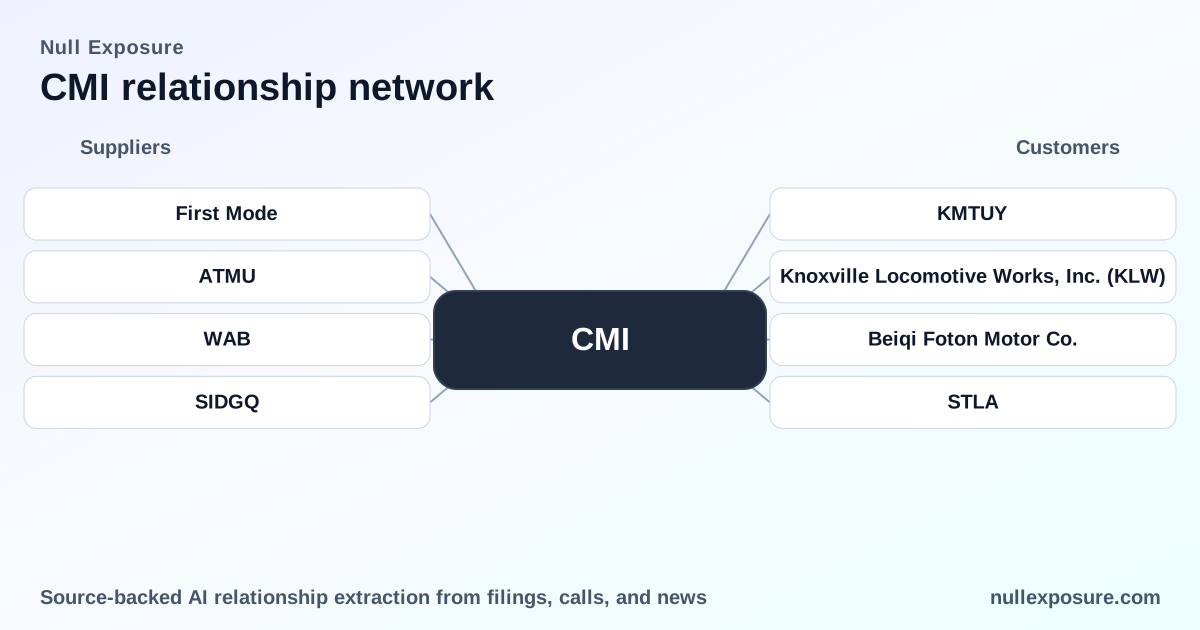
Knoxville Locomotive Works (KLW)
KLW completed a remanufacture of a line-haul freight locomotive using the Cummins 4,400 hp QSK95 engine system, confirming Cummins’ relevance in high-horsepower rail applications. (Railway-News coverage, FY2026.)
Walmart (STN Online)
A STN Online piece notes a third hybrid test vehicle has been in service with Walmart since November 2025, underscoring continuous fleet trials with a major retail operator validating Cummins’ hybrid systems. (STN Online ACT Expo coverage, FY2026.)
MTW (Manitowoc — carrydeck engine)
Manitowoc’s carrydeck crane is offered with a Tier IV final Cummins QSF 3.8-liter engine option, demonstrating Cummins’ penetration into construction and lifting equipment markets. (ForConstructionPros product coverage, FY2021.)
MTW (Manitowoc — GRT8100-1)
Manitowoc also cites the Cummins B6.7L engine and Engine CCS features on its GRT8100-1 rough-terrain crane to deliver TCO savings, signaling OEM-level integration and fuel-efficiency positioning. (ForConstructionPros product launch, FY2025.)
RUSHB (QuiverQuant)
QuiverQuant’s release repeats Rush Enterprises’ use of CNG fuel systems through Cummins Clean Fuel Technologies, further validating the recurring reseller/channel relationship. (QuiverQuant FY2025 release.)
RUSHA (SupplyChainDigital)
SupplyChainDigital similarly documents Rush’s involvement with Cummins Clean Fuel Technologies, reinforcing the distribution/reseller pathway into fleet retrofits and CNG sales. (SupplyChainDigital press release, FY2025.)
Ram / STLA (WBIW)
Local media reported a recall affecting Ram 2500/3500 models (2013–2018) equipped with Cummins diesel engines, a reminder that Cummins’ product quality and remediation can directly influence OEM customer relations and warranty exposure. (WBIW local reporting, FY2026.)
STLA (duplicate Ram note)
A duplicate STLA-tagged entry confirms the same recall targeting Ram models with Cummins diesel engines, emphasizing shared OEM risk between Cummins and vehicle manufacturers. (WBIW FY2026.)
Freightliner (TTNews)
Freightliner opened orders for fifth-generation Cascadias equipped with the X15N in April 2025, indicating Cummins’ engine platform adoption in Class 8 OEM product cycles. (TTNews FY2026 coverage referencing 2025 orders.)
Beiqi Foton Motor Co.
Cummins and Beiqi Foton formed a 50/50 JV, Beijing Foton Cummins Engine Co. Ltd., to produce light-duty engines in Beijing, demonstrating Cummins’ local-production strategy and partnership model in China. (ForConstructionPros / Cummins press, FY2026.)
KMTUY / Komatsu (earnings call)
Cummins announced a collaboration with Komatsu to develop hybrid powertrains for surface-haul mining equipment, reflecting Cummins’ expansion into heavy mining electrification and hybridization. (Cummins 2025Q4 earnings call, FY2025.)
Komatsu (duplicate)
The Komatsu mention in Cummins’ own 2025Q4 briefing confirms the strategic collaboration to co-develop hybrid powertrains for mining applications. (Cummins 2025Q4 earnings call, FY2025.)
Investment implications — synthesis
- Revenue durability: Cummins’ vast distribution and service network underpins recurring aftermarket revenue; Fleet and OEM partnerships (Walmart, Freightliner, Komatsu) create structural demand for parts and service.
- Concentration risk: Public disclosure of a single customer accounting for double-digit percentage of consolidated sales is a material monitoring point for downside in severe OEM cycles.
- Technology transition: Multiple collaborations in hybrid, natural gas and hydrogen indicate Cummins is monetizing both legacy combustion engines and newer low-emission systems—a deliberate dual-track commercialization strategy.
- Execution and quality risk: Recall and remediation exposures tied to OEM partners are operational levers that can affect warranty costs and customer goodwill.
For investors and operators evaluating Cummins’ customer book, the combination of large OEM dependencies, diversified aftersales channels, and active technology partnerships creates a balanced but concentrated commercial profile that rewards monitoring of top-customer dynamics and execution on zero-emission product ramp. For deeper customer relationship analytics and comparative coverage, see https://nullexposure.com/.