Chemomab (CMMB): What the Kestrel Deal Reveals About Customer Relationships
Chemomab Therapeutics operates as an early-stage biotech focused on biologics for inflammatory and fibrotic disease, and it monetizes primarily through asset transactions, licensing and strategic corporate actions rather than product sales. The company is pre-revenue, has negative operating results, and uses mergers, divestitures and program sales to extract value from non-core or preclinical assets — as demonstrated by the recent sale of preclinical RAS programs to Kestrel Therapeutics for $1 million. For investors evaluating counterparty exposure and commercial durability, the Kestrel transaction is evidence of a transactional, deal-driven customer posture rather than a recurring commercial revenue model.
If you want a concise dashboard view of companies like Chemomab, visit https://nullexposure.com/ for structured relationship intelligence.
One-line deal portrait: Kestrel bought preclinical RAS programs for $1M
According to a PR Newswire release tied to Chemomab’s merger activity, Chemomab sold Anchiano’s preclinical RAS programs to Kestrel Therapeutics Inc. for $1 million as part of the corporate reorganization announced in March 2026. This is an asset-sale style transaction that transfers preclinical intellectual property and program rights to Kestrel.
Why this transaction matters to investors
- It confirms Chemomab’s monetization strategy is deal-centric. Rather than generating product revenues, Chemomab converts program value into cash via sales and corporate transactions. With reported RevenueTTM of $0 and negative EPS of -1.45, such transactions supply liquidity and reallocate development risk.
- The relationship is transactional, not commercial. The Kestrel arrangement is a single-program acquisition, not a long-term customer contract or supply agreement; investors should treat this as episodic revenue rather than recurring income.
- Valuation and leverage implications are clear. Small proceeds from program divestitures (the $1M headline) are meaningful to a company with MarketCapitalization of roughly $11.7M, but they do not substitute for clinical validation or sustainable revenue generation.
Every relationship in the search results — concise catalog
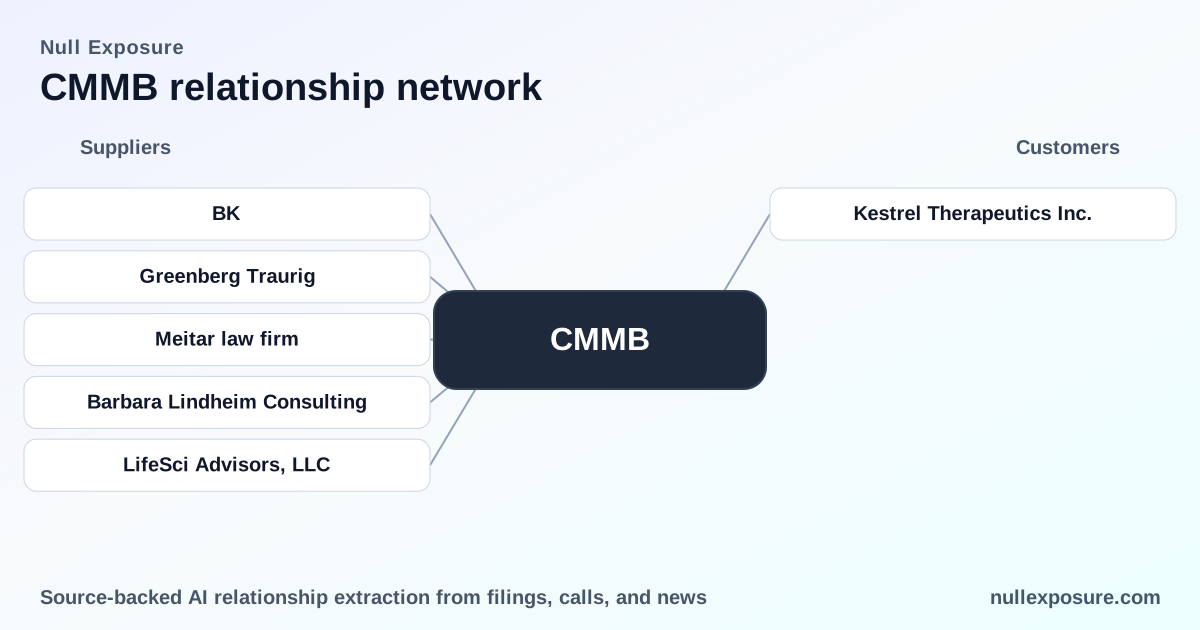
- Kestrel Therapeutics Inc.: Chemomab sold Anchiano’s preclinical RAS programs to Kestrel for $1 million as part of the merger-related announcements in March 2026, indicating an asset-sale customer relationship rather than a commercial partnership (PR Newswire, March 9, 2026).
Interpreting operating model and business-model characteristics
Treat these as company-level signals for Chemomab rather than attributes of any single counterparty.
- Contracting posture — transactional and opportunistic. Chemomab’s visible deal (the Kestrel sale) is an IP/program divestiture. That posture fits a company that leverages corporate actions, mergers and targeted asset sales to raise cash and refocus its pipeline.
- Concentration — low repeat-customer concentration but high outcome concentration. Chemomab currently lacks recurring commercial customers; its commercial exposure is concentrated on whether one-off transactions and future licensing deals succeed in monetizing programs.
- Criticality — low operational criticality of individual buyers. Buyers like Kestrel acquire programs to further their pipelines; they are not critical service providers necessary for Chemomab’s ongoing R&D operations. That reduces counterparty operational risk but increases reliance on capital markets and strategic deals.
- Maturity — preclinical and early-stage. Financial indicators (RevenueTTM: 0, EBITDA: -9,497,000) and the nature of the asset sold (preclinical RAS programs) place Chemomab at an early development stage where value is binary and contingent on clinical progress or subsequent licensing.
Financial context that shapes customer economics
Chemomab’s balance between clinical ambition and corporate finance is stark:
- Pre-revenue company profile. No TTM revenue, negative profit margins and an EPS of -1.45 highlight a financing-first model rather than product-led cash flow.
- Small market capitalization and limited institutional backing. Market cap is roughly $11.7M, with institutional ownership below 10%, which constrains Chemomab’s access to large, patient capital and underscores reliance on strategic asset sales, licensing fees and merger activity.
- M&A and program sales will shape near-term cash flows. The $1M Kestrel payment is modest but meaningful in this context; investors should expect similar episodic monetizations as the company repositions programs or sheds preclinical assets.
Risks and the potential upside — direct takeaways for investors
- Risk — binary value tied to clinical and licensing outcomes. Preclinical programs command low prices relative to clinical-stage assets; without clinical validation, program sales deliver only limited upside.
- Risk — limited diversification of monetization channels. Dependence on one-off transactions increases execution risk: a slow deal cadence or weak interest in specific programs will pressure liquidity.
- Upside — strategic buyers can re-price assets. If a program achieves clinical proof-of-concept or attracts competitive licensing interest, Chemomab’s role as an IP originator could capture materially higher valuations than the $1M sale price suggests.
- Balance — small proceeds are accretive but not transformative. Transactions like the Kestrel sale shore up near-term funding but do not remove the need for further capital raises or strategic partnering to advance late-stage development.
What investors should watch next
- Track future asset sales, licensing announcements or partner-funded development deals; these are the primary cashgenerating events for Chemomab until it reaches commercialization.
- Monitor clinical milestones and data readouts for remaining internal programs — any move from preclinical to clinical stage materially changes buyer appetite and deal economics.
- Watch capital activity: equity raises, convertible financings or strategic mergers will indicate whether the company can sustain operations without aggressive asset divestitures.
For a focused investor read on company relationships and counterparty exposure, visit https://nullexposure.com/ to compare Chemomab’s transactional pattern with peer biotech profiles.
Bold takeaway: Chemomab is an early-stage, pre-revenue biotech that monetizes primarily through strategic asset sales and corporate transactions; the Kestrel purchase is a typical manifestation of that model — useful for liquidity but not a substitute for clinical progress or recurring revenue streams.