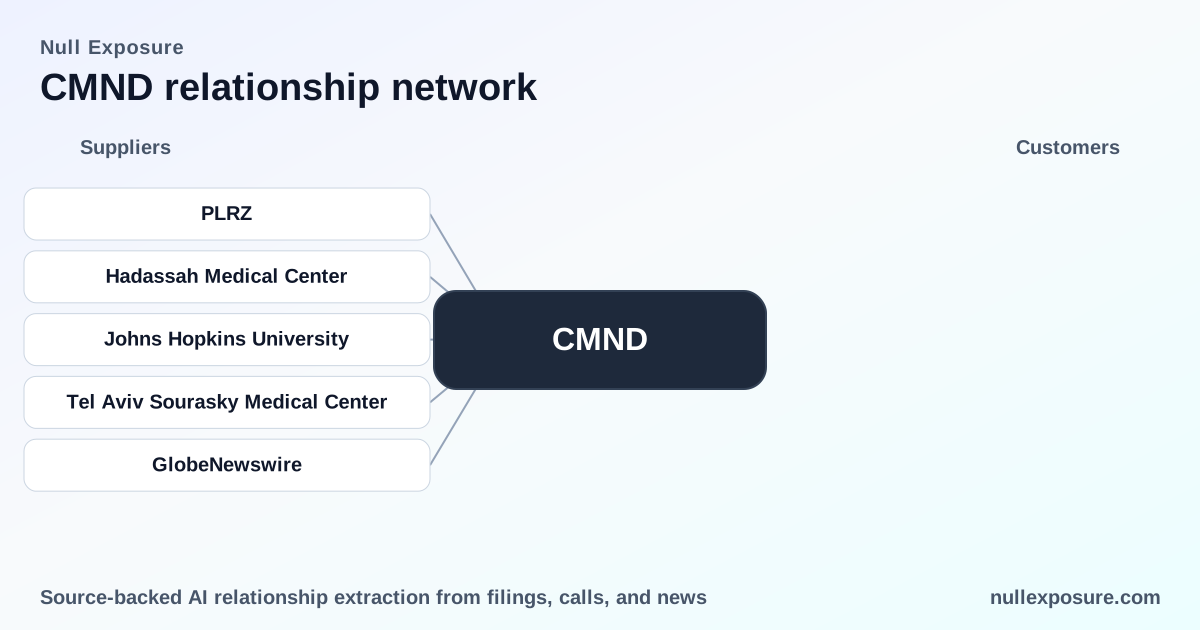
Clearmind Medicine (CMND): Early-stage drug development, high optionality, concentrated commercial relationships
Clearmind Medicine operates as a preclinical pharmaceutical developer focused on novel psychedelic-derived molecules, most prominently its proprietary 5‑methoxy‑2‑aminoindane (MEAI) program. The company monetizes by advancing IP through preclinical and clinical development and by structuring supply and research collaborations that position MEAI for downstream licensing or commercial partnerships; revenue remains zero today and valuation reflects development optionality rather than cash flow. Investors evaluating customer and supplier relationships should treat current ties as partnership-level validation rather than recurring commercial revenue. For a concise snapshot of Clearmind’s coverage and relationship monitoring, see https://nullexposure.com/.
How Clearmind’s operating model translates to investor outcomes
Clearmind is a classic early-stage biotech: intellectual-property centric, cash‑burning, and dependent on a small number of external collaborators for formulation, sourcing and trial-enabling activities. The company’s market capitalization sits at roughly $6.9 million with no reported revenue for the trailing twelve months and negative EBITDA, which positions equity holders squarely behind development counterparties and preferred liquidity sources.
Key operating characteristics:
- Concentration of commercial exposure: Clearmind’s financials show no diversified revenue base; partnerships and supplier relationships are strategic levers for development rather than broad customer revenue streams.
- Contracting posture and maturity: As a preclinical issuer, contracting is transactional and milestone-driven; existing relationships are validation steps that reduce technical risk but do not yet convert into material top-line cash.
- Criticality and dependency: Single-sourced inputs for combination therapies (for example, specialty excipients or co-therapeutic molecules) create supplier dependency and execution risk.
What the news flow tells investors about partnerships
Clearmind’s public disclosures and press coverage over early 2026 highlight collaborative product developments rather than end-customer sales. The most material item in the customer-relationship scan is a media report documenting a combined-product approach that pairs Clearmind’s MEAI with an external bioactive sourced by a partner. This sort of arrangement is consistent with a go‑to‑market strategy that seeks validation and downstream licensing opportunities rather than near-term commercial cash flow.
Customer relationship detail: SciSparc / SPRC and NeuroThera Labs
SciSparc (SPRC) — A May 4, 2026 news release reported that Clearmind’s proprietary MEAI has been combined with Palmitoylethanolamide (PEA) that is sourced through NeuroThera, a participant named alongside SciSparc in the coverage. The report frames this as a collaborative therapeutic construct rather than a pure customer‑vendor sale, indicating an R&D or co‑development posture between the parties. (Source: Yahoo Finance article, May 4, 2026 — https://finance.yahoo.com/news/scisparc-neurothera-labs-clearmind-medicine-122000442.html)
- The relationship description in the report identifies PEA as a supplied compound used with Clearmind’s MEAI; that positions Clearmind as a beneficiary of upstream sourcing rather than as a volume customer. (Same source)
What that relationship implies for valuation and execution risk
The reported tie with SciSparc/NeuroThera signals three practical investor takeaways:
- Scientific validation, not revenue: Public coverage that documents a combined-treatment approach raises the program’s scientific profile, which supports upside in licensing or partnering negotiations. Clearmind’s current P&L shows zero revenue, so the value impact is strategic rather than immediate.
- Supplier concentration risk: Using a named external source for a co‑active ingredient introduces execution dependence; any supply disruption or quality issue could delay development timelines and compress realized value.
- Milestone optionality: Collaborations structured around shared development work create tangible inflection points (preclinical endpoints, IND filings, early clinical signals) that will materially re‑price the equity when achieved.
Constraints and company‑level operating signals
No explicit contractual constraints or structured data flags were provided in the customer-scope results. Presenting that absence as a signal: Clearmind’s public relationship disclosures are sparse, consistent with its early development stage. Company-level operating signals for investors are:
- Low revenue maturity: Financials show zero revenue and negative operating metrics, confirming early-stage dependency on capital markets or partner financing.
- Concentrated partner set: The single public relationship in the customer scan indicates limited, concentrated external linkage rather than a broad commercial network.
- Contracting posture is developmental: Relationships described in news stories are R&D‑focused and do not reflect long-term recurring customer contracts.
- Disclosure conservatism: Sparse relationship data and limited institutional ownership (roughly 0.5% noted) signal thin investor coverage and limited market intelligence available through standard channels.
Risk factors for the customer relationship thesis
Investors should weigh the following risks tied directly to Clearmind’s partnership posture:
- Execution risk: Development timelines, regulatory requirements, and supply quality issues create binary outcomes that determine whether partnerships convert into value.
- Counterparty concentration: Reliance on a small number of named partners for sourcing or co-development creates vulnerability to a single point of failure.
- Market and financing risk: With negative EBITDA and no revenue, Clearmind will require capital to reach clinical inflection points; dilution or unfavorable partner terms can alter the economics for current shareholders.
Practical investor next steps
- Track milestone timing tied to the MEAI program and any formal partner agreements that convert press narratives into filed collaborations or licensing deals.
- Monitor supply-chain disclosures for the PEA source and any multi‑sourcing steps that reduce concentration risk.
- Reassess valuation only after tangible development milestones (IND filing, GLP toxicology completion, or early clinical data) are publicly documented.
For analysts and operators wanting continuous monitoring of how Clearmind’s partner map evolves in real time, visit https://nullexposure.com/ to review the company profile and alerts.
Bottom line
Clearmind’s business remains a classic development-stage biotech proposition: strategic partnerships drive program credibility but do not yet produce revenue. The reported relationship involving SciSparc/NeuroThera supplying PEA for combination with Clearmind’s MEAI is a validation event that reduces scientific uncertainty, yet it leaves commercial and financing risks intact. Investors should value any such relationship as an incremental de‑risking step that must be followed by formal agreements and regulatory milestones before it materially affects enterprise value.