Compass Minerals (CMP) — customer relationships that shape revenue stability and operational risk
Compass Minerals produces and sells essential minerals — primarily highway deicing salt and sulfate of potash (SOP) — and monetizes through volume-based sales to government road agencies, distributors and agricultural customers across North America, the U.K. and select global markets. The business earns roughly $1.33 billion of revenue annually with an EBITDA run-rate near $213 million, driven by durable, often multi-year government contracts for deicing and recurring commercial channels for plant nutrition. For a concise view of the firm and its investor materials, visit the Compass Minerals homepage or explore broader counterparty intelligence at https://nullexposure.com/.
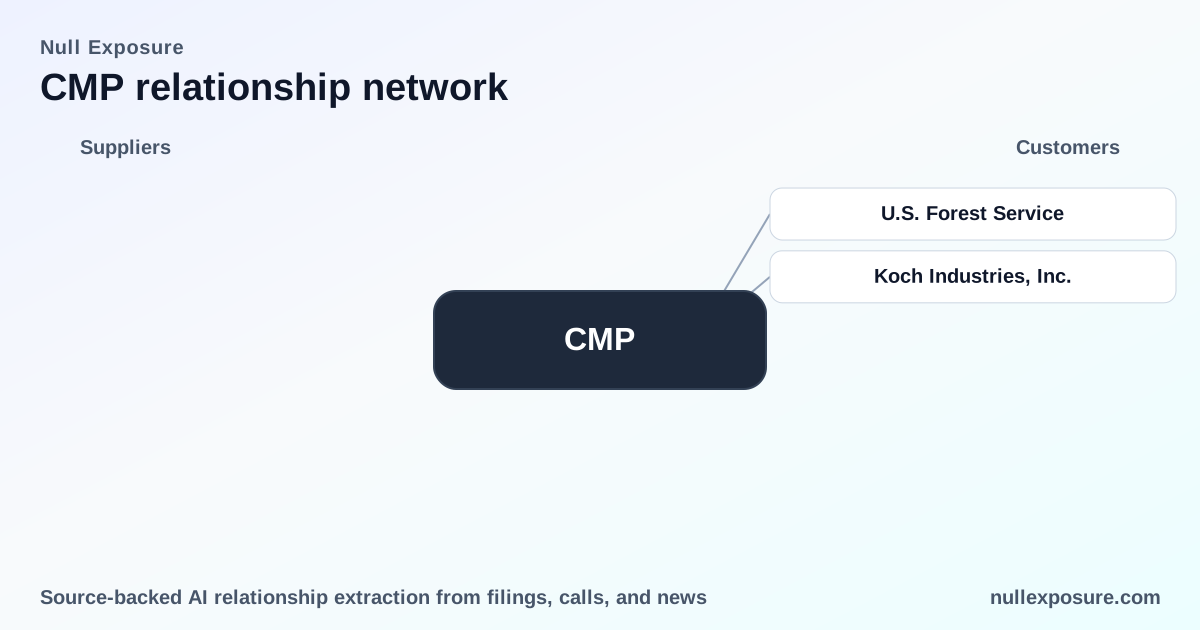
Two explicit customer relationships in public records — what they are and why they matter
U.S. Forest Service — litigation and governance exposure
Compass was publicly linked to allegations that current and former directors misled investors about safety testing of fire retardants and overstated contract prospects with the U.S. Forest Service; those matters were resolved through governance reforms and an insurer payment of $850,000 to cover legal fees. This episode creates a direct reputational and contractual sensitivity when dealing with government wildfire and public land agencies. According to a Finviz news summary reported March 9, 2026, the resolution included governance commitments and the insurer payment.
Koch Industries, Inc. — related-party SOP sales and receivable scale
Compass records small but measurable SOP sales to certain Koch subsidiaries: approximately $3.6 million in fiscal 2025 (and similar amounts in nearby years), with quarterly SOP sales to related Koch entities totaling roughly $0.5 million for the three months ended December 31, 2025 (compared with $1.1 million in the prior-year quarter). Koch is a repeat, related-party commercial buyer at low single-digit millions — material for disclosure but immaterial to consolidated revenue concentration. These figures come from Compass Minerals’ SEC disclosures as rehosted in a March 2026 10‑Q summary.
What the relationships and disclosure constraints reveal about Compass’s operating model
Compass’s disclosed customer relationships and corporate constraints outline a business with specific contracting characteristics and risk vectors:
- Contracting posture — multi-year stability in key markets. The company reports that about 75% of U.K. highway deicing customers operate under multi-year contracts, which creates predictable seasonal demand and supports logistics planning and working-capital management.
- Counterparty concentration — government-heavy, but broad. Principal customers include states, provinces, counties, municipalities and road contractors; government purchasers are a key segment across North America and the U.K., producing predictable bulk demand but concentrated political and budget-cycle exposure.
- Geographic footprint — North America-first with U.K./EMEA presence and global SOP distribution. About 88% of Plant Nutrition sales are to U.S. customers, and consolidated sales break down roughly $875.3M U.S., $288.6M Canada, $65.9M U.K., with modest other revenue — a North America-centric revenue base with targeted EMEA exposure.
- Product criticality and maturity — essential, commodity-driven businesses. Rock salt for highway deicing is a core, mission-critical product for public safety and infrastructure; SOP is a mature agricultural input sold worldwide to distributors and retailers.
- Commercial scale signals — low related-party concentration. Related-party SOP sales to Koch total in the low single-digit millions annually against $1.33B of consolidated revenue, and receivables from related parties sit at roughly $0.2–$0.3 million, indicating disclosure-level related-party activity without material revenue dependence.
These constraints combine into an operating profile of seasonal but recurring government revenue, diversified geography within North America, commodity price and volume sensitivity, and limited but transparent related-party commercial flow.
Operational and financial implications for investors
- Revenue stability comes from recurring, often long-term public contracts. Multi-year U.K. deicing contracts and large municipal/state buyers translate into predictable winter-season volume, aiding free-cash-flow modeling.
- Legal and reputational risks can ripple into contract prospects. The publicized settlement tied to the U.S. Forest Service underscores operational sensitivity when government agencies question product testing or procurement representations; governance reforms were part of the resolution reported in March 2026.
- Customer concentration metrics are favorable in aggregate. Despite government dependence, no single disclosed customer drives a material share of consolidated revenue; related-party sales to Koch are in the $1M–$10M band historically, a small fraction of overall sales.
- Commodity and logistical risk dominate margin volatility. Salt and SOP margins are influenced by mining costs, freight, and seasonal demand swings; investors should stress-test scenarios for harsh winters versus mild winters and for transport bottlenecks.
Short, actionable checklist for underwriters and operators
- Confirm the extent and terms of multi-year deicing contracts across jurisdictions; contract tenure is a primary value driver.
- Model winter-season volumes under multiple severity scenarios to isolate margin sensitivity to freight and commodity costs.
- Monitor legal or procurement disputes with government buyers as an early indicator of contract renewal risk; the U.S. Forest Service matter demonstrates how governance issues translate into exposure.
- Treat related-party SOP sales as disclosure items rather than concentration risk, but validate transfer pricing and receivable aging given the low nominal balances reported.
For an at-a-glance investment view of Compass Minerals’ counterparty posture and to compare customer exposure across peers, explore the company intelligence hub at https://nullexposure.com/.
Conclusion — how to weigh the customer read on CMP
Compass Minerals combines stable, large-volume government deicing contracts and a commercial agricultural product line to produce predictable seasonal cash flows with commodity-driven margin movement. Public records show small related-party SOP flows to Koch and a resolved governance/legal episode tied to U.S. public‑sector contracting; both are material signals for credit officers and active investors when calibrating counterparty and reputational risk. The firm's geography and contract structure provide resilience, but operational execution across logistics and regulatory relationships determines near-term earnings volatility.