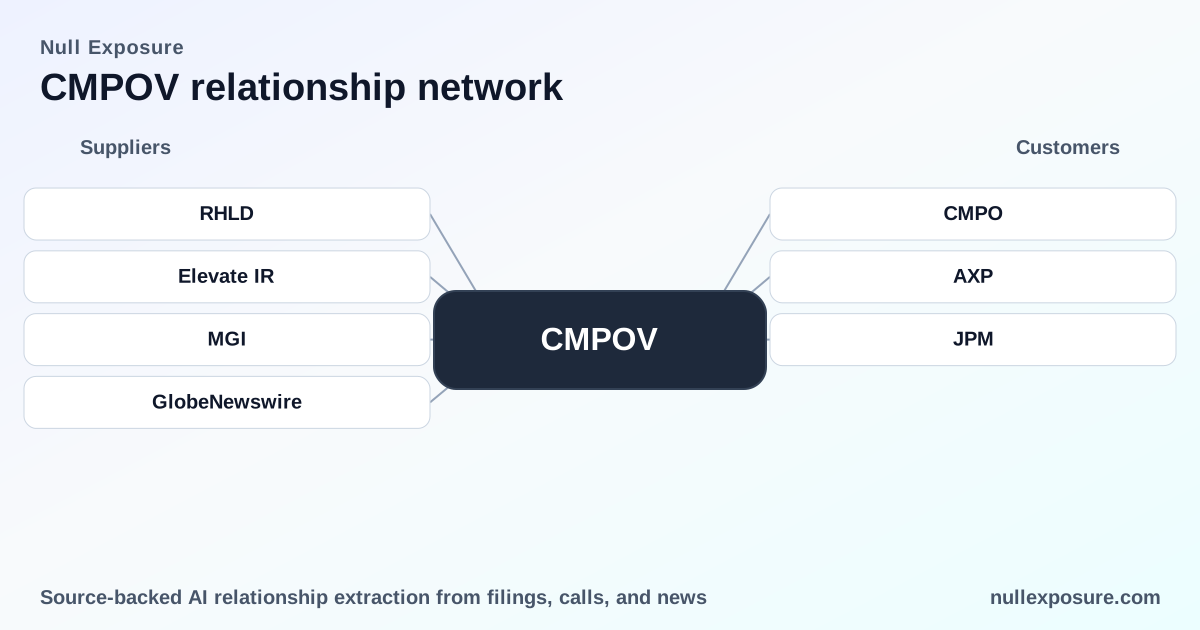
CompoSecure (CMPOV) — Premium card manufacturer with concentrated issuer exposure
CompoSecure manufactures high-end metal, composite and proprietary payment cards and sells them to financial institutions and card issuers worldwide; the company monetizes through card production contracts and value-added security features that command premium pricing. Revenue flows are driven by large institutional orders from global issuers, and contract concentration is the defining investment risk. For a focused commercial read on customer relationships, see https://nullexposure.com/.
What the Indian client list signals about go-to-market strategy
CompoSecure has explicitly targeted premium-credit and wealth-focused card programs in India, where issuance of metal cards is positioned as a high-margin, customer-acquisition tool for banks. A March 2026 report in The Wire lists Kotak, FPL, HDFC Bank, IDFC Bank, ICICI Bank, Axis Bank, State Bank of India, IndusInd and HSBC as CompoSecure clients in India, which demonstrates a broad set of local banking partners and an aggressive international sales footprint focused on large retail issuers.
This Indian client penetration supports two strategic facts: 1) the company secures repeatable institutional orders that scale with card program growth, and 2) regional diversification is active but still weighted toward a few large issuers globally. For more context on customer-level exposure and research tooling, visit https://nullexposure.com/.
Concentration is the dominant commercial constraint
A March 2026 media summary of a November securities filing reported that about 70% of CompoSecure’s revenue comes from just four clients, with American Express and JPMorgan Chase topping the list of metal-card issuers. That disclosure defines a classic supplier concentration profile: high revenue dependency on a small number of large issuers, which implies negotiating leverage for those customers and revenue volatility if any contract is lost or scaled back.
The concentration profile drives three practical implications for investors:
- Revenue volatility risk if large issuer programs pause or internalize production.
- Margin dependency on premium programs; losing one top client could materially compress reported margins.
- Operational alignment toward service and quality features demanded by the largest global issuers, which is a strength but creates switching costs tied to a small counterparty set.
Relationship-by-relationship breakdown (plain-English summaries with sources)
Below are one-to-two sentence summaries for every relationship in the records, followed by the source reference.
-
Axis Bank — CompoSecure is listed among the Indian banks that purchase its premium metal payment cards, indicating Axis participates in card programs driven by enhanced security and luxury positioning. Source: The Wire report, March 2026.
-
CMPO (CompoSecure referenced) — The company itself is cited as counting multiple Indian issuer clients in the March 2026 report, confirming direct commercial engagement with the listed banks. Source: The Wire report, March 2026.
-
FPL — Named as one of the Indian clients buying CompoSecure’s premium metal cards, FPL is part of the firm’s regional commercial footprint. Source: The Wire report, March 2026.
-
HDFC Bank — HDFC Bank is listed among the Indian financial institutions contracting for CompoSecure’s metal card products, signaling adoption by a major retail issuer. Source: The Wire report, March 2026.
-
HSBC Bank — HSBC is included in the Indian client roster for CompoSecure, reflecting cross-border issuer relationships that extend beyond domestic retail banks. Source: The Wire report, March 2026.
-
ICICI Bank — ICICI Bank is a named client for CompoSecure’s metal card programs in India, supporting the company’s penetration into top-tier issuer portfolios. Source: The Wire report, March 2026.
-
IDFC Bank — IDFC Bank is identified among the Indian institutions using CompoSecure’s premium cards, adding to the breadth of the company’s issuer base in the region. Source: The Wire report, March 2026.
-
IndusInd — IndusInd Bank is listed as a CompoSecure customer in India, indicating participation by mid-to-large retail issuers in premium card programs. Source: The Wire report, March 2026.
-
Kotak — Kotak is cited as one of CompoSecure’s Indian clients purchasing metal payment cards, illustrating adoption by another top-tier Indian bank. Source: The Wire report, March 2026.
-
State Bank of India — State Bank of India appears in the client list for CompoSecure, showing that even the largest state-owned issuer engages with premium physical-card offerings. Source: The Wire report, March 2026.
-
American Express — A March 2026 media summary noted American Express among the top metal-card issuers that drive CompoSecure revenue, and the company’s filings indicate American Express is a material customer. Source: ts2.tech summary of a November securities filing, March 2026.
-
AXP — The AXP entry duplicates American Express in the records and reiterates that American Express is a top metal-card issuer contributing materially to CompoSecure’s revenue base. Source: ts2.tech summary of a November securities filing, March 2026.
-
JPMorgan Chase — JPMorgan Chase is listed among the top metal-card issuers supporting CompoSecure revenue, and the company’s disclosures place JPMorgan among the few clients that collectively account for roughly 70% of revenue. Source: ts2.tech summary of a November securities filing, March 2026.
How these relationships shape the operating model
With no explicit contractual constraints excerpted in the relationship records, the commercial profile must be inferred from the client mix itself: CompoSecure operates as a supplier to a small set of very large, sophisticated issuers, which yields concentrated revenue, high operational standards, and contract lengths that likely reflect program-level procurement rather than spot orders. That structure defines the company’s contracting posture as supplier-dependent: the customer holds leverage, and CompoSecure’s bargaining position rests on quality differentiation and integration into card-program logistics.
Maturity is mixed: relationships with legacy global issuers like American Express and JPMorgan signal professionalized, large-scale programs; the Indian bank footprint shows active market expansion into growth geographies. Criticality is asymmetric: for some issuers CompoSecure is a strategic vendor for premium metal programs; for the company, losing any top client is materially disruptive given the reported concentration.
Investment takeaways and next steps
- Concentration is the principal risk: roughly 70% of revenue from four clients creates outsized sensitivity to contract renewals and program demand cycles.
- Commercial reach is broadening: a diversified list of Indian banks indicates successful market penetration beyond the U.S. issuers.
- Operational risk is real but manageable: servicing top issuers requires consistent quality and delivery, which is a competitive moat if sustained.
For investors and operators who require deeper counterparty-level intelligence and continuous monitoring of issuer exposures, Null Exposure provides tailored relationship analytics and alerts. Learn more at https://nullexposure.com/.
Overall, CompoSecure’s business model is clear: sell premium, differentiated card products to a small number of large issuers, capture premium margins on program business, and manage the concentration risk that comes with being the supplier of choice for high-value card programs.