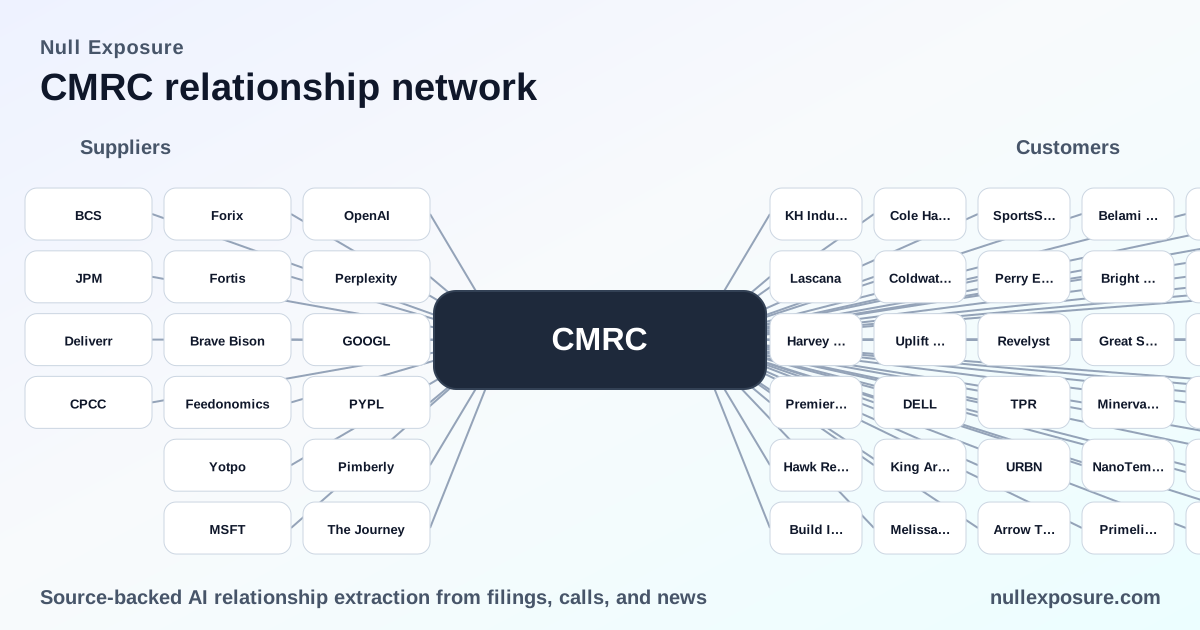
Commerce.com (CMRC) customer map: who’s on the platform and what that means for investors
Commerce.com operates and monetizes a multi-brand SaaS commerce stack—platform subscription fees, recurring feed-management (Feedonomics) contracts, and professional services—that powers storefronts, product data, and AI-ready search across retailers, brands and distributors worldwide. Revenue comes from a mix of monthly retail subscriptions, 1–3 year enterprise contracts, usage-based services billed in arrears, and one-off professional services, giving the company recurring revenue with modular upsell opportunities. For deeper company coverage visit https://nullexposure.com/.
Quick takeaways for investors
- Business model: Hybrid SaaS + services; subscription revenue is the backbone, supported by professional services and usage-based fees.
- Contracting posture: The company serves both month-to-month retail customers and multi-year enterprise accounts, which reduces churn sensitivity for large clients while keeping small-customer acquisition agile.
- Concentration and criticality: Commerce.com reports at least one customer >5% of revenue; the client list mixes household brands and industrial accounts that use the platform for mission-critical storefronts and product data.
- Geography and scale: ~76% of revenue from the U.S., presence in >150 countries, with EMEA and APAC growth visible—this supports large-brand adoption but concentrates macro exposure in North America.
- Segment mix: Revenue derives from software (flagship platform) and services (feed management, professional services)—a commercially attractive combination that permits high-margin subscription growth and incremental services revenue.
If you want a compact feed of relationships and source hits, find full research at https://nullexposure.com/.
What the customer roster actually shows
Below is a concise, relationship-by-relationship read of every named counterparty from the compiled results. Each line is a plain-English summary followed by the source cited in context.
- Build It Right — Added as a new industrial distribution customer in Q4 2025. According to Commerce.com’s 2025 Q4 earnings call.
- Harvey Nichols — Renewed a longstanding department-store relationship with Commerce.com in Q4 2025. According to the 2025 Q4 earnings call.
- KH Industries — Mentioned as a manufacturer client for electrical and AV components. From the 2025 Q4 earnings call.
- Lascana — European apparel brand added on the BigCommerce platform in Q4 2025. According to the 2025 Q4 earnings call.
- Hawk Research Labs — Listed as a customer using refinishing coating systems solutions in Q4 2025. From the 2025 Q4 earnings call.
- Premier Water Tanks — Identified as a water truck manufacturer client added in Q4 2025. According to the 2025 Q4 earnings call.
- Cole Haan — Cited repeatedly as a brand using Commerce.com product data and Feedonomics capabilities. Documented across GlobeNewswire and earnings-related news in FY2025–FY2026.
- Coldwater Creek — Frequently named as a Commerce client across multiple press releases and investor communications in FY2025–FY2026 (GlobeNewswire, QuiverQuant, StockTitan).
- Uplift Desk — Listed by Commerce as a client leveraging storefront and data tools in FY2025–FY2026 press notes. Source: QuiverQuant and GlobeNewswire coverage.
- SportsShoes — Grouped among retail brand customers in multiple FY2025 press items and investor notices. Source: QuiverQuant and GlobeNewswire releases.
- Perry Ellis — Named repeatedly as a customer using Commerce’s platform and Feedonomics, referenced in FY2025–FY2026 filings and press. Source: GlobeNewswire and QuiverQuant.
- King Arthur Baking Co. — Listed as a brand customer in multiple company press releases (FY2025–FY2026). Source: GlobeNewswire and QuiverQuant.
- Mizuno — Identified as a brand using Commerce’s tools in FY2025 announcements and follow-ups. Source: GlobeNewswire and related press.
- Puma — Cited in Feedonomics performance examples and platform press in FY2025. Source: SahmCapital and QuiverQuant coverage.
- King & related fashion groups (Tapestry, URBN, Revelyst) — Large retail parents (Tapestry, URBN, Revelyst) and their brands are reported as users of product-data integrations. Source: GlobeNewswire (July 31, 2025).
- Dell Technologies (DELL) — Noted as a customer leveraging product data integrations for AI-driven search experiences. Source: GlobeNewswire (July 31, 2025).
- Ben & Jerry’s — Cited in marketing copy about client mix using BigCommerce capabilities. Source: StockTitan market write-ups (FY2026).
- Sony (SONY) — Referenced as a client example in coverage of BigCommerce’s customer roster. Source: StockTitan (FY2026).
- Arrow Tool Group — Cited as a multi-storefront use case built on Commerce’s Multi-Storefront functionality. Source: Commerce.com Q2 2025 financial results (GlobeNewswire).
- Great Star Tools / Primeline Parts — Example of a manufacturer using Multi-Storefront to run B2B and B2C sites. Source: Q2 2025 results release.
- Belami e-Commerce — Launched three storefronts on Catalyst and Makeswift using Commerce’s multi-storefront and PayPal Fastlane integration. Source: Q2 2025 results release.
- Bright SG — Implemented a custom recurring payments solution with a Commerce partner; cited in Q2 2025 reporting. Source: Q2 2025 results release.
- Minerva Beauty — Launched a storefront with a custom shipping app via a Commerce agency partner. Source: Q2 2025 results release.
- NanoTemper Technologies — Launched a B2B storefront using Commerce’s B2B Edition. Source: Q2 2025 results release.
- EuroOptic — Reported revenue growth after launching a composable site with Commerce. Source: GlobeNewswire / Finviz summary (FY2025).
- Metrolinx — Collaboration to improve headless ecommerce and secure, scalable selling for transit riders; cited in press. Source: GlobeNewswire / SimplyWallSt (FY2025–FY2026).
- Movora, Sellars Absorbent Materials, Marshall Wolf Automation, Prime-Line Products, Zogics — Highlighted as B2B case studies using BigCommerce B2B Edition. Source: StockTitan and related press (FY2026).
- The RealReal (REAL) — Named as a Feedonomics customer in the Q4 2025 earnings call. Source: 2025 Q4 earnings call.
- Petco (WOOF) — Identified as a Feedonomics user in the earnings call. Source: 2025 Q4 earnings call.
- Grainger (GWW) — Referenced as a large industrial distributor customer in corporate commentary. Source: 2025 Q4 earnings call.
- Fortis — Cited in context of a partnership announcement where BigCommerce (powered by Commerce.com) linked embedded payments to merchants. Source: SimplyWallSt / partnership coverage (Sept 16, 2025).
- Mountain Warehouse — Reported to have launched a composable ecommerce store with BigCommerce; referenced in market alerts. Source: MarketBeat and GlobeNewswire (April 2026/2025).
- Patagonia — Listed among brand clients in Commerce’s July 2025 platform announcement and Q2 results. Source: GlobeNewswire (July 31, 2025).
- Skechers (SKX) — Named as part of the FY2026 client list cited in investor communications. Source: GlobeNewswire April 2026 release.
- Pacsun — Cited as a named client across FY2026 investor communications. Source: GlobeNewswire April 2026 release.
- Euro and ticker variants (MIZUF, PMMAF, PMMAF, PATAF, PERY, SKX, DELL, GWW, REAL, SONY, HMB, BIGC) — These tickerified mentions track the same brand relationships above and are present across press and news aggregators (QuiverQuant, StockTitan, SahmCapital) in FY2025–FY2026.
Interpreting these relationships as investment signals
- Contract mix drives revenue stability and upsell: The roster shows large enterprise logos alongside small and mid-market retailers, which supports the company’s stated mix of month-to-month retail customers and 1–3 year enterprise contracts and explains why subscription revenue is durable while services produce higher short-term revenue variability.
- Concentration risk is real but manageable: One customer exceeded 5% of revenue in 2024, so single-customer concentration is a material line-item to monitor in future filings.
- Global GTM with U.S. bias: Commerce’s customer list includes EMEA and APAC clients, but ~76% revenue concentration in the U.S. concentrates macro risk regionally while enabling scale economies domestically.
- Product strategy validated by marquee clients: Adoption by brands such as Dell, Tapestry, URBN, Puma, and Patagonia signals product fit for complex enterprise needs (product data, headless storefronts, AI search), supporting a premium pricing posture for integrated platform + services offerings.
Bottom line: Commerce.com’s customer roster combines enterprise anchors and a broad retail base, matching the company’s subscription-plus-services monetization and supporting both predictable ARR and professional-services upside; watch concentration, enterprise renewal cadence, and international growth as primary drivers of near-term revenue trajectory. For the complete research workflow and alerts on CMRC relationships, see https://nullexposure.com/.