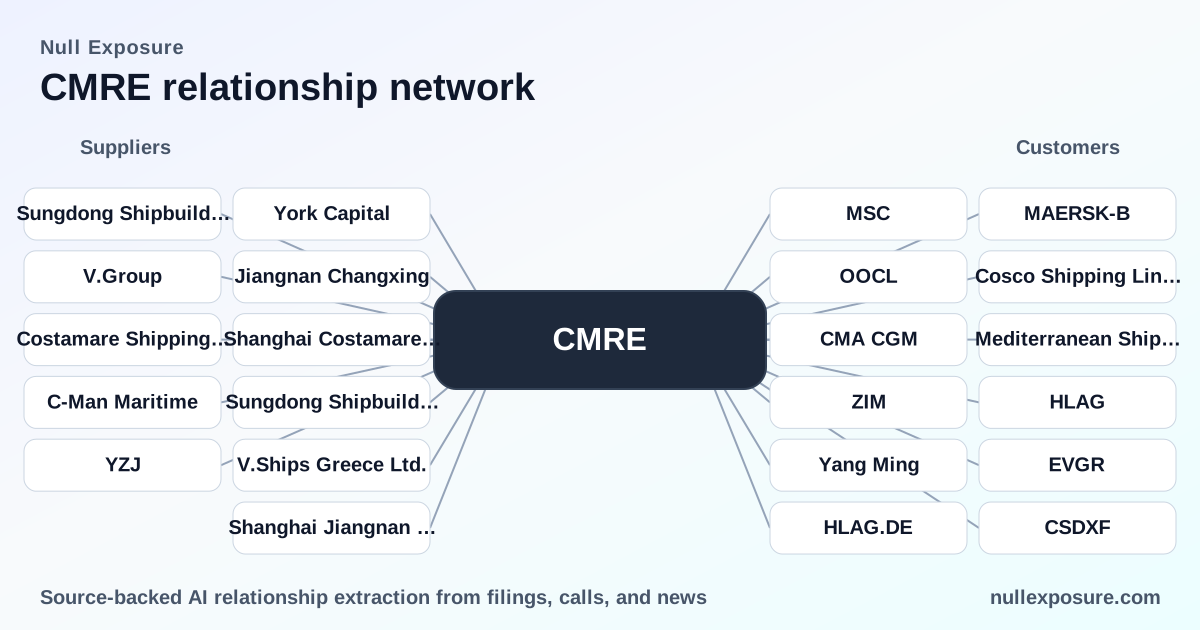
Costamare Inc (CMRE): Customer Relationships That Drive a Shipowner’s Cash Flow
Costamare owns and leases container ships to major liner operators and monetizes through long-term time charters, strategic newbuild investments and an active ordering program that secures contracted revenue and supports dividends. For investors, the company’s value hinges on charter counterparties, charter lengths and the concentration of cash flow tied to a relatively small set of global carriers. Explore deeper research at https://nullexposure.com/.
Why customers matter: the commercial backbone of CMRE’s earnings
Costamare is a capital-intensive lessor that converts ship ownership into predictable cash flow by contracting vessels on multi-year charters with large container lines. Charter counterparties determine revenue visibility, credit risk and fleet deployment optionality — the dominant factor in CMRE’s EBITDA generation and dividend capacity.
Detailed relationship inventory (every result in the record)
- Hapag-Lloyd (SCORPIUS) — Costamare’s press release lists the vessel SCORPIUS on charter to Hapag-Lloyd/Maersk with a March 2028 expiry, indicating a near-term contractual maturity that is meaningful for rollover risk. (GlobeNewswire — Costamare press release, Feb 18, 2026: https://www.globenewswire.com/de/news-release/2026/02/18/3240026/0/en/Costamare-Inc-Reports-Results-for-the-Fourth-Quarter-and-Year-Ended-December-31-2025.html)
- HLAG.DE (same Hapag-Lloyd reference) — The same entry appears under the exchange ticker HLAG.DE confirming the Hapag-Lloyd link and the March 2028 charter maturity cited in the February 2026 release. (GlobeNewswire, Feb 18, 2026: https://www.globenewswire.com/de/news-release/2026/02/18/3240026/0/en/Costamare-Inc-Reports-Results-for-the-Fourth-Quarter-and-Year-Ended-December-31-2025.html)
- MSC (CAPE AKRITAS) — Costamare identifies the 2016-built CAPE AKRITAS (11,010 TEU) on long-term charter to MSC with an August 2031 maturity, representing extended contracted revenue. (GlobeNewswire, Feb 18, 2026: https://www.globenewswire.com/fr/news-release/2026/02/18/3240026/0/en/Costamare-Inc-Reports-Results-for-the-Fourth-Quarter-and-Year-Ended-December-31-2025.html)
- ZIM (ZIM VIETNAM) — The company lists ZIM VIETNAM (2003, 6,644 TEU) under charter to ZIM with a December 2028 expiry, a mid‑dated maturity that supports near-term cash flow. (GlobeNewswire, Feb 18, 2026: https://www.globenewswire.com/de/news-release/2026/02/18/3240026/0/en/Costamare-Inc-Reports-Results-for-the-Fourth-Quarter-and-Year-Ended-December-31-2025.html)
- Yang Ming (YM TRIUMPH) — Costamare reports the YM TRIUMPH (2020, 12,690 TEU) on charter to Yang Ming with a May 2030 maturity, adding long-tenor exposure to the Taiwanese carrier. (GlobeNewswire, Feb 18, 2026: https://www.globenewswire.com/de/news-release/2026/02/18/3240026/0/en/Costamare-Inc-Reports-Results-for-the-Fourth-Quarter-and-Year-Ended-December-31-2025.html)
- MSC (MSC Azov delivery / FY2014 note) — Historic disclosure shows the 9,403 TEU MSC Azov commenced a long-term charter with MSC after delivery, illustrating a precedent of newbuild-to-charter execution. (gCaptain, historical note: https://gcaptain.com/costamare-reveals-orders-for-nine-newbuild-containerships/)
- CMA CGM (NEOKASTRO) — The company lists NEOKASTRO (2011, 4,178 TEU) on charter to CMA CGM with an April 2030 maturity, reflecting multi-year commitments to that counterparty. (GlobeNewswire, Feb 18, 2026: https://www.globenewswire.com/de/news-release/2026/02/18/3240026/0/en/Costamare-Inc-Reports-Results-for-the-Fourth-Quarter-and-Year-Ended-December-31-2025.html)
- OOCL (GLEN CANYON) — GLEN CANYON (2006, 5,642 TEU) is shown on charter to OOCL with a September 2028 maturity, contributing to the company’s diversified customer book. (GlobeNewswire, Feb 18, 2026: https://www.globenewswire.com/de/news-release/2026/02/18/3240026/0/en/Costamare-Inc-Reports-Results-for-the-Fourth-Quarter-and-Year-Ended-December-31-2025.html)
- MSC (CAPE AKRITAS duplicate) — The CAPE AKRITAS / MSC entry is repeated in the press release, underlining its importance to fleet-level contracted revenue through August 2031. (GlobeNewswire, Feb 18, 2026: https://www.globenewswire.com/de/news-release/2026/02/18/3240026/0/en/Costamare-Inc-Reports-Results-for-the-Fourth-Quarter-and-Year-Ended-December-31-2025.html)
- MAERSK-B (MAERSK PUELO) — The MAERSK PUELO (2006, 6,541 TEU) is indexed as chartered to Maersk with an October 2026 expiry, which is an imminent contractual consideration for renewals. (GlobeNewswire, Feb 18, 2026: https://www.globenewswire.com/de/news-release/2026/02/18/3240026/0/en/Costamare-Inc-Reports-Results-for-the-Fourth-Quarter-and-Year-Ended-December-31-2025.html)
- Maersk (same MAERSK PUELO reference) — The press release lists the vessel against Maersk, reinforcing a short‑dated maturity in October 2026 that affects near-term revenue risk. (GlobeNewswire, Feb 18, 2026: https://www.globenewswire.com/de/news-release/2026/02/18/3240026/0/en/Costamare-Inc-Reports-Results-for-the-Fourth-Quarter-and-Year-Ended-December-31-2025.html)
- Cosco Shipping Lines (neo-panamax order context) — TradeWinds reports Costamare is ordering neo-panamax vessels against charter contracts with Cosco Shipping Lines, indicating pipeline growth tied to that counterparty. (TradeWinds, news report: https://www.tradewindsnews.com/containers/costamare-mulls-order-for-12-neo-panamax-container-ships-worth-1-26bn/2-1-1931383)
- Mediterranean Shipping Company, S.A. (10‑year charters historic) — A gCaptain summary documents Costamare entering 10‑year charters with MSC for prior deliveries, showing a strategy of long-term revenue capture with MSC. (gCaptain historical coverage: https://gcaptain.com/costamare-enters-500-million/)
- CMDB (Costamare Bulkers transaction) — A StockTitan note records the May 6, 2025 acquisition by CMDB of Costamare Bulkers Inc. from Costamare, which is a corporate divestiture affecting operating structure. (StockTitan reporting, FY2026: https://www.stocktitan.net/news/CMDB/costamare-bulkers-holdings-limited-reports-results-for-the-fourth-hh6f3tk57h96.html)
- ZIM (duplicate ZIM VIETNAM) — The French GlobeNewswire release repeats the ZIM Vietnam listing with the December 2028 maturity, reinforcing exposure to ZIM. (GlobeNewswire, Feb 18, 2026: https://www.globenewswire.com/fr/news-release/2026/02/18/3240026/0/en/Costamare-Inc-Reports-Results-for-the-Fourth-Quarter-and-Year-Ended-December-31-2025.html)
- Maersk (duplicate MAERSK PUELO entries) — The French press release likewise repeats the Maersk entries showing 41 vessels listed in that group context and the October 2026 maturity for MAERSK PUELO. (GlobeNewswire, Feb 18, 2026: https://www.globenewswire.com/fr/news-release/2026/02/18/3240026/0/en/Costamare-Inc-Reports-Results-for-the-Fourth-Quarter-and-Year-Ended-December-31-2025.html)
- MAERSK-B (duplicate) — The MAERSK-B ticker appears again in the French release, corroborating the Maersk charter line-up disclosed in February 2026. (GlobeNewswire, Feb 18, 2026: https://www.globenewswire.com/fr/news-release/2026/02/18/3240026/0/en/Costamare-Inc-Reports-Results-for-the-Fourth-Quarter-and-Year-Ended-December-31-2025.html)
- CMA CGM (duplicate NEOKASTRO entry) — The FR release restates NEOKASTRO under CMA CGM with April 2030 maturity, corroborating multi-year exposure. (GlobeNewswire, Feb 18, 2026: https://www.globenewswire.com/fr/news-release/2026/02/18/3240026/0/en/Costamare-Inc-Reports-Results-for-the-Fourth-Quarter-and-Year-Ended-December-31-2025.html)
- OOCL (duplicate GLEN CANYON entry) — The French release reiterates the GLEN CANYON/OOCL charter with September 2028 maturity. (GlobeNewswire, Feb 18, 2026: https://www.globenewswire.com/fr/news-release/2026/02/18/3240026/0/en/Costamare-Inc-Reports-Results-for-the-Fourth-Quarter-and-Year-Ended-December-31-2025.html)
- Yang Ming (duplicate YM TRIUMPH entry) — The French release repeats Yang Ming’s YM TRIUMPH with May 2030 maturity. (GlobeNewswire, Feb 18, 2026: https://www.globenewswire.com/fr/news-release/2026/02/18/3240026/0/en/Costamare-Inc-Reports-Results-for-the-Fourth-Quarter-and-Year-Ended-December-31-2025.html)
- Hapag Lloyd (variant HLAG entry) — The French release also lists SCORPIUS against Hapag Lloyd/Maersk with March 2028 maturity, reflecting multiple language versions of the same disclosure. (GlobeNewswire, Feb 18, 2026: https://www.globenewswire.com/fr/news-release/2026/02/18/3240026/0/en/Costamare-Inc-Reports-Results-for-the-Fourth-Quarter-and-Year-Ended-December-31-2025.html)
- HLAG (duplicate HLAG entry) — HLAG appears again in the FR release, confirming the Hapag-Lloyd references under different ticker formatting. (GlobeNewswire, Feb 18, 2026: https://www.globenewswire.com/fr/news-release/2026/02/18/3240026/0/en/Costamare-Inc-Reports-Results-for-the-Fourth-Quarter-and-Year-Ended-December-31-2025.html)
- COSCO (MarketBeat summary of order program) — MarketBeat flagged Costamare’s announcement of a dividend boost and orders for 16 newbuilds on long-term COSCO charters, highlighting COSCO as an active charter counterpart in the 2026 cycle. (MarketBeat coverage referencing company news, May 2026: https://www.marketbeat.com/instant-alerts/costamare-nysecmre-downgraded-to-hold-rating-by-wall-street-zen-2026-02-21/)
- COSCO (secondary MarketBeat note) — A second MarketBeat instant alert reiterates the COSCO-linked newbuild order and dividend action, signaling investor attention on COSCO charters. (MarketBeat, Feb–May 2026: https://www.marketbeat.com/instant-alerts/costamare-nysecmre-hits-new-12-month-high-whats-next-2026-02-18/)
- Evergreen (historic and FY2026 mentions) — Multiple entries show Evergreen as a long‑term charterer (e.g., TRITON, 2016-built 14,424 TEU with March 2036 maturity) and in historical newbuild programs, confirming Evergreen’s role in Costamare’s contracted book. (gCaptain historical; GlobeNewswire Feb 18, 2026: https://gcaptain.com/costamare-enters-500-million/ and https://www.globenewswire.com/de/news-release/2026/02/18/3240026/0/en/Costamare-Inc-Reports-Results-for-the-Fourth-Quarter-and-Year-Ended-December-31-2025.html)
- EVGR (Evergreen ticker variations and historic newbuilds) — Historical gCaptain copy and the press release document multiple Evergreen charters, including five 14,000 TEU ships representing sizeable contracted revenues in prior cycles. (gCaptain, historical and GlobeNewswire: https://gcaptain.com/costamare-reveals-orders-for-nine-newbuild-containerships/ and https://www.globenewswire.com/fr/news-release/2026/02/18/3240026/0/en/Costamare-Inc-Reports-Results-for-the-Fourth-Quarter-and-Year-Ended-December-31-2025.html)
- COSCO / SHANGHAI COSCO (fleet lines in FY2026 disclosure) — The February 2026 release lists SHANGHAI COSCO vessels (2006, 9,469 TEU) with August 2028 maturities, confirming COSCO-linked charters across the fleet. (GlobeNewswire, Feb 18, 2026: https://www.globenewswire.com/fr/news-release/2026/02/18/3240026/0/en/Costamare-Inc-Reports-Results-for-the-Fourth-Quarter-and-Year-Ended-December-31-2025.html)
- CSDXF (COSCO variant ticker entries) — The document contains ticker-format variations (CSDXF) for the COSCO entries, demonstrating consistency across language and ticker formats in the disclosure. (GlobeNewswire, Feb 18, 2026: https://www.globenewswire.com/de/news-release/2026/02/18/3240026/0/en/Costamare-Inc-Reports-Results-for-the-Fourth-Quarter-and-Year-Ended-December-31-2025.html)
What these relationships collectively signal for investors
- Contracting posture: Costamare’s customer book is dominated by long-term time charters to major liners (MSC, Maersk, Evergreen, CMA CGM, COSCO, Hapag-Lloyd, ZIM, Yang Ming, OOCL), which produces predictable cash flow and supports dividend policy.
- Concentration and criticality: The counterparty list is concentrated among the global top-tier carriers, making Costamare’s earnings sensitive to liner credit and volume cycles but benefiting from counterparties that operate at scale and have strategic need for third-party tonnage.
- Maturity profile: Charter maturities in the disclosure range from near-term (October 2026) to long-term (2031–2036), giving a staggered renewal calendar that balances short-term volatility and long‑dated contracted revenue.
- Operational implication: The company’s recurrent newbuild orders tied to specific carriers (COSCO, Cosco Shipping Lines, MSC, Evergreen) confirm a proactive fleet renewal strategy that locks in long-term revenue streams.
Investment takeaways and risks
- Takeaway: Costamare’s business model is cash‑flow centric and counterparty‑driven; major carriers under multi‑year charters underpin high EBITDA conversion and support dividends.
- Key risk: Near-term maturities (notably the Maersk charter expiring October 2026) create renewal risk on a portion of the fleet; investors must watch charter rollovers, counterparty credit and the timing of newbuild deliveries.
- For comprehensive relationship-level monitoring and forward-looking scenario work, review the company press releases and the vessel-level charter schedule in filings — and consult our broader coverage at https://nullexposure.com/.
Conclusion: Costamare is a classic shipping lessor whose value is a function of charter counterparties and the tenure of those contracts. The February 2026 disclosures confirm deep, long‑tenor relationships with the world’s largest liners and an active newbuild program that both de-risks and concentrates future revenue.