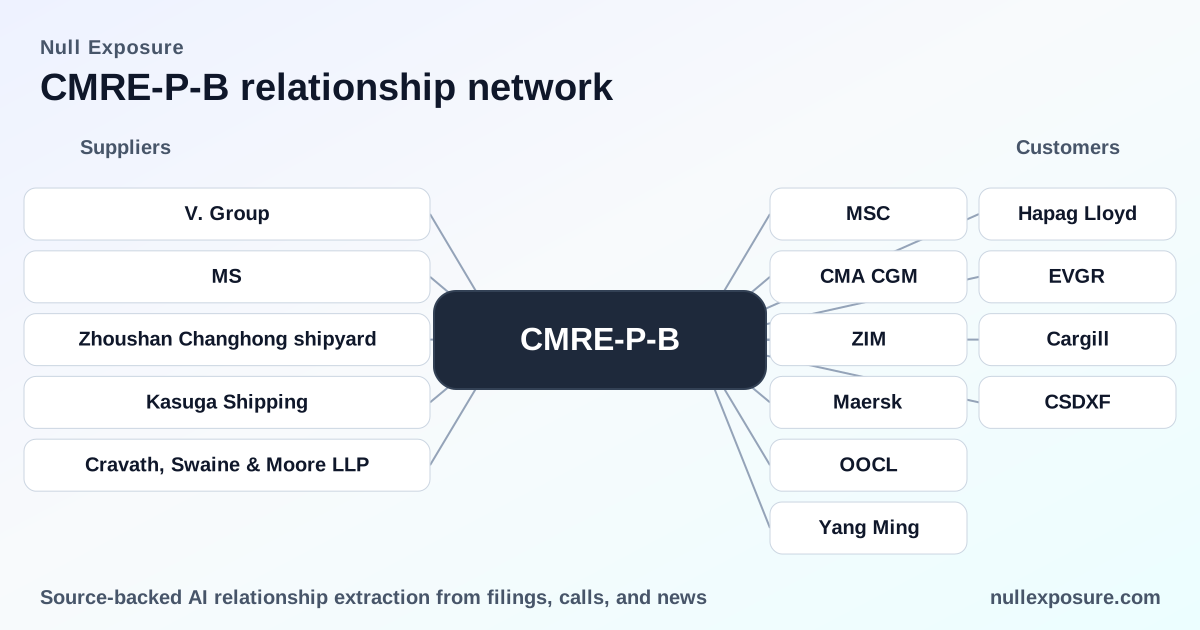
Costamare (CMRE-P-B) — Customer Map and Commercial Implications for Investors
Costamare is a ship-owner that monetizes its fleet through time charters and long-term lease-like agreements with major container lines and commodity traders; its cash generation profile is driven by charter duration, counterparty credit, and fleet renewal or sale timing. This review distills the customer relationships disclosed in recent public filings and news, and draws direct implications for credit stability, revenue visibility, and concentration risk. For a concise view of Costamare's counterparties and what they mean for preferred-equity holders, read on — or visit https://nullexposure.com/ for the full research platform.
How Costamare’s commercial model translates into predictable cash flow
Costamare owns container ships and contracts them out under multi-year charters. Revenue is earned as fixed periodic charter payments, which convert operating asset value into contractually defined cash streams. When Costamare secures long-duration charters with investment-grade or large-scale liner operators, the company locks in cash flow and reduces short-term spot exposure; conversely, high fleet concentration with a single charterer increases counterparty risk. Recent public disclosures show a mixture of long-term charters across the largest global carriers and strategic commercial arrangements with trading houses.
Customer relationship map — what every counterparty tells you
Below I list every customer relationship referenced in Costamare’s recent public materials and media coverage, with a one‑to‑two sentence plain-English takeaway and a source note for each entry.
MSC
Costamare reports a charter for the CAPE AKRITAS with MSC running through August 2031, which represents long-dated revenue tied to a top-tier liner operator. According to the company’s FY2025/FY2026 results coverage reported by QuiverQuant (March 2026), this vessel is secured under charter until 2031.
CMA CGM
The vessel NEOKASTRO is shown under CMA CGM with contractual economics extending to April 2030, locking in medium-term cash flow with a major carrier. This detail is included in the Costamare FY2025 disclosure as reported by QuiverQuant (March 2026).
ZIM
A vessel listed as ZIM VIETNAM is chartered to ZIM with commitments through December 2028, providing multi-year earnings from a regional/global carrier. This appearance comes from Costamare’s FY2025 results coverage on QuiverQuant (March 2026).
Maersk
Costamare has a Maersk-related charter (MAERSK PUELO) scheduled through October 2026, reflecting near-to-mid-term contracted revenue with the world’s largest liner. The charter timing and vessel record are reported in the company results posted on QuiverQuant (March 2026).
OOCL
The GLEN CANYON vessel is chartered to OOCL until September 2028, contributing to the mid-term contracted book. This is disclosed in the firm’s FY2025 report as covered by QuiverQuant (March 2026).
Hapag Lloyd
SCORPIUS is listed under Hapag Lloyd (and referenced alongside Maersk in the same record) with a contract running to March 2028, which diversifies charters across leading carriers. This detail appears in Costamare’s FY2025 release reported by QuiverQuant (March 2026).
Yang Ming
YM TRIUMPH is chartered to Yang Ming with contract expiry in May 2030, adding to Costamare’s multi-year revenue base with an established East‑Asian carrier. QuiverQuant’s March 2026 coverage of the FY2025 results records this vessel and expiry.
COSCO Shipping
Costamare has agreed upon long-term charters with COSCO Shipping, notably 15‑year and 8‑year terms for groups of 9,000‑TEU and 3,100‑TEU ships respectively, effectively converting newbuild deliveries into extended contracted cash flows. This arrangement is described in an earnings call transcript reported by Investing.com (May 2026).
EVGR / Evergreen (two listings)
A TRITON vessel is shown under Evergreen (EVGR) with a charter term recorded to March 2036, representing one of the lengthiest single-counterparty commitments on record and significant future revenue visibility. QuiverQuant’s report on Costamare’s FY2025 results (March 2026) lists this vessel and its long maturity. Separately, the same TRITON/Evergreen reference appears under the name Evergreen, reinforcing that Evergreen represents the counterparty for that long-dated charter in the same March 2026 disclosure.
Cargill
Costamare entered a cooperation agreement with Cargill that includes, among other items, the transfer of a large portion of the company’s trading portfolio, signaling strategic repositioning of commodity‑related activities and a move to partner with a major agribusiness trader. MarineLink covered this cooperation as part of Costamare’s corporate updates (March 2026).
CSDXF / COSCO (Shanghai COSCO listing)
A vessel recorded as SHANGHAI COSCO (listed under ticker/identifier CSDXF and also labeled COSCO) shows chartered economics with expiry in August 2028, reiterating Costamare’s commercial ties to the COSCO group across multiple vessels. This vessel detail is included in the FY2025 published results as reported by QuiverQuant (March 2026).
What these relationships imply for investors
- Contract profile is long-dated and anchored to blue‑chip counterparties. Multiple charters extend into the late 2020s and 2030s with the industry’s largest liners, which creates high revenue visibility for preferred security holders.
- Counterparty concentration is material but diversified across top global players. Costamare’s book shows repeated exposure to COSCO, Evergreen, Maersk, and other leading lines — a concentration that is manageable given the creditworthiness and scale of these counterparties but still a single-industry risk.
- Commercial strategy emphasizes long-term, lease‑like charters over spot exposure. The mix of 8–15 year charters and multi-decade expiries indicates an operating posture that prioritizes stability and predictable payouts.
- Strategic partnerships (Cargill) reduce trading risk and allow focus on core asset leasing. The cooperation agreement with Cargill reflects a deliberate shift away from merchant trading toward asset leasing and long-term charters.
Key takeaways for analysts and operators
- High earnings visibility from long-term charters with major liners.
- Concentration risk exists but is mitigated by counterparty scale and diversified counterparties across routes.
- Maturity profile is favorable for preferred claims: many contracts run well beyond typical preferred dividend horizons.
- Operational risk remains tied to vessel economics and maintenance capex even as commercial risk is constrained by lengthy charters.
For ongoing updates and to track evolving counterparty exposures, explore the research hub at https://nullexposure.com/.
If you want a tailored brief on how these specific charters change Costamare’s cash-flow coverage ratios or preferred‑security risk metrics, I can prepare a short model and sensitivity analysis on request.