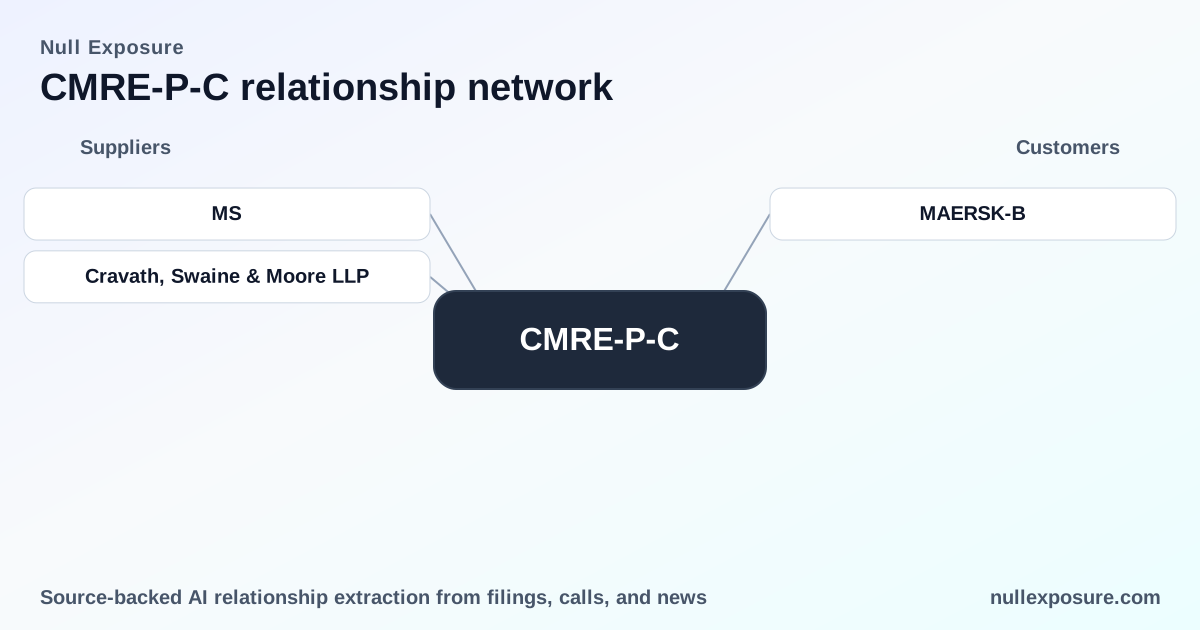
Costamare (CMRE-P-C) — Customer Relationships that Underpin Long‑Term Charter Revenue
Costamare operates as a pure-play containership lessor: it owns containerships and monetizes them by placing vessels on time charters with the world's largest liner companies, converting asset ownership into predictable charter cashflow and fleet renewal optionality. For investors, the key underwriting points are charter duration, counterparty quality, and the degree to which newbuild orders are pre‑secured by long charters. Learn more about our coverage at https://nullexposure.com/.
A concentrated charter book with long tails — why that matters
Costamare’s customer roster reads like a who’s who of container lines. The company secures revenue primarily through multi‑year time charters (often 8–15 years) that deliver contracted cashflow and make vessel financing and newbuild programs underwritable. Public communications in 2026 show an active fleet renewal program anchored by long‑term charters to COSCO and multiple placements with Maersk, MSC and other global carriers (GlobeNewswire, Feb 18, 2026; MarketBeat, May 1, 2026).
That contracting posture — long, asset‑backed time charters with top-tier liners — is the central feature of Costamare’s business model. It increases revenue visibility and supports capital recycling, but it also concentrates counterparty exposure among a limited set of large carriers.
Customer roll call: every relationship the company disclosed
Below are the customer relationships referenced in Costamare’s recent public materials and coverage, each with a concise description and source.
MSC
Costamare lists MSC as the charterer of the containership Cape Akritas, a vessel built in 2016 with a time charter running to August 2031, reflecting a long‑dated commitment from one of the largest global liners (GlobeNewswire, Feb 18, 2026).
Yang Ming
A vessel identified as YM Triumph (built 2020) is on charter to Yang Ming with a contract term extending to May 2030, indicating multi‑year charter coverage to a major Taiwanese carrier (GlobeNewswire, Feb 18, 2026).
CMA CGM
Costamare’s disclosures show multiple vessels tied to CMA CGM; one entry references Neokastro with details that imply ongoing charter coverage and sizable TEU capacity under contract (GlobeNewswire, Feb 18, 2026).
OOCL
The Glen Canyon, a 2006 vessel, is recorded as time‑chartered to OOCL through September 2028, demonstrating Costamare’s exposure to large, legacy carriers across staggered maturities (GlobeNewswire, Feb 18, 2026).
Hapag‑Lloyd
The Scorpius is listed with Hapag‑Lloyd (and in places with Maersk exposure), contracted through March 2028, contributing to the group of investment‑grade and well‑established liner counterparties in the charter book (GlobeNewswire, Feb 18, 2026).
Maersk
Costamare confirms the delivery of a 6,541 TEU containership, Maersk Puelo, which entered a time charter with Maersk; earlier reporting linked the vessel delivery and charter placement specifically in Q3 2025 coverage (GlobeNewswire, Feb 18, 2026; Container News, Mar 9, 2026).
ZIM
A vessel named Zim Vietnam (built 2003) is recorded on contract to ZIM with a charter running into December 2028, indicating multi‑year coverage even for older, still-productive ships (GlobeNewswire, Feb 18, 2026).
COSCO / Cosco Shipping
The most consequential relationship in recent commentary: Costamare announced an order for 16 newbuilds that are committed to long‑term charters with COSCO — twelve 9,200 TEU vessels on 15‑year charters and four 3,100 TEU vessels on 8‑year charters — anchoring a significant wave of fleet renewal and long‑dated contracted revenue (MarketBeat, May 1, 2026; GlobeNewswire, Feb 18, 2026; Manila Times, Apr 29, 2026).
Evergreen
Costamare lists a Triton vessel tied to Evergreen with charter coverage reaching March 2036, signaling very long charter tenors that materially extend revenue visibility at the upper end of the schedule (GlobeNewswire, Feb 18, 2026).
Neptune
Industry commentary highlights Costamare’s diversified leasing exposure, including leasing relationships described as part of the contracted revenue pipeline and Neptune exposure referenced in market analysis of Costamare’s 2026 outlook (SahmCapital, Apr 28, 2026).
How these relationships translate into an operating profile
- Contracting posture: The disclosed charters skew long — many between 8 and 15 years — which transforms asset ownership into reliable, contractual cashflow streams and simplifies debt amortization profiles (GlobeNewswire; MarketBeat, 2026).
- Concentration: Counterparties are concentrated among a small set of global container lines (COSCO, Maersk, MSC, CMA CGM, Evergreen, etc.), which is efficient for placement but raises counterparty concentration risk should any major carrier face systemic stress.
- Criticality and strategic depth: The COSCO newbuild program is a strategic signal: Costamare is replacing and expanding capacity with vessels that come with long‑term charters, demonstrating a shift from reliance on the second‑hand market to structured, secured newbuild rollouts (MarketBeat; Manila Times, 2026).
- Maturity and staggering: Charter maturities are staggered across the fleet (2026–2036 range in disclosures), reducing lumpiness but creating future windows where recharter pricing and counterparty appetite will determine renewal economics. No explicit operational constraints were supplied in the dataset; company‑level communications instead emphasize charter-backed newbuild underwriting and diversified placements across large liners.
Learn more about how coverage of counterparty relationships affects underwriting at https://nullexposure.com/ — useful for assessing preferred and common equity risk premia.
Investment implications — what investors should watch
- Revenue visibility is high where long‑term charters exist, especially the COSCO contracts that materially extend contracted revenue for newbuild delivery years. That underpins the investment case for income stability in preferred instruments.
- Concentration risk is real. A small number of large counterparties account for most contractual cashflows; evaluate counterparty credit metrics and industry cyclicality as potential stress vectors.
- Re‑charter risk and timing matter. The maturity ladder means future revenue resets will occur; monitor recharter rates and liner sector demand when key contracts roll off.
- Fleet renewal reduces technological and operational obsolescence but increases near‑term capex and delivery risk; the COSCO newbuild program shows secured demand but also execution dependencies with shipyards.
Bottom line
Costamare’s customer relationships are the foundation of its monetization model: long, asset‑backed time charters to global carriers provide predictable cashflow and support fleet renewal, while concentration among a handful of major liners is the primary counterparty risk. Investors should focus on charter tenor, counterparty credit, and the delivery schedule of COSCO‑anchored newbuilds when assessing CMRE‑P‑C’s risk/return profile.
For a concise dashboard and ongoing tracking of these customer ties, visit https://nullexposure.com/.