Costamare (CMRE-P-D): What a holding-company carve-out tells investors about customer posture
Costamare’s preferred Series D shares represent a stake in a company that operates and monetizes by owning and chartering containerships to global liners and trading counterparties. Revenue derives from time and voyage charters on a diversified fleet; capital allocation focuses on fleet renewal, transactional vessel sales and structured financing. For investors in CMRE-P-D, the key credit and customer signal is not a single charter party but the corporate behaviors that shape fleet ownership, intra-group transfers and balance-sheet engineering. Visit https://nullexposure.com/ for the platform that tracks these relationship dynamics.
Why this single transaction matters to investors
A corporate-level transfer of vessels between a parent and a newly formed portfolio company is a governance and capitalization event as much as a commercial one. When Costamare seeds a related entity to acquire ships from the parent (for €85.6m in the instance reviewed), investors should treat the move as a signal about capital recycling, tax and regulatory planning, and concentrated asset management rather than a change in end-customer demand. That distinction affects counterparty risk, liquidity pathway and the predictability of charter income for holders of preferred securities.
Key takeaways:
- This is a group-level asset reallocation, not evidence of new charter demand.
- Transaction size and structure influence balance-sheet transparency and could change the effective counterparty to charterers if vessels are reflagged or rechartered under the new entity.
- Concentration risk is relevant if multiple vessels are moved together, increasing single-entity exposure.
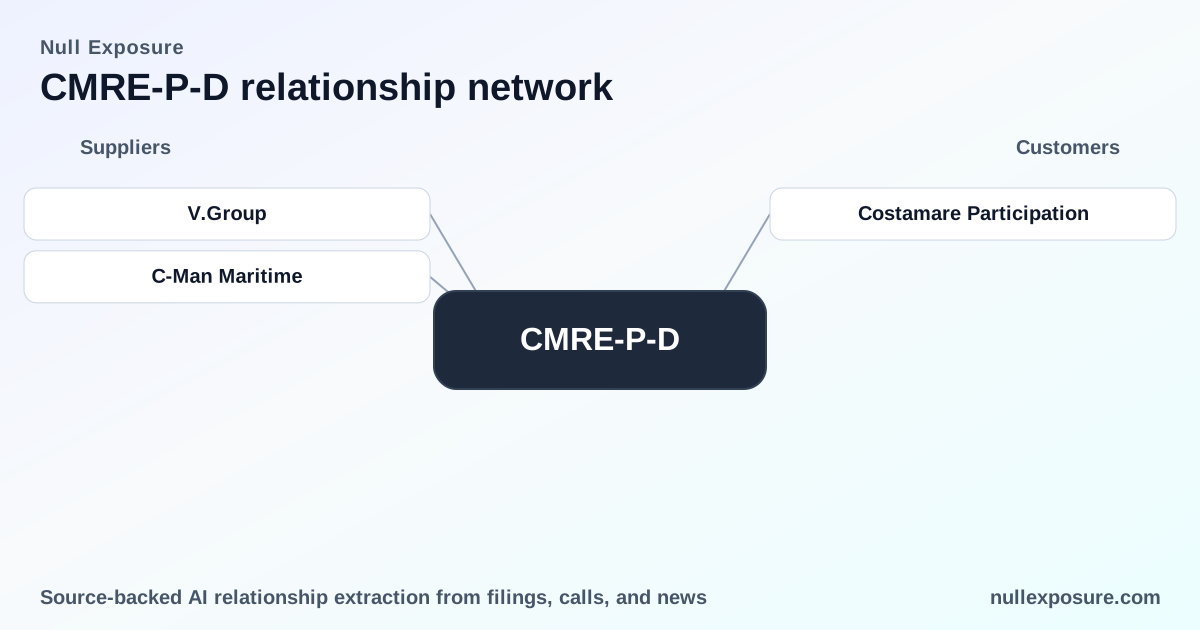
The recorded customer relationship: Costamare Participation
Single-item finding and what it means
Costamare Participation — a newly created portfolio company — committed €85.6 million to acquire three operating companies (each owning one ship) from the parent, Costamare Inc., in FY2021, which represents an intra-group consolidation of assets rather than a third-party customer contract. According to a BusinessVoice report from May 19, 2021, the transaction was structured as a purchase of three companies holding three ships.
Source: BusinessVoice news piece published May 19, 2021 discussing the Costamare Participation formation and the €85.6m purchase.
How that relationship alters the commercial profile investors should model
This particular action changes how to think about counterparty exposures and operational control:
- If the parent continues to charter the vessels back to the same customers, revenue continuity is intact but legal counterparties and collateral profiles change.
- If the new vehicle acts as an independent lessor or seeks third-party charters, charterer mix and concentration dynamics could shift, creating possible variability in cashflow reliability.
Treat this transaction as corporate structuring rather than a commercial shift in demand for container shipping.
Company-level constraints and operating-model signals
There are no recorded constraints tied to customer relationships for CMRE-P-D in the reviewed materials; the constraint set is empty. As a result, the following are company-level signals investors should incorporate into underwriting and research models:
- Contracting posture: Asset-centric and portfolio-managed. Costamare demonstrates a propensity to rearrange asset ownership within the group, which indicates a flexible contracting posture where legal counterparties and collateral assignments are tools of capital management rather than fixed operational endpoints.
- Concentration: Moderate to potentially high within transaction scope. Group-level transfers that cluster multiple vessels under one entity increase concentration risk for that entity even if, at the group level, the fleet remains diversified.
- Criticality: High for financing and governance readers. These transactions materially affect credit profiles — lenders and preferred-holders need clarity on intercompany guarantees, pledge structures and cash-trap mechanics.
- Maturity: Established shipping operator with mature asset-management behavior. Moves like the creation of Costamare Participation indicate sophisticated balance-sheet and tax planning common to mature shipping owners.
These signals should be integrated into counterparty risk frameworks: even without explicit constraints, corporate structuring materially changes where and how risk lands.
Investment implications and risk factors
For preferred shareholders and institutional investors, the implications are concrete and actionable:
- Cashflow predictability remains tied to charter continuity. If charters transfer intact to the new entity, coupon coverage prospects are stable; if not, recharter risk increases.
- Counterparty and collateral visibility is paramount. Investors need up-to-date schedules of vessel ownership, mortgage filings and any intercompany guarantees to assess recovery prospects.
- Liquidity pathways can be altered by intra-group transfers. Selling vessels or securitizing them within a new entity can either free capital or isolate assets from parent-level liquidity support.
Operationally, investors should insist on clear reporting of intra-group transactions and any changes in charter counterparties or mortgage packages.
Practical next steps for analysts and operators
- Request an updated ownership and mortgage schedule showing which vessels sit within Costamare Participation and what charters (if any) were novated.
- Verify whether any intercompany guarantees, charters or management agreements were executed alongside the sale; these documents determine practical cashflows and enforcement options.
- Revisit covenant and collateral assumptions in light of concentrated ownership at the subsidiary level.
For a consolidated view of these relationship dynamics and to monitor future intra-group transfers, visit https://nullexposure.com/ to see how our platform tracks ownership, charter and counterparty changes across shipping portfolios.
Bottom line
This record — a €85.6 million acquisition by a newly formed Costamare Participation of three company-owned ships — is a corporate-structuring event that has immediate relevance to capital structure, counterparty visibility and concentration risk for CMRE-P-D investors. Treat the event as a governance and credit signal that requires direct document-level verification (ownership schedules, charters, guarantees) before adjusting revenue or recovery assumptions in any model.