CMS Energy: Who buys from Consumers Energy and why customers matter for investors
Thesis: CMS Energy (NYSE: CMS) operates principally through Consumers Energy, a regulated electric and gas utility that monetizes a stable franchise via tariff‑based rates complemented by long‑term commercial contracts and power purchase agreements. The company’s cash flow profile is anchored in regulated margins, while incremental earnings and load growth are driven by large industrial users, renewable PPAs, and select subscription programs that bring new demand into the service territory. For a concise external perspective on customer exposures, visit https://nullexposure.com/.
Why the customer list is an investment signal — what to watch beyond headlines
Investors should read the customer relationships as more than names on a page: they reveal contracting posture, concentration, geographic concentration, and the strategic customers that can change load and profit dynamics.
- Contracting posture: Consumers’ disclosed contract language shows a shift toward durable, protective arrangements — minimum 15‑year terms for very large customers, 80% minimum demand billing, upfront fees, and strong collateral and exit‑fee protections. This structure shifts project-level risk onto the counterparty and away from ratepayers, supporting regulated earnings stability.
- Customer concentration and criticality: The utility emphasizes a broad residential and commercial base in Michigan’s Lower Peninsula and explicitly states it is not dependent on any single customer for financial health; this signals low concentration risk at the corporate level, while large industrial wins are nevertheless material to local earnings and load.
- Geographic focus and growth vectors: All commercial activity is centered in Consumers’ Michigan service territory, making regional industrial projects and data center builds direct drivers of incremental energy demand.
- Contract maturity and revenue recognition: A mixture of long‑term PPAs and subscription programs indicates both predictable contracted revenues and optionality through new customer-sourced demand.
These points come from Consumers Energy’s regulatory filings and recent public commentary; read the primary disclosures on CMS’s FY2025 10‑K and Q1‑2026 management remarks for full context.
Customer relationships in the filings and press — the essentials
Below are the explicit customer relationships disclosed in the available filings and media reports; each entry is a plain‑English summary with the primary source cited.
MCV Partnership — a large renewable PPA commitment
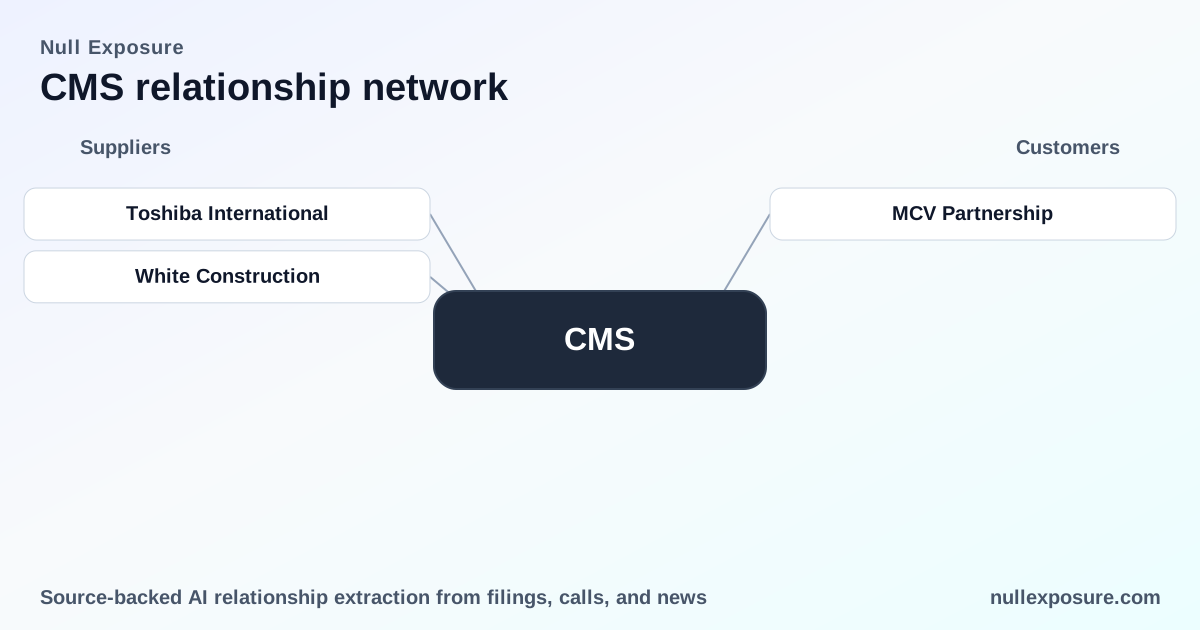
Consumers has a power purchase agreement with the MCV Partnership that gives the utility rights to purchase up to 1,240 MW of capacity and energy from the MCV facility, reflecting a sizable contracted renewable supply commitment for the utility. This is documented in Consumers Energy’s FY2025 10‑K filing. (Source: CMS 2025 10‑K filing.)
Michigan Potash and Salt Company — a major industrial load commitment announced in earnings commentary
Management highlighted a recently signed contract with Michigan Potash and Salt Company — a domestic potash producer — describing it as a strategic, critical‑mineral manufacturer expanding in Consumers’ territory with roughly 130 jobs and over $1.3 billion of investment, indicating a substantial long‑term load and economic development win for the utility. This description came in a Q1‑2026 earnings call transcript. (Source: Q1‑2026 earnings call transcript captured by InsiderMonkey.)
Microsoft — pursuing an AI training facility that could add large incremental demand
Public reporting notes Consumers is pursuing an AI training facility with Microsoft near Grand Rapids, a type of customer that brings high, steady electricity demand and potential for premium infrastructure arrangements. The Microsoft engagement was reported in coverage of industrial customer activity in FY2026. (Source: Utility Dive, May 2026 coverage.)
Michigan Potash & Salt Co. (trade reporting) — project timing and scale
Trade and industry reporting describe a planned $1.2 billion fertilizer mine and processing plant from Michigan Potash & Salt Co., expected to open in mid‑2028, representing a near‑term, high‑intensity load project for Consumers’ grid. This reporting was summarized in industry press coverage. (Source: Utility Dive, May 2026.)
What these relationships imply for CMS’s operating and financial profile
These customer relationships collectively reinforce a dual thesis about CMS’s business model: regulatory income provides stability while selective industrial contracts and PPAs drive incremental growth.
- Stability with upside: The regulated tariff framework supplies a steady revenue base (FY2025 revenue ~ $8.82B; Market Cap ~ $23.4B), while the combination of PPAs and large industrial customers offers growth in kilowatt‑hours sold and potential margin accretion if load rises faster than incremental cost.
- Risk allocation through contracts: The company’s contractual posture — 15‑year minimums, demand billing floors, upfront fees, and collateral — protects existing ratepayers from cost shifts and reduces downside for CMS. Those contract features are explicit in regulatory disclosures and represent a conservative approach to adding large industrial customers.
- Concentration is low at the company level, but local impact is high: Consumers stresses it is not materially dependent on any single customer; that is a corporate‑level signal that loss of one customer would not threaten balance‑sheet health. Still, winning or losing a multi‑hundred‑MW industrial or data‑center customer can move utility load and near‑term capital planning in the service territory.
- Maturity and timing: Several relationships are long‑term or development projects (PPAs, multi‑year mineral and industrial buildouts), translating to multi‑year visibility on incremental load rather than one‑off swings.
How investors should price these developments
Investors should incorporate three practical adjustments into valuation and risk models:
- Credit and cashflow upside from contracted load: Long‑term PPAs and industrial customers provide stable, contractually backed revenues that support credit metrics and justify regulatory filings for cost recovery.
- Value optionality from industrial and tech customers: Projects like the potash mine and a Microsoft AI center materially increase kWh demand and can absorb incremental generation investment; price the potential for step‑function load growth into longer‑term earnings assumptions rather than one‑year forecasts.
- Regulatory and execution risk remain the tether: The company’s conservative contract terms reduce ratepayer exposure, but regulatory approvals, construction execution, and timing of industrial builds still determine near‑term cash flow realization.
For investors wanting a focused analysis of customer exposures and how they drive Consumers’ revenue mix, see additional resources at https://nullexposure.com/.
Bottom line
Consumers Energy’s disclosed customer relationships and contract language paint a clear picture: a regulated utility with predictable tariffs that is selectively growing load through long‑term industrial partnerships and large‑scale PPAs. Contract design shifts financial and operational risk onto counterparties, the Michigan service territory remains the center of gravity, and incremental demand from projects such as the potash facility and a potential Microsoft data center offers measurable upside to earnings. Investors should underwrite CMS as a regulated earnings story with targeted growth optionality tied directly to measurable, long‑term customer commitments.