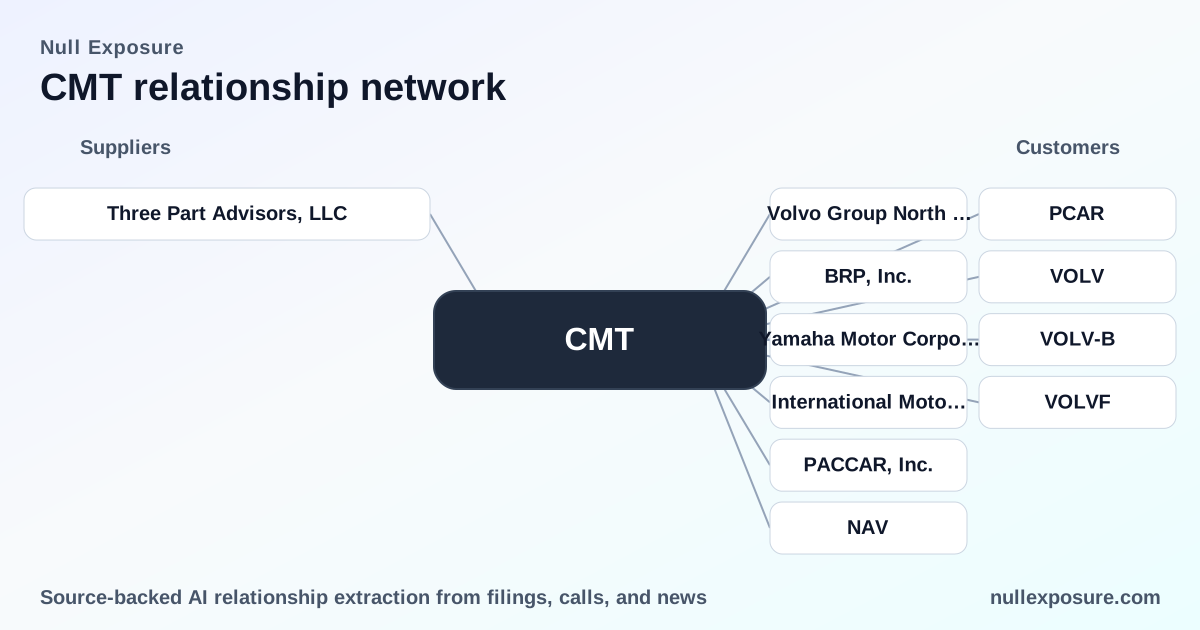
Core Molding Technologies (CMT): Customer Map and Commercial Constraints
Core Molding Technologies manufactures thermoplastic and thermoset structural products and monetizes through manufacturing and sale contracts with OEMs in heavy trucks, power sports, automotive and industrial markets, where a small set of large customers generates the majority of revenue; the company’s economics are driven by long-term, price-fixed customer agreements, North American production footprint, and concentrated demand from a handful of OEMs. For investors evaluating customer risk and operational levers, this piece unpacks every disclosed customer relationship and the company-level constraints that govern them. For a broader view of supplier and customer exposures, visit https://nullexposure.com/ for our platform coverage.
Why customers matter for CMT: concentration, contract length, capital intensity
Core Molding discloses that five customers accounted for roughly 69% of 2024 sales, creating a capital allocation and revenue-risk profile that is highly customer-dependent. The firm operates under long-term contracts that fix price and obligate acceptance of orders, which stabilizes margins on awarded programs but also creates dependency on winning and retaining program awards. With manufacturing operations aggregated as a single North America segment (U.S., Canada, Mexico), geographic concentration in NA raises cyclical exposure to regional OEM demand and ties capital spend to program awards (for example, sizeable investment to support new Volvo Mexico programs).
- Key operational signals: concentrated customer base, long-term commercial posture, active program investment, North American manufacturing footprint, and materiality of customer loss.
Customer-by-customer read: what the filings and press coverage show
Below I cover every relationship disclosed in the available results. Each entry is a concise, plain-English takeaway with the original source noted.
BRP, Inc.
Core Molding lists BRP as one of its five major customers for fiscal 2024, confirming BRP is a material buyer within the five-customer concentration (Core Molding FY2024 10‑K).
International Motors, LLC
International Motors appears among the five major customers named in the FY2024 10‑K, indicating an active commercial relationship in the company’s reported customer mix (Core Molding FY2024 10‑K).
PACCAR, Inc.
PACCAR is explicitly named among the five major customers in the FY2024 10‑K, reflecting Core Molding’s exposure to large heavy-truck OEMs (Core Molding FY2024 10‑K).
Volvo Group North America, LLC
Volvo Group North America is listed in the FY2024 10‑K as one of the five major customers; subsequent disclosures and investor materials also describe new program awards and significant capital investment tied to Volvo business, underlining strategic importance (Core Molding FY2024 10‑K; investor presentations and Q3 2025 results).
Yamaha Motor Corporation
Yamaha is the fifth company listed among the five major customers in the FY2024 10‑K, demonstrating exposure to the power sports segment (Core Molding FY2024 10‑K).
PACCAR (news reference: Dispatch 2018)
A Dispatch profile from 2018 identifies PACCAR as one of Core Molding’s largest customers historically, reinforcing long-standing commercial ties to heavy-truck OEMs (Dispatch.com, Oct 2018).
Navistar (news reference: Dispatch 2018)
The same 2018 Dispatch article names Navistar as a major customer alongside Volvo and PACCAR, indicating historical concentration in heavy-truck makers (Dispatch.com, Oct 2018).
Volvo (news reference: ManilaTimes / GlobeNewswire, FY2025)
Core Molding’s FY2025 communications discuss the award of Volvo Mexico business and an associated $25 million investment plan over 18 months, tying capital expenditure directly to a customer program (GlobeNewswire/ManilaTimes report on Q3 2025 results).
VOLV-B (news references)
Investor slides and press notices reference Volvo program awards, including a reported $150 million Volvo roof contract to start production Q1 2027, showing program-level revenue potential and the need for manufacturing expansion in Matamoros and Monterrey (investor slides and announcements, 2025–2026).
Paccar Inc. (historical press)
A 2013 Dispatch report indicated that Paccar historically contributed a large share of sales (circa 35%), highlighting legacy concentration and the firm’s multi-year dependency on major truck OEMs (Dispatch.com, Apr 2013).
NAV / Navistar (historical)
Historical coverage notes that Navistar accounted for a significant portion of sales in earlier years, evidencing how the customer mix has been dominated by truck OEMs over time (Dispatch.com, Apr 2013).
Multiple Volvo news mentions (TradingView, InsiderMonkey, QuiverQuant, Intellectia)
Across trading updates and earnings call transcripts (FY2025–FY2026 materials), management reiterated Volvo program wins and capital plans — including an explicit $8–10 million near-term spend in FY2025 and a larger $25 million program investment — emphasizing that future revenue and capacity are program-contingent (Q3 2025 call transcripts and investor presentations, 2025–2026).
VOLVF / VOLV / VOLV-B variants (news coverage)
Multiple outlets reused similar language on Volvo awards and timing; these references collectively document the same commercial reality: new Volvo programs drive near-term capital outlays and multi-year production commitments, and are repeatedly cited in filings and investor materials (various news and trading platforms, 2025–2026).
(Note: the results include multiple distinct entries for the same OEM under slightly different names or tickers; each entry above corresponds to the disclosed item and its source.)
Operational constraints that drive value and risk
- Contracting posture: Core Molding enters long-term, price-fixed contracts that provide rebound protection on awarded programs and require acceptance of orders, which preserves utilization but concentrates negotiation and award risk.
- Geography and footprint: The business reports a single North America operating segment comprising the U.S., Canada and Mexico, aligning capacity and demand within a single regional cycle and focusing capital deployment on Mexican expansions for Volvo programs.
- Concentration and materiality: With five customers accounting for ~69% of sales in 2024, the loss of a major customer would be materially adverse, placing a premium on program retention and new contract wins.
- Role and revenue mechanics: The company is both seller of molded products and buyer within its supply chain, but investor focus should remain on program awards and OEM pipeline as the primary revenue driver.
- Relationship maturity and stage: Disclosure classifies these customer relationships as active, with ongoing production programs and announced future launches that carry committed capital plans.
Investment implications and risks
- Upside: Program awards (notably Volvo) create multi-year revenue streams and justify capital investments that can scale adjusted EBITDA if volume targets are met. Win-driven capital deployments are a primary growth lever.
- Downside: High customer concentration and program-specific exposure create single-customer event risk; failure to secure or retain programs would materially compress utilization and profits.
- Catalysts to watch: ramp timelines for Volvo Mexico programs, reported capital spend cadence ($8–10M near-term outlay within FY2025 and $25M total), and renewal outcomes with the five named OEMs.
For a focused data-driven dashboard on buyer-supplier exposures and to track program awards and capital spend across CMT’s customer base, explore our platform at https://nullexposure.com/.
Bold takeaway: CMT is a manufacturing OEM supplier whose valuation sensitivity is tied directly to a small number of large program awards; Volvo wins improve scale but increase the company’s program concentration and capital intensity.