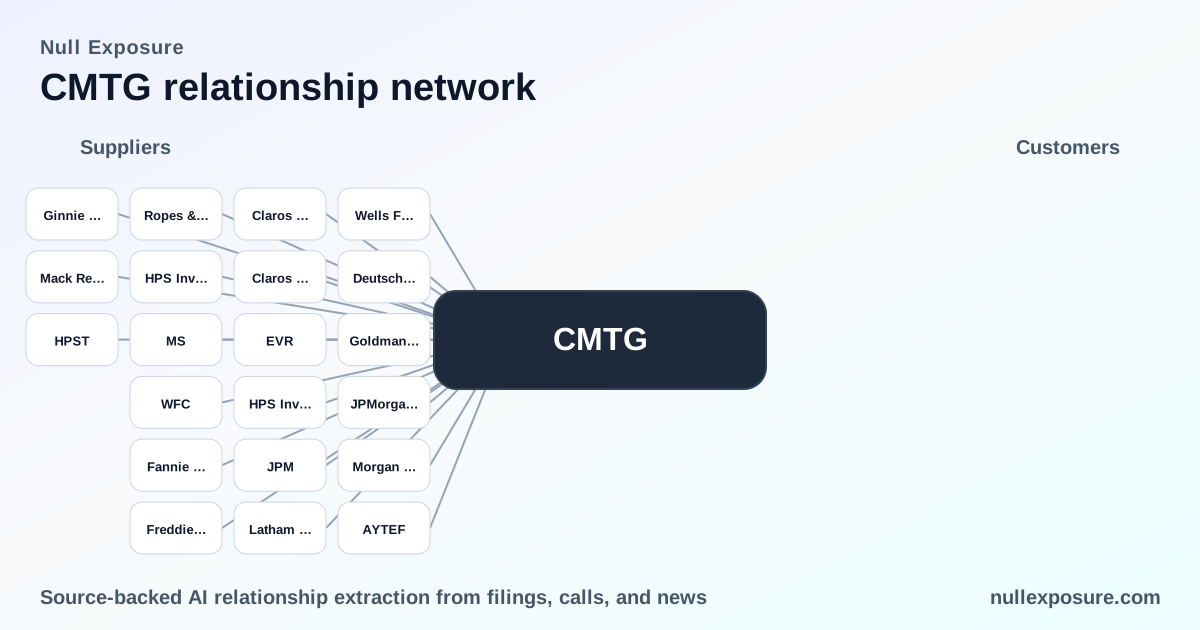
Claros Mortgage Trust (CMTG) — customer relationships and what they tell investors
Claros Mortgage Trust (CMTG) operates as a mortgage REIT that originates, acquires and manages short-duration, floating-rate commercial real estate loans secured primarily in the United States; it monetizes through interest spreads, loan workout recoveries and selective asset dispositions while financing those positions with floating-rate liabilities and repurchase facilities. Investors should view CMTG as a rate‑sensitive, credit‑first originator with active balance‑sheet management rather than a long-duration lender. For more context on how we source and analyze counterparty exposure, visit https://nullexposure.com/.
Business model in one paragraph Claros concentrates on transitional commercial real estate (CRE) loans sized typically between $50 million and $300 million, targeting initial loan terms of two to four years and underwriting against sponsor expertise and property fundamentals. The firm reduces interest-rate mismatch by originating floating-rate assets and funding them with floating-rate liabilities; it also uses repurchase agreements as an element of its liability stack. As of December 31, 2024, Claros reported a $6.1 billion diversified loan portfolio, reflecting scale in senior and subordinate positions across multifamily, hospitality, office and other transitional property types.
How Claros underwrites customers and structures exposure Claros’s contracting posture is transactional and short-term, which gives it pricing flexibility and the ability to re-underwrite credits on refinancing or maturity. The company explicitly targets loans with 2–4 year initial terms, which means the portfolio is exposed to near-term repricing and refinancing cycles rather than long-duration carry. Geographic concentration is deliberate: Claros focuses primarily on U.S. markets, concentrating lending in major metropolitan corridors and listing exposures by region and property type in its filings.
Key structural characteristics that matter to investors
- Contract tenor and re-underwriting frequency: Short initial terms compress the horizon for credit events and collateral value resets; this enables rapid earning-rate resets but increases near-term refinancing and liquidity sensitivity.
- Loan size and counterparty sophistication: Target tickets ($50M–$300M) place Claros in first‑tier sponsor finance, where sponsor capital and experience materially affect recoveries.
- Floating-rate matching: Originating floating-rate loans and financing them with floating liabilities materially reduces duration risk and preserves margins as base rates move.
- Repo and secured funding dependence: Claros uses repurchase agreements to finance certain loans, which accelerates liquidity risk if wholesale funding markets tighten. These characteristics create an operating model that is earnings‑sensitive to both credit cycles and wholesale funding availability while offering the benefit of rapid repricing for performing assets.
Customer relationships: what the public record shows The public relationships dataset for CMTG’s customer scope is concise and result-driven. Below I cover every relationship listed in the record and the direct, plain-English implications for investors.
Z&L Properties — workout and foreclosure action A subsidiary of Claros Mortgage Trust scheduled an auction for two San Jose condominium towers after Z&L Properties defaulted on a $264 million loan, with an auction slated for early February following the default. This is a clear example of Claros enforcing collateral remedies and harvesting recovery through foreclosure procedures. (Source: TheRealDeal report, January 21, 2025.)
What this relationship tells investors
- The Z&L workout demonstrates Claros’s willingness to litigate or foreclose when sponsor performance deteriorates, indicating active portfolio surveillance and enforcement capability.
- The size of the loan ($264M) is consistent with Claros’s stated ticket sizes and highlights exposure to transitional, for-sale residential product in a high-cost Bay Area market—an area where asset liquidity and price realization will determine recovery rates. (Source: company disclosures and the TheRealDeal article.)
Operational constraints and company‑level signals that shape customer outcomes The available company excerpts and filings surface a set of constraints that shape both deal flow and credit outcomes; these are company-level signals, not tied to any single borrower unless explicitly stated in the record.
- Contracting posture: Claros targets loan initial terms between two and four years, which institutionalizes high portfolio turnover and frequent counterparty re‑underwriting. (Source: company filing language on loan terms.)
- Geography and concentration: The firm originates, co‑originates and acquires loans primarily in U.S. markets, with portfolio reporting showing the United States as the primary geographic exposure. That concentration increases sensitivity to U.S. CRE cycles and regional market differentials. (Source: company disclosures.)
- Ticket size and spend profile: The company focuses on $50M–$300M loans, which places its counterparty base in the institutional sponsor class where deal complexity and sponsor balance‑sheet strength drive outcomes. (Source: company disclosures.)
- Funding posture: Claros finances certain loans via repurchase agreements and otherwise seeks to match floating-rate assets with floating-rate liabilities, underscoring both funding efficiency and susceptibility to repo market stress. (Source: company disclosures.)
- Segment emphasis: The business is oriented toward transitional CRE and a mix of senior and subordinate positions, including mezzanine loans secured by equity pledges rather than first liens—this elevates the importance of sponsor capitalization and collateral marketability. (Source: company disclosures.)
- Portfolio scale and activity: As of December 31, 2024, Claros reported a $6.1 billion loan portfolio, indicating meaningful scale but also significant near-term refinancing windows given the short-tenor strategy. (Source: company statement as of December 31, 2024.)
How to interpret credit events and enforcement activity Foreclosure activity such as the Z&L matter is a signal of active workout capability and of realized credit stress within targeted asset classes and markets. For investors, the critical follow-ups are recovery timing, realized loss severity versus reserves, and whether workout proceeds materially offset carrying values. Claros’s short-term origination profile accelerates both the frequency of such events and the speed at which they affect reported earnings.
How this fits into valuation and risk assessment CMTG’s market capitalization, book-value dynamics and operating results reflect stress across earnings and asset valuations: the company reported negative EPS and a low price-to-book multiple, while institutional ownership is high, suggesting broad investor scrutiny. The combination of short tenors, repo funding and exposure to transitional CRE creates a dynamic where credit execution and liquidity management are the primary drivers of near-term returns and downside risk.
For further, structured client analysis and counterparty tracking, visit https://nullexposure.com/ for additional research and relationship intelligence.
Bottom line Claros Mortgage Trust runs a concentrated, short-term, floating-rate CRE lending franchise that generates returns through spread capture and active credit enforcement. The Z&L foreclosure is a tangible demonstration of the firm’s workout playbook and the credit sensitivity embedded in its portfolio; investors should prioritize monitoring funding lines, sponsor quality and regional market liquidity as the primary determinants of near‑term results.