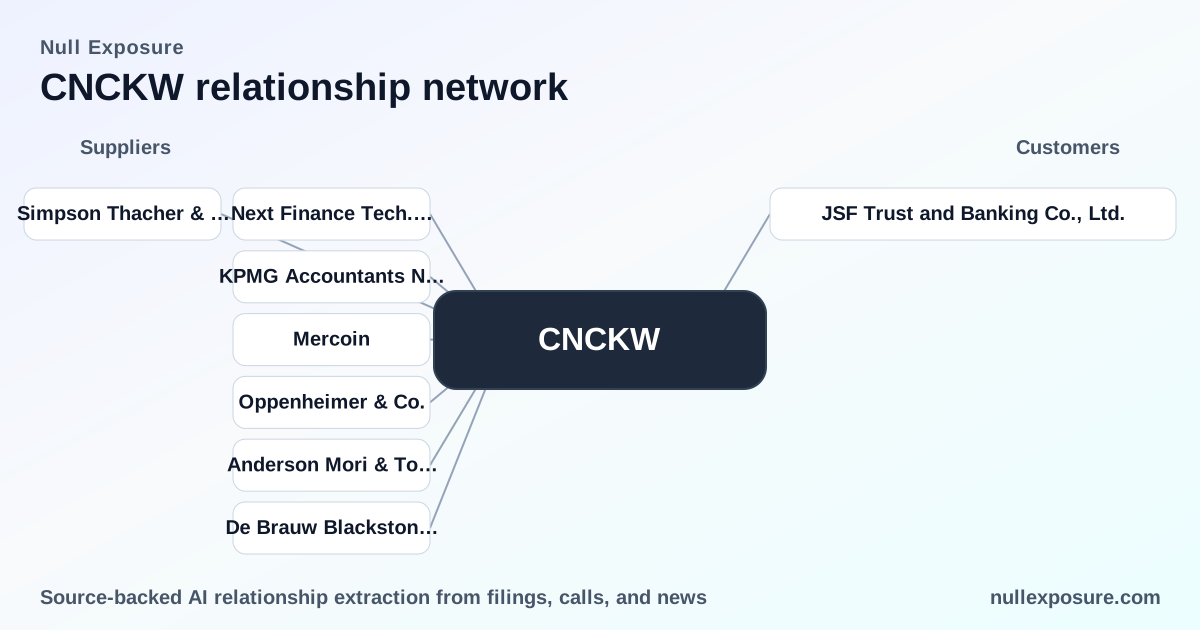
CNCKW — Coincheck Group N.V. Warrants: Customer-relationship briefing for investors
Coincheck Group operates a leading digital-asset exchange platform and captures revenue through trading fees, custody and asset servicing, and financial income tied to deposited balances and trust arrangements. The CNCKW warrants give investors leveraged exposure to Coincheck’s enterprise value; assessing customer relationships and counterparties is essential because non-trading revenue streams such as interest and custody fees materially influence cash flow stability and regulatory counterparty risk. For a quick company overview and ongoing monitoring, see NullExposure’s coverage: https://nullexposure.com/.
How Coincheck earns and where customer links matter
Coincheck’s reported consolidated performance is driven by transaction volumes and ancillary services: trading commissions, custody and storage, and interest income. The company’s reported trailing revenue figure is 475,128,005,000 (as provided in public company data), and gross profit is listed at 13,709,000,000; these headline numbers reflect a mix of core exchange economics and financial income from institutional counterparties. For warrant investors, the critical distinction is that non-fee financial flows — interest on deposits and institutional trust balances — create different counterparty exposure than pure retail trading volumes.
Operationally, Coincheck’s posture looks like a regulated exchange operator that combines platform economics with banking and trust relationships to optimize yield on holdings. That hybrid model reduces dependence on pure trading fees but substitutes in counterparty credit and contractual risk linked to banks and trust companies.
Customer relationships disclosed: one partner, clear line item
Coincheck’s customer relationship data returned a single explicit counterparty in recent filings:
- JSF Trust and Banking Co., Ltd.
- Coincheck reports that “other revenue is mainly the interest received from JSF Trust and Banking Co., Ltd.” in FY2026, indicating a direct interest-bearing arrangement between the companies. This identifies JSF Trust as a source of interest income reported as “other revenue.” Source: company filing (current report) for FY2026, published March 2026 on Stocktitan: https://www.stocktitan.net/sec-filings/CNCK/6-k-coincheck-group-n-v-current-report-foreign-issuer-8f686b5f516a.html.
This single explicit relationship makes the counterparty visible in filings and anchors a portion of non-operating income to a named trust/banking entity.
What the JSF Trust link implies for investors
The disclosure that interest income is “mainly” received from JSF Trust signals a contracted yield-generating position rather than anonymous market cash balances. For investors, this has three practical consequences:
- It introduces counterparty credit exposure into what otherwise looks like an exchange-driven revenue mix; credit quality and contractual terms with JSF determine recoverability and yield.
- Interest income from a named bank/trust suggests liquidity management practices that allocate client or corporate cash into deposit/trust arrangements rather than leaving all balances on the exchange.
- The relationship is discrete and documented in filings, which improves transparency versus unreported counterparties.
Source reference reiterated: FY2026 company report via Stocktitan (March 2026).
Company-level signals from constraints (what’s not shown)
The returned constraints list for customer relationships is empty. That absence is itself an informative company-level signal: Coincheck does not disclose additional contractual constraints, concentrations, or material third-party limitations in the customer-relationship results provided. Investors should interpret this as:
- Contracting posture: The firm positions itself as the primary platform operator with selective institutional relationships rather than a web of disclosed large single-customer dependencies.
- Concentration: Public data lists only one named counterparty for interest income, which highlights concentration in that revenue subcategory — but the absence of more disclosed counterparties leaves overall concentration ambiguous.
- Criticality: The documented JSF Trust relationship is revenue-relevant (interest income), but there is no stated supplier/customer constraint that marks it as a single point of failure in filings returned here.
- Maturity: The presence of a named trust/bank partner for interest income signals a mature cash-management approach consistent with institutionalized exchange operations.
These operating-model characteristics should be seen as company-level signals, not as assertions about other nondisclosed partners.
Risk profile and investor action items
Investors evaluating CNCKW should weigh the following key risks and considerations:
- Counterparty credit risk: Named interest income from JSF Trust means a portion of non-operating revenue hinges on the health and contractual standing of that trust/bank. Verify JSF’s credit standing and contractual terms in detailed filings.
- Concentration risk for non-trading revenue: With a single explicitly disclosed provider of interest income, fluctuations in that relationship will have an outsized impact on “other revenue” line items.
- Regulatory and jurisdictional complexity: Coincheck operates within Japanese regulatory frameworks and lists warrants on NASDAQ via Coincheck Group N.V., exposing investors to cross-border regulatory dynamics that affect banking and custody partnerships.
- Warrant-specific leverage: CNCKW is a warrant instrument; investors should separate operational credit exposure (exchange and counterparties) from the leverage and time-decay mechanics inherent in warrants.
Practical next steps for investors:
- Inspect the FY2026 Form 6-K and subsequent filings for contractual detail and any collateral or netting arrangements with JSF Trust; the March 2026 current report is the starting point (Stocktitan hosting link above).
- Monitor announcements from Coincheck and JSF for changes to interest terms, custody arrangements, or events affecting liquidity parked with the trust.
- Consider hedging or position sizing that accounts for both exchange-volume volatility and distinct counterparty credit events.
For ongoing coverage and deeper counterparty maps, NullExposure maintains a running dossier on exchange counterparties and financial partners: https://nullexposure.com/.
Final view: transparency where it counts, but watch the credit link
Coincheck’s filings establish a clear link between a segment of “other revenue” and JSF Trust and Banking Co., Ltd., which turns an otherwise anonymous interest line into a traceable counterparty exposure. That transparency is positive for investors, but the single disclosed relationship for interest income concentrates credit exposure and elevates the importance of monitoring JSF’s standing and the contractual protections Coincheck holds.
Key takeaway: CNCKW investors must evaluate both platform economics and the credit posture of named institutional partners — trading volumes drive headline revenue, but the stability of non-fee income depends on counterparties like JSF Trust and the terms in disclosed filings.