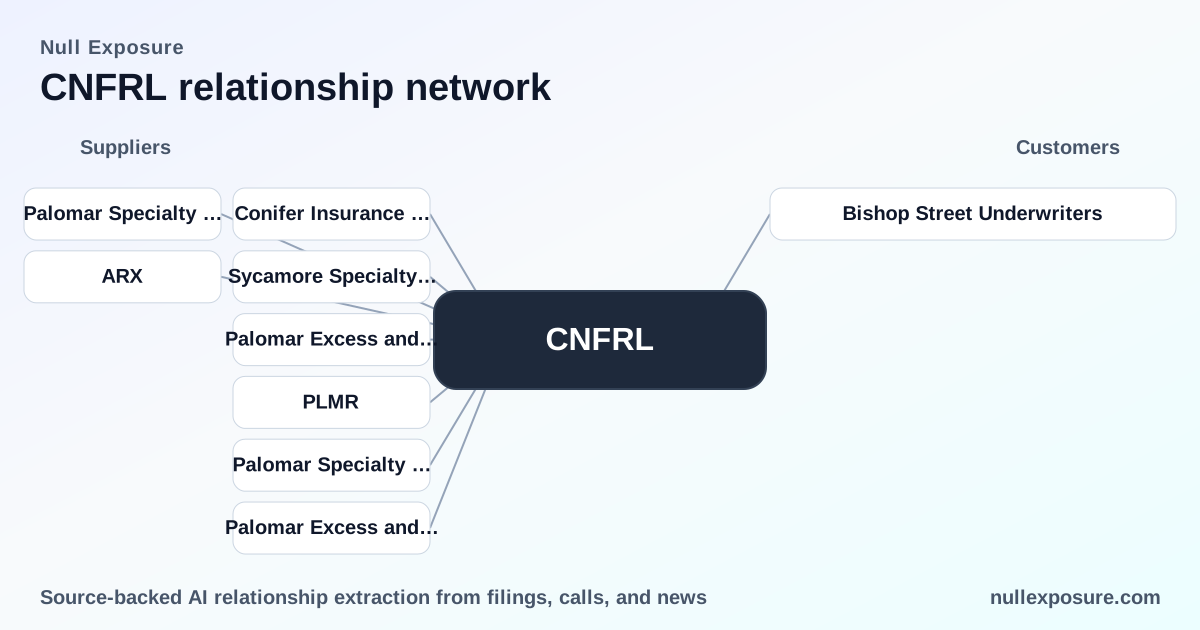
Conifer Holdings (CNFRL): Customer relationships that moved the P&L — what investors need to know
Conifer Holdings operates insurance distribution businesses and monetizes both through ongoing agency/MGA operations and through strategic disposals of those businesses. Recent activity — notably the sale of Conifer’s managing general agent/agency operations — converted an operating asset into a $61 million after-tax gain in FY2024, demonstrating a hybrid monetization profile that combines fee and commission economics with one-time realization events from asset sales. For investors evaluating CNFRL customer and partner relationships, the pattern of divestitures and legacy book sales is the central signal about where earnings and capital will come from in the near term.
Explore Null Exposure’s company coverage for additional context: https://nullexposure.com/
A decisive FY2024 transaction: Bishop Street Underwriters bought Conifer’s MGA operations
Conifer completed the sale of its insurance agency operations and managing general agent (MGA) business to Bishop Street Underwriters in August 2024, and the transaction produced a $61 million gain reported in FY2024. According to Reinsurance News, the disposal was recorded as a $61 million gain despite an adjusted operating loss for the quarter, and Insurance Business reported that Bishop Street is a multi-boutique insurance platform that acquired Conifer Insurance Services during the quarter. (Reinsurance News, March 2026: https://www.reinsurancene.ws/conifer-posts-61m-gain-from-agency-sale-despite-7-4m-adjusted-operating-loss-in-q324/; Insurance Business, March 2026: https://www.insurancebusinessmag.com/us/news/breaking-news/conifer-swings-to-profit-after-major-insurance-agency-sale-514548.aspx)
- Key takeaway: The Bishop Street transaction materially altered Conifer’s P&L in FY2024 via a realized gain, and reflects a strategy of monetizing distribution assets to boost near-term reported earnings.
Legacy carve-outs: RHP General Agency and the HomeValue book (2017)
Conifer sold the book of HomeValue business produced through Sycamore Insurance Agency to RHP General Agency Inc. in 2017. The Insurance Journal reported the transfer as a sale of the HomeValue book to Texas-based RHP, underscoring a prior pattern of divesting discrete blocks of agency-produced business. (Insurance Journal, July 2017: https://www.insurancejournal.com/news/southcentral/2017/07/12/457429.htm)
- Key takeaway: Conifer has executed smaller, targeted book sales historically, indicating an active posture toward optimizing its agency footprint and monetizing legacy producer-generated books.
What these relationships collectively reveal about Conifer’s operating model
The transactional record captured in the customer relationship set is limited but informative. Present signals at the company level:
- Contracting posture: Conifer demonstrates an asset-management posture — it operates agency/MGA businesses but is willing to exit or sell them when valuation or strategy justifies realization. Sales are executed as discrete transactions rather than ongoing, programmatic transfers.
- Revenue concentration and sensitivity: The FY2024 $61 million gain was material enough to swing Conifer to a reported profit for the period; this indicates earnings volatility driven by deal activity rather than solely by stable commission or fee income.
- Criticality of partners: Buyers such as Bishop Street Underwriters are strategic platforms that absorb entire operating units, suggesting Conifer’s agency operations were transferable and valuable to larger distribution consolidators.
- Maturity of disposition strategy: Transactions across multiple years (2017 book sale; 2024 MGA sale) indicate a consistent, multi-year pattern of portfolio pruning and selective monetization rather than a one-off event.
These are company-level signals; the underlying constraints dataset provides no additional contract-level limits, so the above are inferred from the observed transactions rather than bound by explicit contractual excerpts.
Investor implications: what to watch next
- Earnings base and predictability: With a significant portion of FY2024 upside coming from a sale, core operating earnings should be analyzed separately from one-time gains to assess sustainable cash generation. Investors should normalize earnings and model potential absence of similar disposal events.
- Strategic optionality vs. repeatability: Conifer’s ability to sell entire operating units to buyers like Bishop Street is an asset — it accelerates capital recycling — but it also signals that repeatable earnings will depend on what remains after divestitures.
- Buyer landscape and valuation capture: The profile of acquirers (multi-boutique platforms, regional general agencies) defines exit channels and valuation benchmarks for remaining lines; monitor consolidation activity among buyers as it affects Conifer’s ability to monetize future assets.
- Balance sheet and capital allocation: Realized gains provide one-off capital; assess how Conifer redeploys proceeds — into debt reduction, dividends, share buybacks, or reinvestment — because that will determine long-term shareholder value creation.
Relationship-by-relationship review (complete)
- Bishop Street Underwriters — Conifer sold its managing general agent operations (Conifer Insurance Services) to Bishop Street in August 2024, and recognized a $61 million gain on the sale in FY2024. (Reinsurance News, March 2026: https://www.reinsurancene.ws/conifer-posts-61m-gain-from-agency-sale-despite-7-4m-adjusted-operating-loss-in-q324/; Insurance Business, March 2026: https://www.insurancebusinessmag.com/us/news/breaking-news/conifer-swings-to-profit-after-major-insurance-agency-sale-514548.aspx)
- RHP General Agency Inc. — In 2017 Conifer divested the HomeValue book produced by Sycamore Insurance Agency to RHP General Agency Inc., a Texas-based buyer that took on the book of business. (Insurance Journal, July 2017: https://www.insurancejournal.com/news/southcentral/2017/07/12/457429.htm)
Conclusion: position, risk, and the next data points to demand
Conifer’s recent customer-relationship activity is defined by active monetization of distribution assets, producing meaningful one-time accounting gains that materially impact near-term results. For valuation and credit analysis, isolate recurring distribution economics from disposal-driven gains, monitor buyer-market liquidity among platforms like Bishop Street, and demand disclosure on how realized proceeds are allocated. For a concise feed of relationship-level developments and transaction tracking, visit Null Exposure’s company hub: https://nullexposure.com/
Bold signals for investors: earnings volatility from disposals, strategic optionality through exitable agency assets, and dependence on market appetite among consolidators to realize further value. These are the drivers that will determine CNFRL’s next inflection points.