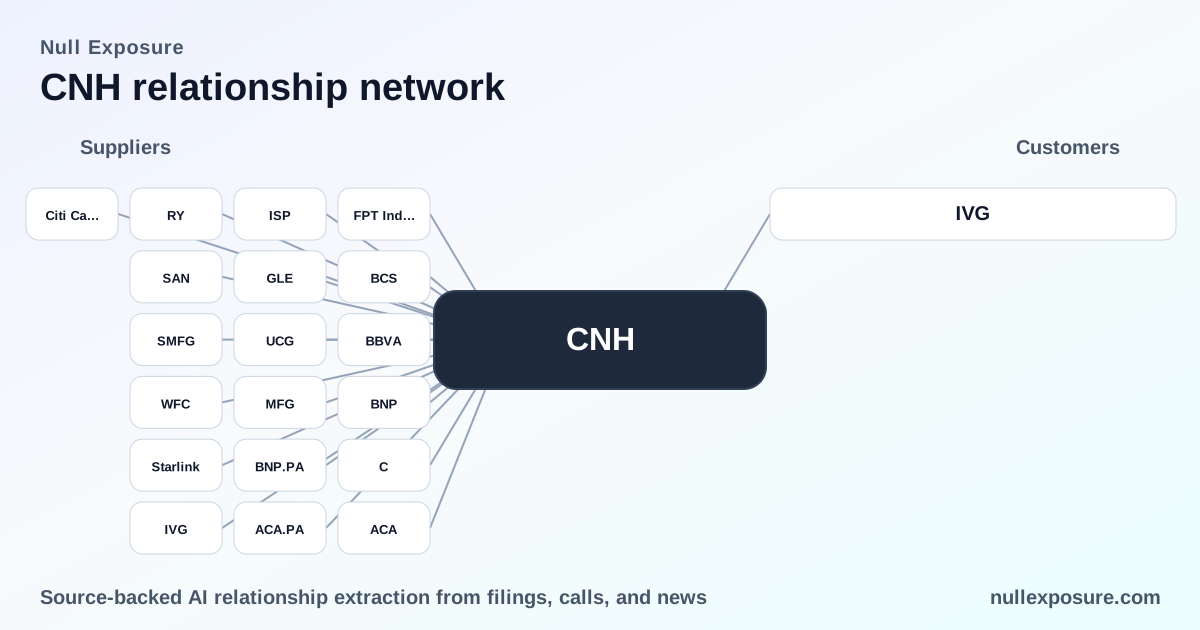
CNH Industrial: Dealer-led revenues, embedded finance, and related-party flows investors must price
CNH Industrial operates and monetizes through three tightly connected engines: manufacturing and selling agricultural and construction equipment through a global dealer network, after-sales parts and services delivered by those same dealers, and an in-house Financial Services arm that finances wholesale dealer inventories and retail equipment purchases. These activities generate cyclical equipment sales and a stickier services-and-finance revenue base that supports margins and working capital needs. For a focused review of CNH’s customer relationships and the counterparty risks baked into that model, read on — or visit https://nullexposure.com/ for broader portfolio signals.
Why CNH’s customer map matters to valuation and credit risk
CNH’s revenue model blends volume sensitivity with recurring-service cash flow. No single external customer accounted for 10%+ of consolidated revenue in 2022–2024, which is a structural deconcentration benefit for investors. At the same time, Financial Services is a material driver, underwriting a meaningful portion of sales through retail and wholesale financing and generating finance income that flows to operating results. The consequence is a two‑edged operating posture: diversification across dealers reduces single‑counterparty revenue concentration, while financing exposures and related‑party transactions concentrate credit and cash‑flow risk in specific counterparties and geographies.
Key operating characteristics:
- Contracting posture is mixed: CNH runs both long‑term service and finance master agreements for cross‑group services and multi‑year retail/lease finance products, and short‑term wholesale receivable arrangements with interest‑free periods up to 12 months.
- Counterparty universe is broad and global, including dealers, distributors, governments, and rental fleets; credit stress is geographically concentrated at times (notably Brazil/LATAM).
- Related‑party and supplier flows are nontrivial — the company reports nine‑figure transactions with affiliates, particularly Iveco, which translates to measurable counterparty exposure on the balance sheet.
Relationship-by-relationship review (all observed links)
Iveco Group N.V. — a material related-party debtor and services counterparty
CNH reports meaningful receivable balances from Iveco on its financial statements and has executed multi‑year service and financial‑services master agreements with the group; these arrangements cover leases of premises, IT services and wholesale/retail financing activities between the parties. CNH’s Q1 2026 press release shows receivables from Iveco at $192m on the balance sheet (GlobeNewswire, 2026-04-30), and CNH’s Q3 2025 release previously disclosed financial receivables and related items showing balances in the hundreds of millions (GlobeNewswire, 2025-11-07). Company filings describing the post‑demerger Master Services Agreement and a three‑year Financial Service MSA confirm multi‑year contractual ties and recurring finance income between CNH and Iveco (CNH filings, FY2024–FY2026).
AG‑Industrial — dealer consolidation and network strengthening
News coverage reports that AG‑Industrial was acquired by Forrester Farm Equipment, with the transaction expanding CNH’s dealer footprint and strengthening parts and service cooperation across North America, which deepens CNH’s retail coverage and after‑sales reach (Sahm Capital, 2026-03-14). This consolidation is effectively an extension of CNH’s channel strategy: larger dealer groups increase scale in parts, service and used inventory flows.
Forrester Farm Equipment — an expanded CNH dealer partner
Forrester Farm Equipment’s acquisition activity is presented as a strategic distributor expansion that deepens cooperation with CNH on parts and service support across North America, reinforcing CNH’s route‑to‑market and recurring revenue from after‑sales (Sahm Capital, 2026-03-14).
TITN / Titan Machinery — a large dealer relationship that underscores distribution dependence
Titan Machinery’s dealerships sell a range of CNH brands (Case IH, New Holland Agriculture, Case Construction, New Holland Construction and others), illustrating the dealer‑based distribution model CNH relies on. Titan’s 2025 10‑K explicitly states dependence on CNH as a primary supplier of equipment and parts and describes the need for CNH to provide competitive products, financing support, marketing and warranty reimbursements — all of which underscore how dealer economics hinge on CNH’s product and finance programs (Titan Machinery 10‑K, filed 2025-01-31). An earlier investor presentation and news coverage also documented Titan’s representation of CNH brands (Yahoo Finance coverage, 2012-10-24).
What the constraints tell investors about operational risk and contract structure
CNH’s constraint signals describe a mixed but coherent operating model:
- Long‑term contracting exists where strategic intercompany services and finance are required — CNH and Iveco’s MSAs and FS MSAs run multiple years and produce recurring finance income, which embeds counterparty credit as a company‑level risk.
- Short‑term trade finance is prevalent in wholesale dealer receivables, with interest‑free periods up to 12 months and accelerated repayment upon equipment resale, which preserves dealer liquidity but concentrates near‑term credit exposure.
- Customer types are broad (dealers, distributors, public entities, retail end users), which reduces single‑buyer risk but increases operational complexity and credit monitoring needs across jurisdictions.
- Geographic footprint is global with LATAM sensitivity; CNH flags retail reserve increases driven by South America (Brazil) conditions such as crop prices and extreme weather, indicating geographic credit pockets that require provisioning.
- Materiality is bifurcated: no external customer is individually >10% of revenue (limiting supplier concentration risk), yet Financial Services materially supports equipment sales and thus amplifies credit and funding risk when volumes decline.
- Spend and related‑party flows are significant: disclosed related‑party transaction tables show net revenues and purchases with Iveco and unconsolidated affiliates in the hundreds of millions, signaling meaningful intercompany economic exchange that investors should track.
Risk implications and what to watch next
- Credit exposure to related parties and dealer network health is a first‑order risk. The receivable lines with Iveco and wholesale dealer financing expose CNH to counterparty functioning and macro cycles. Monitor quarterly receivable balances and provisioning trends reported in CNH releases (GlobeNewswire Q3 2025 and Q1 2026).
- Dealer consolidation can be a structural benefit for after‑sales and parts margins, as the Forrester/AG‑Industrial transaction demonstrates, but it concentrates negotiating power and could compress dealer economics if not offset by CNH support programs.
- LATAM agronomic volatility is a provisioning driver. Watch CNH’s retail reserve commentary and Brazil crop‑related disclosures for credit cost trends.
If you want a concise, machine‑readable view of these relationships and how they influence CNH’s receivables and finance income, explore more at https://nullexposure.com/.
Bottom line for investors
CNH’s customer picture is a diversified dealer network underpinned by a material in‑house finance business and specific, large related‑party flows — principally with Iveco. That structure reduces single‑buyer revenue concentration but increases counterparty and credit risk through financial services and related‑party receivables. For valuation and credit analysis, prioritize trends in dealer receivables, related‑party balances (Iveco), and regional provisioning (Brazil/LATAM), while recognizing that dealer consolidation can both stabilize and centralize channel risk.