Canadian National Railway (CNI): Customer Relationships That Drive a Capital-Intensive Moat
Canadian National Railway (CNI) operates a Class I North American freight railroad that monetizes through movement of bulk and intermodal freight across an integrated rail network, collecting freight revenue, access fees, and ancillary logistics income under long-term service contracts and tariff schedules. CN’s economics are driven by network density, service reliability, and pricing power on routes that connect ports, industrial clusters and inland hubs. For investors, customer relationships translate directly into predictable revenue streams and operating leverage — and recent reporting shows CN actively stepping into traffic roles for large shippers and other carriers. Learn more at https://nullexposure.com/.
Why customer linkages matter to CN’s investment thesis
CN is a capital-intensive operator where the customer base defines utilization, pricing leverage, and return on invested capital. Contracts and routings set locomotive and crew deployment; a handful of large shippers and interchange partners determine yard throughput and margin volatility. Institutional ownership is high (about 74% according to the latest company snapshot), which reinforces a market narrative that CN is a mature, cash-generative infrastructure play with steady dividend policy.
- Contracting posture: CN operates predominantly under commercial tariffs and negotiated service agreements rather than spot-only transactions; this supports predictable revenue but requires rigorous capacity management.
- Concentration: A small set of large logistics and industrial customers underpins volume; this concentration amplifies both upside (pricing for scarce capacity) and downside (lost volume exposure).
- Criticality: Rail is essential for bulk commodities, container movements, and many industrial supply chains — CN’s network is often indispensable for inland-to-port flows.
- Maturity: The business is mature with stable margins and high free cash flow conversion, evidenced by strong EBITDA and dividend metrics in recent filings.
The relationship roster: what the recent reporting reveals
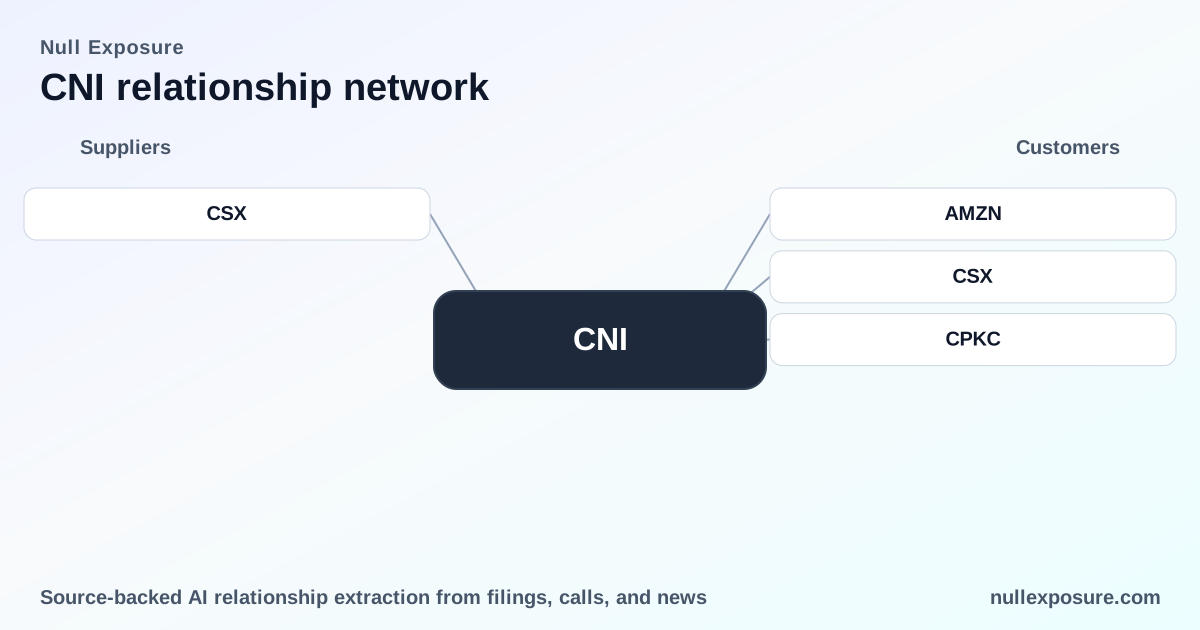
Below are the customer and partner mentions captured in the most recent news. Each listing is presented exactly as found in reporting, with a short plain-English summary and a source reference.
Amazon (AMZN) — news mention CN is cited as a “quiet backbone” for the physical movement of Amazon packages, EV components and grain, underscoring the railroad’s role in large-scale e‑commerce and industrial supply chains. According to an Ad-Hoc News piece published March 9, 2026, investors should not overlook CN’s logistics role in supporting Amazon’s North American distribution flows.
AMZN (duplicate mention) The same Ad-Hoc News March 9, 2026 reference repeats the point that CN is a crucial mover of goods for Amazon’s supply chain, highlighting ongoing visibility in e‑commerce logistics conversations. The duplication in coverage reinforces the perception of CN as a carrier for high-volume retail flows.
CSX (CSX) — operational interchange Progressive Railroading reported on March 9, 2026 that CN will handle CSX Transportation traffic to and from Sarnia, Ontario and on interchange points in Buffalo, N.Y., and Toledo, Ohio, indicating operational cooperation on cross-border and Great Lakes-region freight corridors. That arrangement positions CN as an active interchange partner moving another major carrier’s volumes.
CSX Transportation (duplicate entry) A second Progressive Railroading entry on March 9, 2026 reiterates that CN is taking responsibility for CSXT traffic on specified routings, confirming the operational shift rather than a single isolated movement.
Canadian Pacific Railway (CPKC) — traffic handoffs Reporting from Progressive Railroading on March 9, 2026 notes that CN will carry CSX’s long‑haul traffic destined for Canadian Pacific Railway to London, Ontario, indicating CN’s role as an intermediary for long-haul flows that ultimately interline with CPKC. This underscores CN’s network relevance within the Canadian transcontinental landscape.
CPKC (duplicate entry) A duplicate Progressive Railroading mention on March 9, 2026 repeats that CN will move CSXT’s long‑haul traffic bound for Canadian Pacific Railway into London, Ontario, emphasizing the recurring reporting of CN’s interchange responsibilities.
What these relationship signals mean for investors
- Network flexibility and optionality: CN stepping in to move CSX traffic and to serve flows related to Amazon shows the railroad’s operational flexibility and ability to monetize spare capacity across cross-border corridors. That flexibility supports utilization and incremental margin without immediate heavy capital expenditures.
- Revenue quality uplift: Handling third‑party carrier traffic and large shippers like Amazon indicates diversified revenue channels—tariffed interchanges, service agreements, and interline fees—improving revenue resilience against single-segment cyclicality.
- Counterparty risk profile: The presence of large counterparties concentrates credit exposure but also increases switching costs for shippers; CN’s value proposition is its geographic reach and reliability, which translate into durable service contracts.
- Operational execution is the margin lever: Successful integration of CSX-origin traffic and Amazon‑linked flows requires precise yard and crew management; execution lapses would compress operating margin quickly. Operational risk is the central near-term variable for investors.
Constraints and company-level signals
There are no relationship-specific contractual constraints captured in the current reporting; this is a company-level signal. From an investor perspective, that absence translates to two practical interpretations:
- Commercial posture: CN is operating with transactional and negotiated interchange agreements rather than long-term exclusive concessions disclosed in the public references.
- Disclosure maturity: Reporting focuses on operational routing changes and partner names rather than detailed contract terms, which is consistent with rail industry practice where commercial terms are often confidential.
Conclusion: read the signals, price the operations
CN’s role as an intermediary for CSX traffic and a logistics mover for high-volume shippers like Amazon is not incremental noise — it is a reaffirmation of CN’s core economic model: monetize network reach and operational execution. For investors, the key questions are whether CN can sustain reliability as volumes increase and how much pricing power it extracts from interline and shipper relationships. Monitor operating ratios, interchange throughput, and any subsequent corporate disclosures that convert these operational alignments into explicit contractual revenue.
For a deeper read on cross‑customer exposure and to track new mentions as they surface, visit https://nullexposure.com/.