CONMED (CNMD) — Customer relationships and what the Gore distribution change means for investors
CONMED develops, manufactures and sells surgical devices and related equipment for minimally invasive procedures and monetizes through hardware sales, recurring single‑use disposables and service/support arrangements across a global dealer/distributor network. The company places capital equipment on short-term loan to customers in exchange for multi-year consumable purchase commitments, generates revenue primarily as a seller through direct and distributor channels, and recognizes sales at shipment.
If you want a concise place to track CNMD customer intelligence and evolving distribution relationships, visit the Null Exposure homepage: https://nullexposure.com/
How CONMED sells and why that shapes customer risk
CONMED is a hardware-led medical device company with a monetization model built around installed capital and repeatable consumable revenue. Company disclosures state that certain capital equipment is provided loaned and at no charge in exchange for purchase commitments for single‑use products that typically run one to three years, which creates short-term contractual revenue visibility tied to consumable attachment rates. The business is managed on a consolidated, global basis — products are sold in over 100 countries through a mix of direct subsidiaries and local dealers/sub-distributors — and CONMED reports that no single customer represented over 10% of consolidated net sales for recent years, indicating low customer concentration.
These structural features produce a set of predictable investor constraints:
- Contracting posture: short‑term, binding consumable commitments anchored to loaned capital equipment (1–3 year horizons).
- Customer mix: significant sales to government and large institutional buyers (GPOs, IDNs, Veterans Administration), increasing procurement and reimbursement exposure.
- Distribution model: a hybrid of direct sales and distributors/sub‑distributors, which spreads geographic reach but introduces channel dependency in certain product lines.
- Materiality: company statements signal immaterial single-customer concentration, which lowers counterparty concentration risk at the consolidated level.
The reported Gore / GTEN relationship(s) — full coverage of the sources
Below I cover every relationship record returned in the customer results. Each listing is summarized in plain English and cites the original reporting.
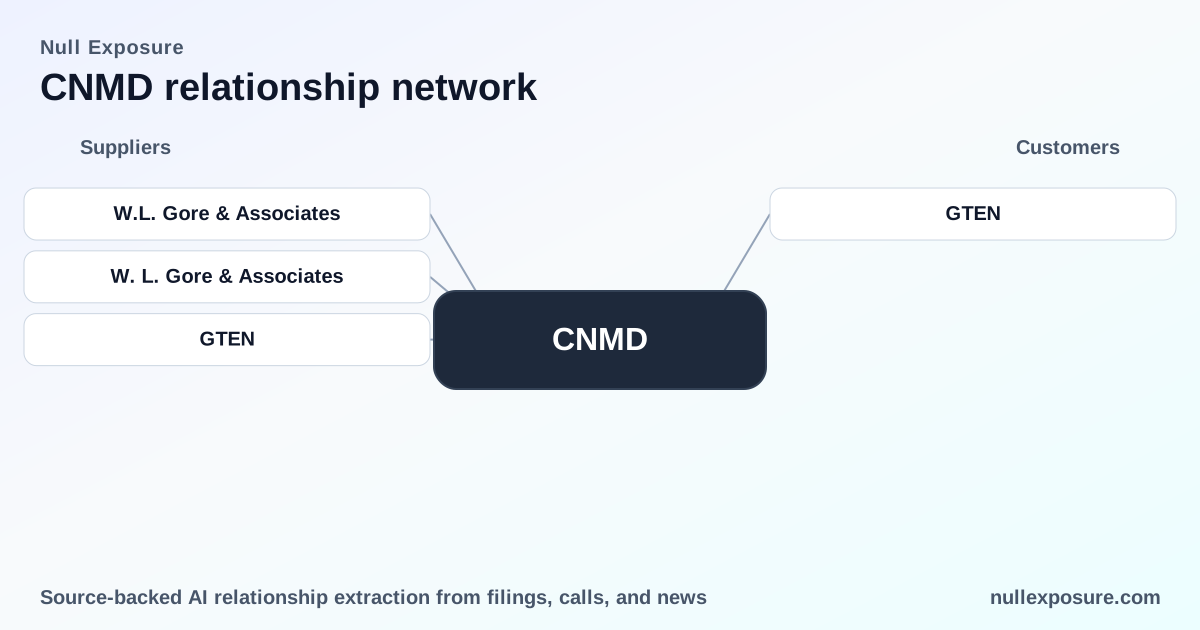
Conmed to exit gastroenterology lines and end Gore distribution (MarketScreener, March 9 2026) — result 1
CONMED announced it will exit gastroenterology product lines and end a distribution deal with Gore MT, a move that removes Gore as a distribution partner for those products and will require CONMED to reassign channel responsibilities or absorb direct distribution expenses. According to MarketScreener coverage of CONMED’s FY2026 guidance release on March 9, 2026, the company specifically referenced ending the Gore MT distribution arrangement. Source: MarketScreener report on March 9, 2026 — https://www.marketscreener.com/news/cnmd-conmed-expects-2026-adjusted-earnings-range-4-30-4-45-vs-factset-est-of-4-50-ce7e5bded881f020
Same disclosure indexed under GTEN (MarketScreener, March 9 2026) — result 2
The same MarketScreener item is indexed to the inferred ticker GTEN: it reiterates that CONMED will terminate the distribution agreement related to gastroenterology work with Gore MT as part of a strategic exit from those product lines, affecting the partner channel economically and operationally through FY2026. Source: MarketScreener coverage (FY2026 commentary) — https://www.marketscreener.com/news/cnmd-conmed-expects-2026-adjusted-earnings-range-4-30-4-45-vs-factset-est-of-4-50-ce7e5bded881f020
Revenue guidance item noting the Gore distribution change (MarketScreener, March 9 2026) — result 3
In a revenue guidance release on March 9, 2026, MarketScreener again highlighted the decision to exit gastroenterology lines and end the Gore distribution deal, linking the change to FY2026 revenue range expectations and the company’s top-line outlook for the year. Source: MarketScreener report on FY2026 revenue guidance — https://www.marketscreener.com/news/cnmd-conmed-expects-2026-revenue-range-1-35b-1-38b-vs-factset-est-of-1-38b-ce7e5bded881f023
Same guidance item indexed under GTEN (MarketScreener, March 9 2026) — result 4
This entry mirrors the previous item but is indexed to the inferred GTEN symbol; it again links CONMED’s FY2026 revenue guidance to the operational choice to cease the Gore MT distribution arrangement for gastroenterology products. Source: MarketScreener FY2026 revenue guidance article — https://www.marketscreener.com/news/cnmd-conmed-expects-2026-revenue-range-1-35b-1-38b-vs-factset-est-of-1-38b-ce7e5bded881f023
Operational and financial implications for investors
The MarketScreener items confirm a discrete change in CONMED’s distribution footprint for gastroenterology products. Investors should weigh three practical implications:
- Revenue reallocation and transitional costs. Ending a distribution deal shifts responsibility for revenue capture and logistics back to CONMED or to new partners; this can temporarily depress margins while the company re‑routes sales or incurs transition expenses. The company’s FY2026 guidance referenced in March 2026 news flow reflects this reallocation.
- Low single‑customer concentration cushions impact. Company filings state no single customer exceeded 10% of consolidated net sales in recent years, which implies that losing a single distributor or partner—while operationally disruptive—is unlikely to create catastrophic revenue loss at the consolidated level.
- Channel and government exposure. CONMED sells through a broad distributor network and to government hospitals and large IDNs; these channels increase procurement friction but also provide scale and diversity across geographies, mitigating the concentration risk of any one commercial partner.
Key risks to monitor
- Transition execution risk: reassigning distribution responsibilities for gastroenterology inventory and customers can create temporary share loss and margin pressure.
- Contract rollover cadence: because capital equipment placements are tied to one‑to‑three‑year purchase commitments, watch consumable renewal rates and loaned‑equipment attrition at contract expiry.
- Procurement and reimbursement headwinds: sales to GPOs, IDNs and federal hospitals expose revenue to bidding cycles and policy shifts.
- Channel complexity: global dealer and sub‑distributor relationships are a force-multiplier for reach but a monitoring burden for compliance, supply chain and local market execution.
Bottom line: measured exposure, but execution matters
CONMED’s business model — hardware plus recurring consumables, global channels, and short‑term equipment commitments — produces steady recurring revenue with relatively low customer concentration. The termination of the Gore MT gastroenterology distribution agreement is material at the product-line level and will require effective execution to preserve consumable revenue and margins, but company disclosures indicating no customer larger than 10% of revenue limit single‑counterparty tail risk at the consolidated level.
For ongoing monitoring of CNMD customer signals and distribution changes, see Null Exposure’s intelligence hub: https://nullexposure.com/