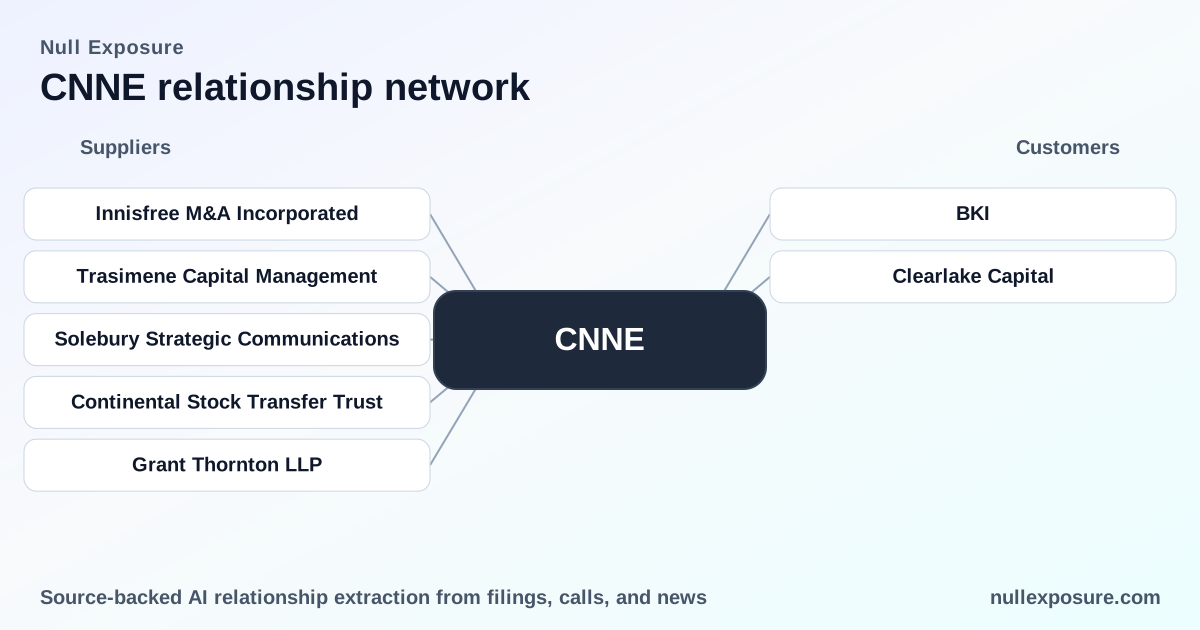
Cannae Holdings (CNNE): Portfolio exits and service-provider exposures drive near-term cash dynamics
Cannae Holdings operates as a diversified investment holding company that monetizes primarily through strategic disposition of portfolio assets and cash generation from operating subsidiaries. The company realizes large, discrete cash inflows by selling controlling or minority interests in businesses (for example, Dun & Bradstreet and Optimal Blue), while ongoing revenues arrive from its Restaurant Group and other operating businesses. For an investor, the thesis is simple: value realization comes from measured exits and redeployment of proceeds, with near-term liquidity and earnings volatility tied to timing and scale of those transactions.
For deeper, transaction-level context and curated relationship intelligence, see the firm profile at Null Exposure: https://nullexposure.com/.
Recent transaction relationships that matter to shareholders
The public record in early 2026 documents two sale-related relationships that materially affected Cannae’s balance sheet. Each of the following items is drawn from contemporary reporting and company filings.
Black Knight / BKI — March 2026 (Optimal Blue)
- Black Knight announced it acquired the outstanding interests in Optimal Blue from co-investors including Cannae Holdings, reflecting a divestiture of Cannae’s stake in that mortgage technology asset. According to the March 9, 2026 report, Black Knight completed the purchase of the remaining Optimal Blue interests from Cannae and Thomas H. Lee-affiliated investors. Source: advfn report on Black Knight’s acquisition (March 9, 2026).
BKI (alternate listing) — March 2026 (same transaction)
- The same transaction is reported under the ticker BKI: Black Knight’s acquisition of Optimal Blue removed Cannae’s remaining economic interest in that business and crystallized proceeds tied to Cannae’s earlier investment. Source: advfn coverage of the BKI announcement (March 9, 2026).
Clearlake Capital — FY2025 (Dun & Bradstreet sale, Q3 2025 reporting)
- Cannae disclosed that the previously announced sale of Dun & Bradstreet to Clearlake Capital produced $630 million in proceeds to Cannae, a transaction noted in the company’s Q3 2025 commentary and public earnings transcript. This sale materially altered Cannae’s public-company exposure and delivered significant liquidity. Source: Q3 2025 earnings call transcript coverage on InsiderMonkey (FY2025).
Clearlake Capital — FY2026 (SEC material event / 8‑K reporting)
- Company filings and SEC event reporting reiterated the Dun & Bradstreet divestiture and the cash proceeds received by Cannae in 2025, documenting the transaction in the FY2026 reporting cycle and reinforcing the company’s strategy of portfolio reshaping through selective exits. Source: 8‑K material event summary reported on March 2026 via stocktitan (SEC filing commentary).
Takeaway: recent activity demonstrates Cannae’s playbook—sell high-value holdings to strategic buyers (Clearlake, Black Knight) to generate large one-time inflows, then redeploy or return capital. Those transactions are the primary drivers of the company’s near-term liquidity profile.
What the disclosed constraints say about Cannae’s operating posture
The collection of constraint excerpts in public materials yields a consistent picture of Cannae’s operating and commercial model.
- Geographic concentration: “All of our revenues are generated in the United States,” and restaurant operations are located across 20 U.S. states. This is a company-level signal that operating cash flow from the Restaurant Group is highly U.S.-centric, concentrating macro and regulatory risk domestically.
- Global footprint through portfolio holdings: Other excerpts reference global players including Dun & Bradstreet and Paysafe, showing Cannae’s investment footprint extends beyond the U.S. through portfolio companies, which introduces cross-border exposure despite core operating revenues being domestic.
- Counterparty mix and contracting posture: Excerpts indicate a dual contracting posture—Cannae acts as a seller (restaurant sales recognized at point of service) and as a portfolio manager that sells minority/majority interests in businesses; it also functions as a counterparty to many service providers (payments, HCM, fintech). This mix implies recurring operating vendor relationships coexisting with episodic, high-impact exit transactions.
- Service-provider dependence and criticality: The constraint list highlights providers such as Sightline Payments, Alight, CSI, Paysafe and System1 as service-provider examples; collectively this indicates reliance on specialized fintech, HCM and marketing partners that are operationally critical to certain portfolio segments.
- Segment exposure: The company’s exposures span services, manufacturing (via Watkins flavorings) and software/customer-acquisition platforms, which supports a diversified but heterogeneous earnings base—some predictable, some inherently lumpy.
From an investor perspective, these signals translate into practical operating implications:
- Contracting posture is transactional and opportunistic; Cannae routinely monetizes investments rather than holding indefinitely for uniform recurring cash flows.
- Concentration is U.S.-weighted for operations but globally exposed via portfolio assets, leading to mixed macro sensitivity.
- Criticality is highest around payments, data and fintech partners where outages or contract shifts would meaningfully affect operating subsidiaries.
- Maturity of relationships varies: some service-provider contracts are ongoing and operationally embedded, while strategic buyers (Clearlake, Black Knight) are episodic counterparties in exit transactions.
For more structured reporting on these relationship types and to monitor counterparty signals, visit Null Exposure: https://nullexposure.com/.
Investment implications and risk signals
- Liquidity profile driven by exits. The $630 million Dun & Bradstreet proceeds and the Optimal Blue disposition are explicit examples that liquidity and realized gains are concentrated in discrete sale events rather than smooth operating cash flow.
- Operational concentration in U.S. consumer-facing businesses. With Restaurant Group revenues generated in the U.S., domestic consumer trends drive a material portion of operating revenue.
- Vendor and platform dependency. Reliance on payments and technology service providers creates operational counterparty risk that is less visible in headline exit transactions but crucial for continuity and margins.
- Portfolio diversification reduces single-bet risk but increases heterogeneity. Holdings across services, software and manufacturing create diversification benefits while complicating valuation comparability and forecasting.
Bottom line for investors
Cannae is executing a clear, realization-first strategy: transform the portfolio through selective sales to strategic acquirers and redeploy capital where returns exceed the company’s internal hurdle rates. That strategy generates meaningful cash inflections but makes near-term earnings and EBITDA metrics volatile. For investors evaluating CNNE as a customer/partner risk or as an asset-backed play, the priority is to track transaction pipelines and vendor relationships that underpin ongoing operations.
If you want a continuously updated view of Cannae’s counterparty map and transaction signals, Null Exposure maintains a consolidated feed of these relationship events: https://nullexposure.com/.
Bold decisions by management on redeployment or shareholder returns will determine whether these realized proceeds translate into sustainable value growth or episodic gains.