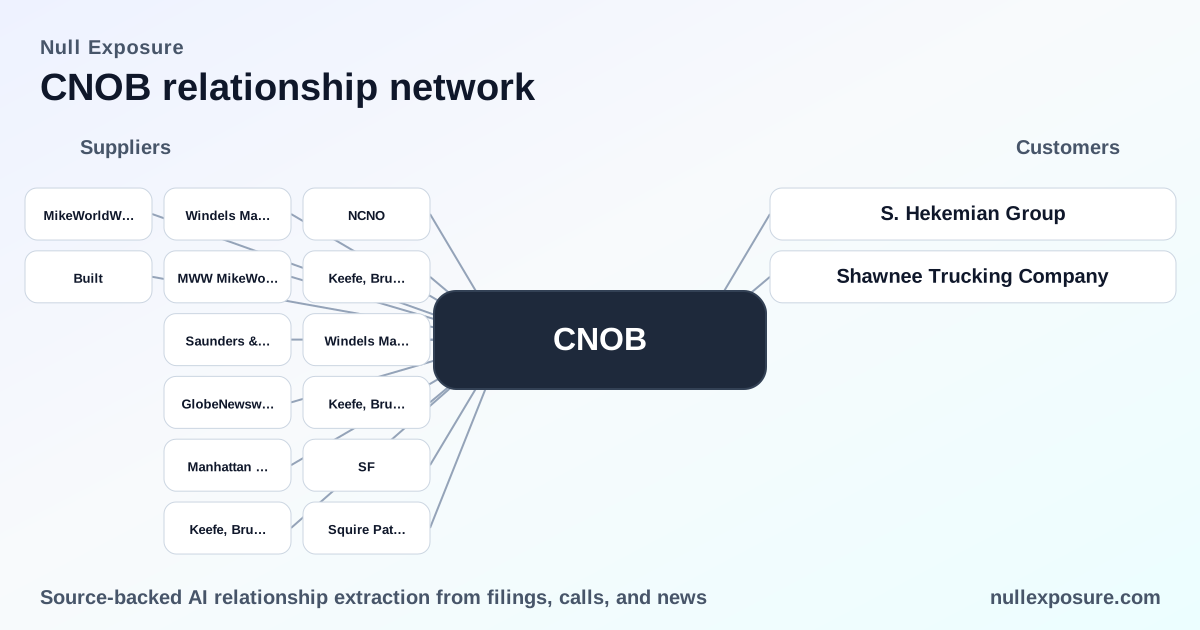
ConnectOne Bancorp (CNOB): Customer Relationships and Commercial Footprint
ConnectOne Bancorp operates as a regional commercial bank focused on middle-market and retail banking in the New York metropolitan and South Florida markets; it monetizes primarily through net interest margin on commercial and consumer loans, complemented by fee income from deposit services and loan sales (including secondary-market SBA activity). This profile positions ConnectOne as a locally concentrated lender with an earnings mix tied to loan origination, portfolio management and active SBA sales. For a deeper look at counterparty and customer signals, visit https://nullexposure.com/.
Business model in plain terms: how ConnectOne earns and scales
ConnectOne generates revenue through three straightforward channels:
- Net interest income earned on a portfolio of commercial, residential and consumer loans concentrated in small-to-mid-sized business and high-net-worth individual borrowers in the New York metro and West Palm Beach markets.
- Fee and non-interest income, including deposit service fees, electronic banking services and periodic gains from SBA loan sales and other secondary market activity.
- Capital efficiency and branch banking, where local relationship banking and targeted commercial lending drive deposit acquisition and cross-sell into fee products.
Key balance-sheet and market signals: Market capitalization of roughly $1.48 billion, trailing P/E ~15.8 and forward P/E ~10.2, price-to-book near 1x, and institutional ownership above 76% indicate a well-followed regional bank with predictable return-on-equity characteristics (ROE ~6.9% TTM). Dividend yield sits around 1.84% with a recent dividend payment in June 2026.
Customer relationships observed in public reporting and press
Below I summarize every customer or counterparty mention captured in our results. Each is presented with a concise plain-English summary and the reporting source.
S. Hekemian Group — construction financing for retail/medical redevelopment
ConnectOne provided a two-year floating-rate construction loan to the S. Hekemian Group for a large Montvale redevelopment project, while a life insurer provided subordinate financing, positioning ConnectOne as the lead construction lender on the deal. (Re-NJ report, March 9, 2026: https://re-nj.com/jll-s-hekemian-group-lands-financing-for-retail-surgery-center-project-in-montvale/)
Bowfly — partner in SBA loan sales activity (press reference)
Management noted accelerating activity in SBA loan sales supplemented by Bowfly, indicating Bowfly participates in the bank’s secondary-market execution for government-backed loans and contributes to non-interest income generation. (Benzinga coverage of Q1 2026 results, May 2026: https://www.benzinga.com/insights/news/26/04/52002023/connectone-bancorp-reports-q1-2026-results-full-earnings-call-transcript)
BoeFly — alternative spelling / additional mention around SBA sales
A duplicate press mention references BoeFly in the same context: accelerating SBA loan sales subsequent to the quarter, reinforcing that ConnectOne is actively selling SBA loans into distribution channels to manage capital and realize fee/gain income. (InsiderMonkey earnings transcript coverage, May 2026: https://www.insidermonkey.com/blog/connectone-bancorp-inc-nasdaqcnob-q1-2026-earnings-call-transcript-1745809/)
Shawnee Trucking Company — local commercial lending and economic development
Shawnee Trucking Company received assistance that included ConnectOne Bank alongside NJEDA to support transportation/logistics job creation, demonstrating ConnectOne’s role in small-business and community lending tied to regional economic development initiatives. (TapInto report, 2026: https://www.tapinto.net/towns/paterson/sections/business-and-finance/articles/shawnee-trucking-company-with-assistance-of-njeda-and-connect-one-bank-brings-transportation-logistics-jobs-to-area)
What these relationships reveal about ConnectOne’s operating posture
The relationship evidence maps directly to ConnectOne’s business model signals and constraints:
- Contracting posture and role: ConnectOne operates primarily as a lender and service provider to local businesses and individuals; public language underscores a customized, relationship-led approach to banking services rather than commodity or platform-only offerings.
- Customer concentration and segmentation: The bank’s client base is geographically concentrated in the New York metro and select Florida markets and skewed toward small and mid-sized businesses, professional practices, and HNW individuals — a structure that supports margin but concentrates regional credit risk.
- Criticality of relationships: Customer relationships are commercial and community-critical to borrowers but represent standard counterparty exposures from the bank’s perspective (i.e., loans and deposits rather than single-vendor technology or operational dependencies).
- Maturity and stage: ConnectOne is an established community-focused bank (founded 2005) with active operations across more than 20 banking offices; the relationship stage is active and ongoing, with routine origination, servicing and periodic secondary-market sales.
For investors, these company-level signals suggest a stable regional lending franchise that balances organic deposit funding with opportunistic loan sales to manage capital and earnings volatility.
Constraints and governance signals that matter to investors
- Domestic, regional focus: All operations and lending are domestic, concentrated in New Jersey, New York and Florida, which compresses macro exposure to US regional economic cycles.
- Client mix creates exposure to SMEs and individuals: The bank’s lending orientation toward small and mid-sized businesses and individuals implies higher borrower granularity but elevated sensitivity to regional employment and commercial real estate cycles.
- Materiality posture: Management states that commitments and contingent liabilities are not expected to be material to the company’s financial condition, signaling conservative contingent exposure assessment in filings.
- Seller/service-provider dual posture: ConnectOne both originates and sells loans (notably SBA) and provides deposit and treasury services, giving the bank flexibility to manage balance-sheet growth and fee income.
If you want a concise view of these counterparty relationships and what they imply about credit and revenue concentration, see https://nullexposure.com/.
Investment implications — where upside and risk align
- Upside drivers: Active SBA loan sales (and the partners that facilitate them) provide a mechanism to monetize originations and convert credit spread into realized gains; forward P/E of ~10.2 and price-to-book near 1x suggest market recognition of earnings capacity with valuation upside if loan-sale volumes and NII expand.
- Key risks: Geographic concentration, SME lending exposure, and sensitivity to construction and commercial real estate cycles (exemplified by construction financing to projects such as S. Hekemian’s Montvale redevelopment). Institutional ownership and a modest dividend yield reflect a stable investor base but also expectations for disciplined capital management.
- Operational flexibility: The bank’s mix of direct lending plus secondary-market activity (SBA sales) lowers the duration of credit exposure and supports earnings visibility, while maintaining deposit-based funding.
Bottom line
ConnectOne is a regionally concentrated commercial bank that earns through loan interest margin, fee income and sale of originated loans, with public signals showing active participation in construction financing, small-business lending, and SBA secondary market activity. The customer relationships captured here are consistent with a community-oriented, mid-market lending franchise that uses loan sales and local deposit networks to manage capital and earnings. For practitioners evaluating counterparty or investment exposure, these relationships reinforce an operating model with local concentration, active balance-sheet management, and predictable fee channels — all relevant when sizing credit risk or upside from improved loan-sale execution.
For a structured view of counterparty relationships and to explore similar customer intelligence across other regional banks, visit https://nullexposure.com/.