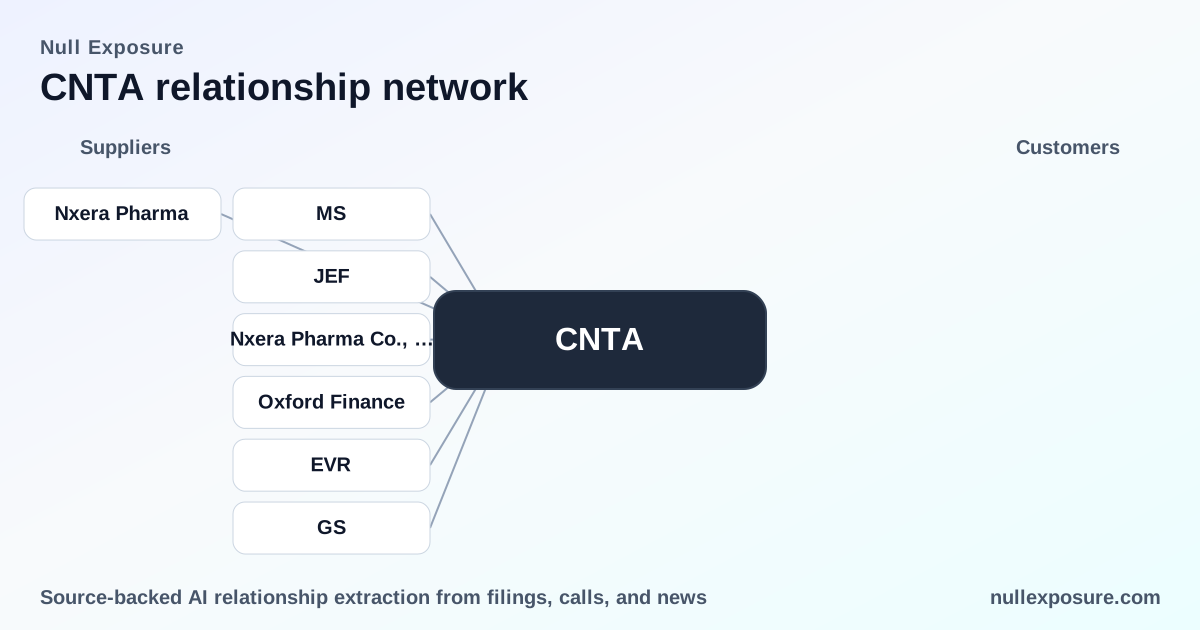
Centessa Pharmaceuticals (CNTA): Eli Lilly’s Bid Rewrites the Customer Map and the Exit Thesis
Centessa operates as a portfolio-driven biotech: it develops and advances therapeutic candidates through clinical stages and monetizes primarily through licensing, milestone-based partnering and, ultimately, strategic M&A. Its reported revenue is immaterial relative to market value — $15 million revenue TTM versus roughly $6.14 billion market capitalization — which makes Centessa’s commercial profile dependent on clinical success and strategic transactions rather than operating cash flows. The announced transaction with Eli Lilly transforms Centessa’s customer and partner dynamics and crystallizes an exit route for investors. For a concise view of contract and relationship exposures, visit https://nullexposure.com/.
Headlines: how the market reported the Lilly transaction
-
Finviz reported on May 2, 2026 that “Eli Lilly outlays $7.8bn to acquire sleep drug biotech Centessa.” This headline framed the deal in large-dollar acquisition terms and drove immediate market reaction. (Finviz, 2026-05-02 — https://finviz.com/news/270677/needham-hikes-centessa-cnta-pt-to-38-on-high-potential-for-orx-750-trial-success-and-ma-appeal)
-
Intellectia.ai summarized the buyer consideration as $38.00 per share in cash plus a non-transferrable right worth up to $9.00, detailing the per-share economics that underpin the transaction. (Intellectia.ai, 2026-05-02 — https://intellectia.ai/news/stock/tanager-wealth-management-fully-exits-centessa-pharmaceuticals-stake)
-
A shareholder litigation notice published via GlobeNewswire referenced the recently announced transaction with Lilly, highlighting that legal scrutiny of deal fairness entered the public record. (GlobeNewswire, 2026-04-07 — https://www.globenewswire.com/news-release/2026/04/07/3269006/884/en/Shareholder-Alert-The-Ademi-Firm-investigates-whether-Centessa-Pharmaceuticals-plc-is-obtaining-a-Fair-Price-for-Public-Shareholders.html)
-
MarketScreener reported that Eli Lilly entered into a definitive agreement to acquire Centessa from a group of shareholders for $5.1 billion, a characterization that frames the transaction at a different headline valuation. The report also noted insider selling activity filed with the SEC. (MarketScreener, 2026-05-02 — https://www.marketscreener.com/news/centessa-pharmaceuticals-insider-sold-shares-worth-1-927-131-according-to-a-recent-sec-filing-ce7e5edadb8cf22d)
Each of these items reflects the same commercial relationship in different dimensions: buyer identity, per-share economics, legal scrutiny and public filings. All four sourced items are included here to provide the comprehensive read across market coverage.
Why this relationship matters to investors and operators
-
Transaction finalizes a primary exit path. For a company with limited recurring revenue ($15M TTM) and negative operating margins, an acquisition transforms the value realization mechanism from speculative clinical upside to a locked-in transaction outcome.
-
Deal economics influence implied multiples and comparables. Conflicting headline valuations ($5.1bn vs. $7.8bn vs. $38+/share plus contingent rights) create a zone of valuation interpretation; use the per-share mechanics reported by Intellectia.ai alongside the definitive agreement language described by MarketScreener for a reconciled model.
-
Legal and governance risk has moved to the foreground. The GlobeNewswire shareholder alert signals that transaction fairness and process will receive formal scrutiny, a common post-announcement risk vector that can affect timing and ultimate proceeds to certain shareholder cohorts.
Centessa’s operating model signals (company-level)
-
Contracting posture — acquisition-ready and partner-oriented. Centessa behaves like an asset-aggregator biotech: it centralizes multiple therapeutic programs and commercializes value through partnerships or sale. The Lilly transaction confirms a strategy where monetization is dominated by strategic M&A rather than self-funded commercialization.
-
Revenue concentration and business maturity. With $15 million TTM revenue, negative EBITDA and negative EPS, Centessa is in clinical/near-commercial maturity rather than a revenue-driven commercial maturity. This drives reliance on trial readouts and strategic buyers for value capture.
-
Criticality of relationships. For a firm with limited product revenues, a single strategic counterparty or acquirer can be critical to shareholder outcomes. The transaction with Lilly replaces multiple potential partner negotiations with a single, material corporate control event.
-
Institutional ownership and governance posture. Centessa’s overview shows ~97.6% institutional ownership and minimal insider stake, suggesting deal dynamics are highly influenced by institutional positions and proxy/tender mechanics rather than concentrated founder control.
Relationship-level summaries (each source listed)
-
Finviz (news, 2026-05-02): Reported that Eli Lilly outlaid $7.8 billion to acquire Centessa, framing the transaction in headline enterprise-dollar terms that influenced immediate market sentiment. (Finviz — https://finviz.com/news/270677/needham-hikes-centessa-cnta-pt-to-38-on-high-potential-for-orx-750-trial-success-and-ma-appeal)
-
Intellectia.ai (news, 2026-05-02): Reported the per-share structure as $38.00 in cash plus a non-transferrable right worth up to $9.00, providing the granular per-share economics that determine shareholder proceeds. (Intellectia.ai — https://intellectia.ai/news/stock/tanager-wealth-management-fully-exits-centessa-pharmaceuticals-stake)
-
GlobeNewswire (press/legal notice, 2026-04-07): Published a shareholder alert investigating whether Centessa obtained a fair price in the transaction with Lilly, signaling active legal and fairness-review processes tied to the deal. (GlobeNewswire — https://www.globenewswire.com/news-release/2026/04/07/3269006/884/en/Shareholder-Alert-The-Ademi-Firm-investigates-whether-Centessa-Pharmaceuticals-plc-is-obtaining-a-Fair-Price-for-Public-Shareholders.html)
-
MarketScreener (news, 2026-05-02): Noted that Eli Lilly entered a definitive agreement to acquire Centessa for $5.1 billion and reported insider share dispositions filed with the SEC, highlighting transaction documentation and insider activity. (MarketScreener — https://www.marketscreener.com/news/centessa-pharmaceuticals-insider-sold-shares-worth-1-927-131-according-to-a-recent-sec-filing-ce7e5edadb8cf22d)
What investors should watch next
- Regulatory and integration timing: monitor official regulatory filings, the definitive agreement text, and any required antitrust or clinic-data consents that set closing timelines.
- Shareholder litigation and fairness opinions: the GlobeNewswire notice indicates active legal review; any litigation can delay closing or alter net proceeds through settlement.
- Disclosure reconciliation: reconcile per-share economics and headline enterprise valuations across filings to model expected cash proceeds and taxable treatment.
- Program continuity and retention: post-close integration choices by Lilly will determine which programs are advanced, shelved or reprioritized, affecting contingent consideration value.
Key datapoints to keep on hand: market cap ~$6.14B; revenue $15M TTM; institutional ownership ~97.6%; analyst target price $44.57.
If you want a concise report that integrates counterparty disclosures, filing-level deal language and relationship risk scoring, visit https://nullexposure.com/ for a deeper read.
Bottom line
The Eli Lilly relationship changes Centessa from a standalone clinical-stage consolidator to an asset within a large pharmaceutical platform — an outcome that crystallizes value for shareholders while introducing governance and legal complexity around deal fairness and integration. For investors, the transaction replaces speculative clinical upside with definitive consideration mechanics; for operators, it redefines commercial dependencies and the governance spotlight. Monitor filings and litigation developments to refine valuation and cash-flow timing expectations.